
What It Is
An essential oil is a concentrated liquid containing the volatile aroma compounds of a plant. The name reflects that the oil carries the plant's characteristic scent or "essence," not that it is essential to nutrition. Essential oils are complex mixtures — a single oil can contain dozens to hundreds of individual compounds such as terpenes, alcohols, aldehydes, and esters. This makeup distinguishes them from single-molecule synthetic fragrance ingredients and from fragrance oils, which are blended aroma formulations that may combine natural and synthetic materials. In cleaning products, essential oils commonly used include tea tree, lavender, lemongrass, orange, lemon, peppermint, and eucalyptus.
What we make for this


Common Uses
Essential oils appear in cleaning products for two overlapping reasons: scent and function. As scent, they provide a product's fragrance without a separate synthetic fragrance blend. Functionally, several oils contribute cleaning-relevant properties — citrus oils act as natural solvents on greasy residues, and oils such as tea tree, eucalyptus, and lemongrass have documented antimicrobial activity in laboratory studies. Beyond cleaning, essential oils are widely used in aromatherapy, personal-care products, and as food flavorings. On a cleaning-product label they are typically listed by common or INCI name, and any regulated fragrance-allergen constituents they contain may be declared separately.
How It Works
Because essential oils are volatile, their compounds evaporate readily at room temperature, which is why they release scent into the air. Their functional roles depend on chemistry. Citrus oils are rich in d-limonene, a terpene that dissolves oils and adhesives, giving them degreasing and sticker-removing ability. The antimicrobial activity seen in oils like tea tree is generally attributed to terpene components such as terpinen-4-ol, which can disrupt microbial cell membranes. It is important to distinguish laboratory antimicrobial activity from a registered disinfection claim: demonstrating that an oil inhibits microbes in a dish is not the same as a product being registered to disinfect surfaces, which is a separate regulatory pathway.
Safety and Regulation
Many essential oils and their constituents have long histories of regulated use. The U.S. FDA recognizes numerous essential oils — including orange, lemon, and peppermint — as generally recognized as safe (GRAS) for use as food flavorings under 21 CFR 182.20. Under the EPA's Federal Insecticide, Fungicide, and Rodenticide Act, certain essential oils are listed as minimum-risk active or inert ingredients exempt from registration under the 25(b) program. In the European Union, the Cosmetics Regulation requires that specified fragrance allergens naturally present in essential oils — such as limonene, linalool, citral, geraniol, and eugenol — be declared on labels above set thresholds, based on opinions from the Scientific Committee on Consumer Safety (SCCS). Essential oils are concentrated and are intended for use as formulated, not undiluted.
Which Oils Natural Flower Power Uses
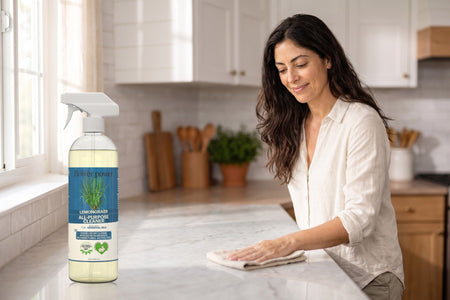
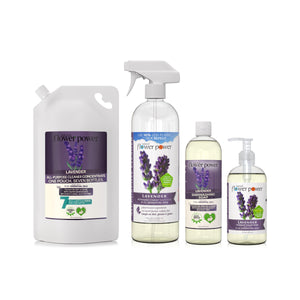
Natural Flower Power scents its cleaning products with essential oils rather than a synthetic fragrance blend, and chooses specific oils for what they contribute.
The oils in our formulas are lavender, lemongrass, peppermint, lemon, orange, cassia and cinnamon bark in our Citrus & Spice scent, and a supporting note of rosemary in the Lemongrass line. Cold-pressed citrus oils earn their place twice over: d-limonene is a genuine solvent on greasy residue as well as a scent, which is why we use cold-pressed citrus oils rather than an isolated synthetic compound. We also sell several oils on their own, including eucalyptus, which is offered as a pure single oil rather than blended into a cleaner.
Being specific also means naming what we leave out. We do not use tea tree oil in any product, despite it being the most frequently marketed "natural cleaning" oil — its page explains why, and the short version is that the antimicrobial reputation does not survive contact with how a cleaning product actually works. Our cleaners are cleaners, not disinfectants; we hold no pesticide registration and make no germ-kill claims. For anyone who would rather have no added fragrance at all, our Free & Clear line is unscented.
We have formulated in-house since 2012, and as an independently owned company we name the oils we use so the source of a product's scent is never a mystery.
Related Ingredients
Each essential oil in this family has its own reference page: tea tree oil, lavender oil, lemongrass oil, orange oil, lemon oil, peppermint oil, and eucalyptus oil. Two related oils are also documented: thyme oil and rosemary oil. For how real cold-pressed citrus oils differ from an isolated compound, see the cold-pressed citrus oils guide, and for the synthetic fragrance family see the synthetic fragrance family hub. Editorial explainers cover essential oils beyond scent, essential oils versus fragrance oils, and why synthetic fragrances are avoided. Browse the essential oils collection.
Sources
- U.S. Food and Drug Administration. "Substances Generally Recognized as Safe: Essential Oils, Oleoresins, and Natural Extractives." 21 CFR 182.20.
- Carson, C.F., Hammer, K.A., and Riley, T.V. "Melaleuca alternifolia (Tea Tree) Oil: a Review of Antimicrobial and Other Medicinal Properties." Clinical Microbiology Reviews, vol. 19, no. 1, 2006, pp. 50-62.
- U.S. Environmental Protection Agency. "Minimum Risk Pesticides Exempted under FIFRA Section 25(b)." Accessed 2026.
- European Commission. Regulation (EC) No 1223/2009 on Cosmetic Products, Annex III fragrance allergen labeling; Scientific Committee on Consumer Safety opinions.
