
This ingredient is used in our products.
What It Is
Lemon oil is an essential oil obtained by cold-pressing the outer peel of Citrus limon (CAS 8008-56-8). The oil is a pale yellow to greenish-yellow liquid with a sharp, fresh, tart citrus scent. Its major components include d-limonene (typically 60%-80%), beta-pinene (7%-16%), and gamma-terpinene (6%-12%), with small amounts of citral, geranial, and various aldehydes that contribute to its distinctive scent. Lemon oil functions as a fragrance ingredient in cleaning and personal care products.
What we make for this



Common Uses
Lemon oil is among the most widely used essential oils in household cleaning products, appearing in all-purpose cleaners, dish soaps, hand soaps, furniture polishes, and air fresheners. Its sharp citrus scent is strongly associated with cleanliness in consumer perception. Lemon oil is also used in food and beverage flavoring, personal care products, and aromatherapy. Global production is significant, with major sources in Italy, Argentina, and the United States (primarily California and Florida).
How It Works
Lemon oil's scent is driven by a combination of d-limonene (which provides the base citrus note) and a complex group of aldehydes and terpenes that give lemon oil its distinctly sharp, tart character. Citral (a mixture of geranial and neral) is present at low concentrations but is an important scent contributor -- it provides the "true lemon" top note that distinguishes lemon oil from other citrus oils high in limonene.
Like orange oil, lemon oil has mild solvent properties from its limonene content, contributing supplementary degreasing action in cleaning formulations. The effect is modest at fragrance-level concentrations but contributes to the overall cleaning system.
Safety and Regulation
The FDA classifies lemon oil as GRAS for food use. IFRA permits lemon oil in all product categories with application-specific concentration limits. Limonene and citral -- both present in lemon oil -- are listed as fragrance allergens under EU cosmetic regulations (EC No 1223/2009).
Cold-pressed lemon oil contains furanocoumarins (primarily bergaptene and oxypeucedanin) that can cause phototoxic reactions -- skin irritation or burns when exposed to UV light after application. This concern applies primarily to leave-on products applied to sun-exposed skin. In rinse-off cleaning products and air freshener sprays, phototoxic risk is negligible due to dilution, brief skin contact, and rinsing. IFRA sets specific concentration limits for cold-pressed lemon oil in different product categories to manage phototoxicity risk.
As with other citrus oils, oxidized lemon oil has higher sensitization potential than fresh oil. Antioxidants like tocopherol help slow degradation during product shelf life.
Why Natural Flower Power Uses It
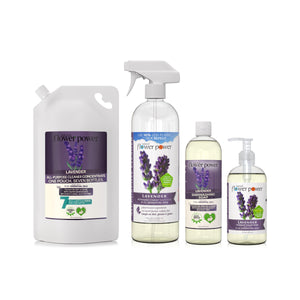
Natural Flower Power uses lemon oil in its all-purpose cleaners, hand soaps, dish soaps, and air fresheners.
Lemon oil shows up in multiple scent blends -- it is part of the Citrus & Spice, Lemongrass, and Peppermint & Lemon formulations. We use cold-pressed lemon oil rather than distilled lemon oil because cold-pressing retains the full aldehyde profile that gives lemon its recognizable tart, zesty character. Distilled lemon oil loses most of those aldehydes, leaving a flatter citrus scent that reads more like generic "citrus" than actual lemon. The tradeoff is that cold-pressed lemon oil contains furanocoumarins (which distilled does not), but since our products are either rinsed off or sprayed into the air rather than applied to skin, phototoxicity is not a practical concern in our formulations.
We also sell pure lemon essential oil as a standalone essential oil.
Related Ingredients
Orange oil is the most closely related citrus essential oil, with a sweeter, rounder scent profile compared to lemon's tartness. Lemongrass oil provides a herbal-citrus scent that is often paired with lemon oil in NFP's blends. Synthetic limonene replicates the d-limonene component of citrus oils but lacks the complex aldehyde profile of cold-pressed lemon oil. Lime oil is another cold-pressed citrus essential oil with stronger phototoxic potential than lemon oil; Natural Flower Power does not use lime oil in its current formulations.
Sources
- European Commission. Regulation (EC) No 1223/2009 on Cosmetic Products. Annex III (Fragrance Allergens).
- IFRA. Standards Library. Lemon Oil, Cold-Pressed.
- Tisserand, R., and Young, R. Essential Oil Safety. 2nd ed., Churchill Livingstone/Elsevier, 2014.
