
This ingredient is used in our products.
What It Is
Peppermint oil as used by Natural Flower Power is derived from Mentha arvensis (Japanese peppermint, also called cornmint) (CAS 68917-18-0). This is distinct from Mentha piperita (true peppermint), though both are commonly sold under the name "peppermint oil." The oil is a colorless to pale yellow liquid with a strong, sharp, cooling mint scent. Its primary component is menthol (typically 65%-80% in M. arvensis), with smaller amounts of menthone, menthyl acetate, and limonene. It functions as a fragrance ingredient in cleaning and personal care products.
What we make for this


Common Uses
Peppermint oil (from both M. arvensis and M. piperita) is used in toothpastes, mouthwashes, hand soaps, shampoos, lip balms, cleaning products, and air fresheners. It is also a major commodity in food and confectionery flavoring and in pharmaceutical products (menthol is an active ingredient in topical pain relievers and cough drops). India and China are the largest producers of M. arvensis oil, while the United States (primarily the Pacific Northwest) dominates M. piperita production.
How It Works
Peppermint oil's scent and cooling sensation come primarily from menthol. Menthol activates TRPM8 receptors in sensory neurons -- the same cold-sensing receptors that respond to low temperatures -- which is why peppermint oil produces a cooling feeling on skin even though it does not actually lower skin temperature. This receptor activation is also what creates the sensation of "freshness" that makes peppermint a popular scent in cleaning and hygiene products.
The aromatic profile of M. arvensis differs from M. piperita in menthol-to-menthone ratio. M. arvensis has a higher menthol content and a more straightforwardly "minty" profile, while M. piperita has more menthone and menthyl acetate, which add sweetness and complexity. For cleaning product fragrance applications, the high-menthol profile of M. arvensis provides a cleaner, more direct mint scent.
Safety and Regulation
The FDA classifies peppermint oil as GRAS for food use (21 CFR 182.20). IFRA permits peppermint oil in all product categories. Menthol is not classified as a fragrance allergen under EU cosmetic regulations, though limonene (present in small amounts in peppermint oil) is listed and requires declaration above specified thresholds.
Peppermint oil can cause skin irritation at high concentrations due to its menthol content. The CIR Expert Panel assessed peppermint oil and related mint oils in 2001 and concluded they are safe as cosmetic ingredients at concentrations of 5% or below in rinse-off products (CIR, 2001). At the much lower concentrations used in cleaning products and air fresheners (typically 0.1%-1%), irritation risk is minimal.
Peppermint oil should be kept away from infants and young children's faces, as menthol can cause respiratory distress in very young children. This concern applies to concentrated oil and high-menthol products, not to diluted cleaning products.
Why Natural Flower Power Uses It
Natural Flower Power uses peppermint oil in its hand soaps, dish soaps, and air fresheners.
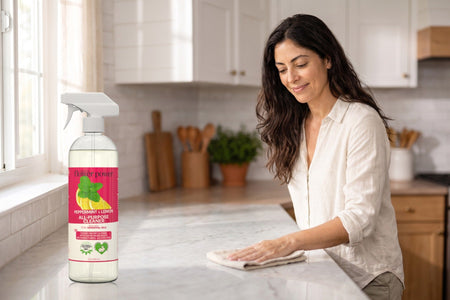
Peppermint is the lead scent in our Peppermint & Lemon product line, paired with lemon oil to create a bright, clean scent profile. We use Mentha arvensis rather than Mentha piperita for a practical reason: the higher menthol content gives a stronger, more immediate mint impact in a cleaning product, where you want the scent to register quickly during use rather than unfold slowly like it might in a perfume or food application. M. piperita has a more nuanced scent that works well in lip balms and teas, but in a hand soap competing with surfactant aromas, the directness of M. arvensis cuts through better.
We also sell pure Japanese peppermint (Mentha arvensis) essential oil as a standalone essential oil.
Related Ingredients
Lemon oil is paired with peppermint oil in NFP's Peppermint & Lemon scent line. Eucalyptus oil shares some aromatic characteristics with peppermint due to overlapping terpene compounds, particularly 1,8-cineole, and is sometimes used in similar cleaning product applications. Tea tree oil has a fresh, camphoraceous scent that complements mint-based blends. Spearmint oil (Mentha spicata) is a related mint oil with a sweeter, softer scent profile dominated by carvone rather than menthol; Natural Flower Power does not use spearmint oil.
Sources
- Cosmetic Ingredient Review (CIR). "Final Report on the Safety Assessment of Mentha Piperita (Peppermint) Oil and Related Ingredients." International Journal of Toxicology, vol. 20, Suppl. 3, 2001, pp. 61-73.
- U.S. Food and Drug Administration. 21 CFR 182.20 -- Essential Oils, GRAS.
- McKay, D.L., and Blumberg, J.B. "A Review of the Bioactivity and Potential Health Benefits of Peppermint Tea." Phytotherapy Research, vol. 20, no. 8, 2006, pp. 619-633.
