
What It Is
Tea tree oil is an essential oil steam-distilled from the leaves and terminal branches of Melaleuca alternifolia, a tree native to Australia (CAS 68647-73-4). The oil is a pale yellow to nearly colorless liquid with a fresh, camphoraceous scent. Its composition includes over 100 individual compounds, with the most significant being terpinen-4-ol (typically 30%–48% of the oil) and 1,8-cineole (typically below 15% in oil meeting the commercial standard). The ISO 4730 standard defines the terpinen-4-ol chemotype sold as tea tree oil, setting a minimum terpinen-4-ol content of 30% and a maximum 1,8-cineole content of 15%. That standard matters because Melaleuca alternifolia produces several distinct chemotypes, and an oil labeled "tea tree" without a certificate of analysis can be a materially different substance.
What we make for this
Common Uses
Tea tree oil appears in hand soaps, body washes, facial cleansers, shampoos, acne treatments, household cleaners, and laundry products. It is one of the most researched essential oils, and that research is the reason it turns up so often in "natural cleaning" marketing. It is also sold widely as a standalone oil for aromatherapy and topical use. Production is dominated by Australian plantations, with additional growing in China, South Africa, and elsewhere.
How It Works
Tea tree oil's antimicrobial activity in laboratory conditions is attributed primarily to terpinen-4-ol, which integrates into the lipid bilayer of bacterial and fungal cell membranes, increasing permeability and causing leakage of cell contents. Carson, Hammer and Riley's 2006 review in Clinical Microbiology Reviews reports minimum inhibitory concentrations across a broad range of organisms from roughly 0.03% to 8% v/v, with most bacteria tested inhibited at or below 1%.
Two findings from that same body of work are routinely left out of the marketing, and they are the ones that matter for cleaning products. Hammer, Carson and Riley showed in 1999 that organic matter at 1% or more and non-ionic surfactants both measurably reduce tea tree oil's activity — the surfactant partitions the oil into micelles, away from the microbes. Those two conditions are the normal operating conditions of a cleaning product: surfactants in water, applied to a soiled surface. Laboratory inhibition in a petri dish does not transfer to a diluted cleaner on a countertop, and in the United States a product making germ-kill claims must be registered as a pesticide under FIFRA regardless of what its ingredients do in an assay.
As a fragrance ingredient, tea tree oil provides a sharp, medicinal, camphor-adjacent scent that many people associate with cleanliness. The 1,8-cineole fraction contributes a eucalyptus-like note; terpinen-4-ol reads as slightly spicy and herbaceous.
Safety and Regulation
Tea tree oil is a documented skin sensitizer, and the regulatory record on it has tightened rather than loosened. The EU's Scientific Committee on Consumer Products concluded in 2008 (SCCP/1155/08) that neat tea tree oil is a sensitizer in humans and that neat oil or formulations at 5% or more can irritate skin and eyes. Its successor committee, the SCCS, adopted an opinion in October 2025 (SCCS/1681/25) classifying tea tree oil as a moderate skin sensitizer while judging it acceptable for specific cosmetic uses at capped concentrations — up to 2.0% in shampoo, 1.0% in shower gel and face wash, and 0.1% in face cream. Routine patch-test clinics report positive reactions in roughly 0.1% to 3.5% of tested patients (de Groot and Schmidt, 2016).
Oxidation is the variable that drives most of that risk. On exposure to air, light, and heat, tea tree oil forms peroxides, epoxides, and in particular an endoperoxide called ascaridole, which carries much of the allergenic load. In a 2014 Contact Dermatitis study, 319 eczema patients patch-tested with ascaridole at 1%, 2%, and 5% reacted at rates of 1.4%, 5.5%, and 7.2% respectively, and every patient who reacted to oxidized tea tree oil also reacted to ascaridole. Old or badly stored oil is a meaningfully different ingredient wearing the same name.
Tea tree oil also has the clearest published toxicity record of any common essential oil in companion animals. A retrospective case series in the Journal of the American Veterinary Medical Association in 2014 (Khan, McLean and Slater) reviewed ten years of ASPCA Animal Poison Control Center records and found 443 cases involving undiluted tea tree oil — 337 dogs and 106 cats. In 89% of them the oil had been applied deliberately by an owner. Reported signs included drooling, lethargy, central nervous system depression, ataxia, tremors, and partial paralysis, appearing typically within 2 to 12 hours and persisting up to 72 hours, with cats more likely than dogs to become seriously ill. The Merck Veterinary Manual lists tea tree among the essential oils associated with hepatotoxicity in animals. Cats are the sharper edge of this for a metabolic reason: they lack a liver enzyme pathway other species use to conjugate and clear compounds of this kind. Pet Poison Helpline draws the line at concentration, noting that pet products formulated below roughly 1% to 2% are generally not considered a poisoning concern when used per label, while a few drops of concentrated oil can cause severe poisoning.
Tea tree oil is toxic if ingested. Oral exposure has caused central nervous system depression, confusion, and ataxia in documented human poisoning cases, particularly in children (Hammer et al., 2006). This concern attaches to the concentrated oil, not to finished products containing it at fragrance levels.
Why Natural Flower Power Does Not Use It
We don't use tea tree oil in any of our products, and we don't sell it as a standalone oil.
That isn't a verdict on the oil. Tea tree is a legitimate, well-characterized ingredient with more real research behind it than almost any essential oil on the shelf. The problem is that the research is also the most over-extended, and the version of tea tree that sells cleaning products — a plant-derived substitute for bleach, a mold treatment, a disinfectant you don't have to feel bad about — is not the version the literature supports. We would be buying the reputation, not the function.
The honest accounting looks like this. At the fraction of a percent where an essential oil sits in a scented cleaner, tea tree's antimicrobial contribution is real chemistry and a rounding error in practice; the surfactants do the cleaning. Its degreasing character is genuine but modest, and the terpene that actually earns its place in cleaning formulas is d-limonene from cold-pressed citrus oils, used at levels chosen for that purpose. What we would be left with is scent — and for scent we prefer oils that don't carry a moderate-sensitizer classification, a well-documented companion-animal toxicity record, and an oxidation profile that gets more allergenic the longer the bottle sits.
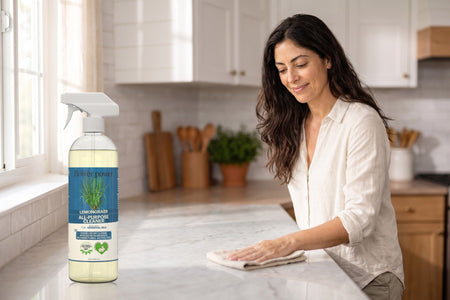
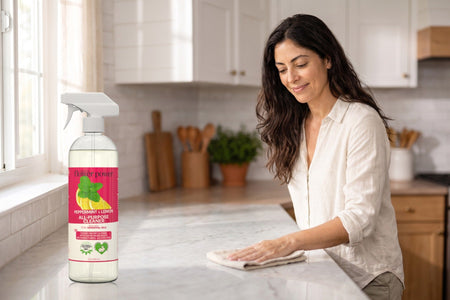
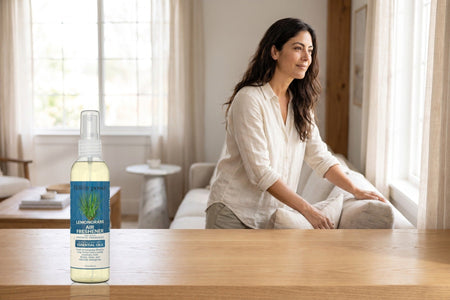
So we scent with oils we can stand behind on their own terms: lavender, lemongrass, peppermint, lemon, and orange. Our cleaners are cleaners, not disinfectants; we make no germ-kill claims and hold no pesticide registration, which is precisely why we have no incentive to keep an ingredient around for the claim it implies. For anyone who would rather have no added fragrance at all, our Free & Clear line is the answer.
We have formulated and manufactured in-house since 2012, which is what lets us say plainly which oils are in a product and which are not.
Related Ingredients
Eucalyptus oil shares aromatic character with tea tree through overlapping 1,8-cineole content. Thyme oil is another essential oil with documented laboratory antimicrobial activity, working through a different active compound (thymol). Lavender oil is frequently blended with tea tree in other companies' products because the scent profiles complement each other. For the family overview, see the essential oils in cleaning guide, and for how manufactured scent differs from named oils, the synthetic fragrance family hub. Editorial explainers cover essential oils beyond scent and essential oils versus fragrance oils. Browse the essential oils collection for the oils we do use.
Sources
- Carson, C.F., Hammer, K.A., and Riley, T.V. "Melaleuca alternifolia (Tea Tree) Oil: A Review of Antimicrobial and Other Medicinal Properties." Clinical Microbiology Reviews, vol. 19, no. 1, 2006, pp. 50–62.
- Hammer, K.A., Carson, C.F., and Riley, T.V. "Influence of Organic Matter, Cations and Surfactants on the Antimicrobial Activity of Melaleuca alternifolia (Tea Tree) Oil in Vitro." Journal of Applied Microbiology, vol. 86, no. 3, 1999, pp. 446–452.
- Hammer, K.A., et al. "A Review of the Toxicity of Melaleuca alternifolia (Tea Tree) Oil." Food and Chemical Toxicology, vol. 44, no. 5, 2006, pp. 616–625.
- Khan, S.A., McLean, M.K., and Slater, M.R. "Concentrated Tea Tree Oil Toxicosis in Dogs and Cats: 443 Cases (2002–2012)." Journal of the American Veterinary Medical Association, vol. 244, no. 1, 2014, pp. 95–99.
- Scientific Committee on Consumer Products. Opinion on Tea Tree Oil. SCCP/1155/08, 2008.
- Scientific Committee on Consumer Safety. Opinion on Tea Tree Oil. SCCS/1681/25, adopted 30 October 2025.
- Christoffers, W.A., et al. "Allergic Contact Dermatitis to Ascaridole and Oxidized Tea Tree Oil." Contact Dermatitis, 2014.
- de Groot, A.C., and Schmidt, E. "Tea Tree Oil: Contact Allergy and Chemical Composition." Contact Dermatitis, vol. 75, no. 3, 2016, pp. 129–143.
- Merck Veterinary Manual. "Toxicoses From Essential Oils." Accessed 2026.
- Pet Poison Helpline. "Tea Tree Oil." Accessed 2026.
- International Organization for Standardization. ISO 4730:2017. Oil of Melaleuca, Terpinen-4-ol Type (Tea Tree Oil).
- U.S. Environmental Protection Agency. Federal Insecticide, Fungicide, and Rodenticide Act — antimicrobial product registration requirements.
