


TL;DR: Essential oils and fragrance oils both make products smell, but they're chemically and functionally different. Essential oils are distilled from plants and bring antimicrobial properties along with scent; synthetic fragrance oils are petroleum-derived blends optimized for shelf-stable scent at lower cost. This walks through where each shows up, the performance and safety tradeoffs, and why NFP uses only essential oils.
You open one of our hand soaps and the scent is clean, present, but not overwhelming. You open a mass-market competitor's product and it's intense—that bright, artificial "fresh" smell that fills your entire bathroom. Both say they're scented. Both work. Both cost roughly the same amount per ounce. So why does one feel premium and the other feel like a chemistry set?
The difference isn't confidence or marketing. It's what's actually dissolving in the liquid. One product is scented with essential oils—concentrated plant compounds captured through steam distillation or cold pressing. The other is scented with fragrance oils—synthetic molecules designed in a lab to smell like something without being that something. The choice between them determines not just how a product smells, but how stable it is, how long it lasts on the shelf, how much it costs to make, and whether the scent will be consistent from bottle to bottle.
After we started manufacturing our own products in 2012, we tested formulas with both types of scenting. We tracked shelf life, customer feedback, consistency, cost. We made a choice that sounds simple but affects everything we do operationally: we use essential oils only. No synthetic fragrance oils. That means higher ingredient costs, shorter shelf life, and batch-to-batch scent variation that we have to explain to customers. It also means a product that feels like it's made from something real, not something imagined in a chemical lab. For the customers we're built to serve, it's exactly right. For everyone else, it would feel like we were paying unnecessarily.
What They Actually Are
Essential oils are plant-derived. They're created by capturing the volatile aromatic compounds from plants—flowers, leaves, peels, resins—through steam distillation or cold pressing. Steam distillation heats plant material with water; the steam carries the oils off, condenses them, and separates them from the water. Cold pressing (used for citrus oils) literally squeezes the compounds out of the peel. The result is a concentrated liquid that contains hundreds of individual chemical compounds working together as they exist in the plant.
Fragrance oils are synthetic. They're formulated in laboratories by combining individual aroma chemicals—some derived from plants but processed and recombined, others entirely synthesized—to create a target scent profile. A fragrance oil labeled "lavender" might contain ten to forty individual synthetic or semi-synthetic molecules blended to approximate the smell of lavender. The formulator is designing a scent, not extracting one.
This distinction matters because the two substances behave completely differently in a cleaning product. Essential oils are plant-derived but volatile—they're meant to evaporate from plant leaves and flowers to attract pollinators, so they're naturally unstable in storage. Fragrance oils are chemically stable by design. They're built to persist, not to dissipate. One smells like it came from something. The other smells like it was designed to smell like something. There's no moral judgment in that—it's just chemistry.

What we make for this



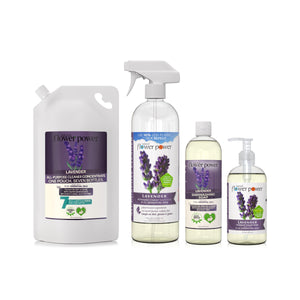
How They Behave in Cleaning Products
In a liquid cleaning product, these differences become operational realities. An essential oil-scented product is an inherent instability problem that a formulator has to actively manage. Water and oil don't mix naturally, so we have to use emulsifiers or solubilizing agents to keep the essential oils dispersed rather than pooling at the top of the bottle. The oils break down over time, especially when exposed to oxygen, light, or heat. The scent profile changes as some volatile components evaporate faster than others. A bottle of essential oil-based cleaner that smells perfect today might smell noticeably different in eight months, depending on storage conditions.
Fragrance oils, by contrast, are chemically designed to survive in formulations. They're soluble in the kinds of carriers that cleaning products use. They don't break down as quickly. They create a consistent scent experience across bottles and over time. If you buy a fragrance oil-based cleaner in January, it will smell nearly identical to the one you buy in December, because the fragrance oil is stable by design.
There's also the question of scent intensity. Fragrance oils are much more powerful. A small amount creates a strong smell. Essential oils are less concentrated; you need more of them to achieve the same olfactory impact. That matters on the shelf in a store—the customer who sniffs three bottles will pick the one that smells strongest, and fragrance oils win that test. It also matters for cost, because creating a perceptible scent with essential oils requires a higher percentage of the ingredient, which increases the cost of goods.
In a cleaning product, this means fragrance oils make economic sense for manufacturers. They use less of the ingredient, so margins stay high. They don't require complex solubilizing systems. They don't degrade, so there's no quality control concern over months or years of shelf life. They create a consistent sensory experience that customers expect and appreciate.
Why Most Manufacturers Use Fragrance Oils
If you surveyed 100 cleaning product manufacturers, probably 90 or more are using synthetic fragrance oils, not essential oils. This isn't because fragrance oils are better—they're not. It's because they're cheaper and more manageable operationally. The economics are straightforward: a pound of lavender essential oil might cost $40 to $60 in bulk. A pound of synthetic lavender fragrance oil might cost $8 to $15. At that price difference, the choice becomes obvious if your primary goal is margin and consistency.
Add to that the operational simplification. A formulator using fragrance oil doesn't have to worry about shelf life degradation, solubilization challenges, or explaining to customers why the scent is slightly different from batch to batch. They can scale up to thousands of units and guarantee consistency. That predictability matters enormously for large manufacturers with retail distribution and supply chain contracts.
Fragrance oils also let manufacturers create scents that don't exist in nature—"ocean breeze" or "clean linen"—and they allow for extreme scent intensity that many consumers expect from familiar brands. You open a mass-market cleaner and it hits you with scent immediately. That's fragrance oil working as designed.
The quality concern, if there is one, doesn't matter to most purchasing decisions. Most consumers don't compare fragrance oils to essential oils. They smell a bottle, it smells good, they buy it. If it's cheaper, even better. The cost difference between a $2.99 bottle and a $5.99 bottle is meaningful in a household budget, and not many people are paying the premium just to know the scent comes from a plant.
Our Experience: Why We Chose Essential Oils (And What It Costs)
When we started formulating in our facility in 2012, we didn't start with a strategic choice about essential oils versus fragrance oils. We started with a practical one: we were making small batches and testing with real customers. We listened to what people wanted, and a consistent pattern emerged. People with sensitive skin, people with scent sensitivities, people who just wanted to know what was in the bottle—they all asked the same question: can we have a version without synthetic fragrances?
We tested formulas with fragrance oils first, because that's what the ingredient catalogs had. We tested them with customers, got feedback, and learned that the scent was too intense for people who were sensitive, and that when they read the label and saw only fragrance oils, they didn't trust it. They trusted products where they could see the actual source of the scent.
So we switched. We reformulated everything to use essential oils only. No fragrance oil backups, no synthetic aroma chemicals. Every scent in every one of our products comes from plant material. We do this because the customers we serve value knowing what's in the bottle, and because we want the scent to actually come from something you could recognize if you smelled the plant.
This choice changed everything about how we operate. Our ingredient costs went up immediately—sometimes substantially. For a liquid hand soap, using essential oils instead of fragrance oils adds roughly $0.40 to $0.70 per unit in ingredient cost, depending on which oils we're using and which scent profile we're creating. That's a direct margin hit that most manufacturers wouldn't accept.
Our shelf life became something we had to actively manage. We have to be careful about light exposure, temperature, and bottle design, because UV light and heat accelerate the breakdown of essential oils. We recommend using products within 18 months of purchase and storing them away from direct sunlight. We've tested this extensively, and we're confident in that window, but it's shorter than what a fragrance oil-based product would offer.
Our scent consistency became batch-dependent in ways that customers have to understand. Essential oils vary by harvest, growing conditions, and extraction method. A batch of lavender oil from June might smell slightly different than a batch from August, even from the same supplier. The botanicals just vary. We work with our suppliers to minimize this, and we educate customers about it, but we can't guarantee that every bottle will smell exactly identical across months or years. That's the cost of using something real.
Finally, we have to charge more. Our essential oil-based products cost more than fragrance oil-based equivalents, and the ingredient costs are the reason. We don't hide from this. When customers ask why our hand soap costs more, we explain: real essential oils cost more than synthetic fragrance oils, and we chose the real thing because the customers we're building for prefer to know what's in their bottles. If someone wants the cheapest option that works, we're probably not it. We're made for people who want to know.
Quality Through the Material Itself
This positioning doesn't depend on claiming that essential oils are "safer" or that fragrance oils are "toxic." Both are used safely in cleaning products when formulated correctly. The real difference is about quality in the way that word actually works: something made from real materials that you can perceive, rather than something engineered to simulate those materials.
This is the same logic that drives other quality decisions in households. You choose a leather jacket over synthetic leather because you can feel the difference and because it's made from a real material that will age and develop character. You choose wooden cutting boards over plastic not because plastic is dangerous, but because wood is a material with actual properties—it looks better, feels better, and means something different. You choose real butter over margarine not because margarine is unsafe, but because butter is simply what you're choosing to buy.
Essential oils fit the same category. The customer who chooses a product scented with essential oils is choosing based on the same logic: it's made from something real, it will have subtle variation that reflects that realness, and the cost reflects both the ingredient itself and the complexity of working with something that's genuinely alive and variable. That's a legitimate quality choice. That's a perception of what makes a product feel premium and intentional, not a health claim.
Our product line reflects that choice consistently. You can smell the difference between our lavender soap and our eucalyptus soap because they're actually lavender and eucalyptus, not two different fragrance oil formulations engineered to be distinct. Our lemon and sweet orange soaps both have a brightness that comes from actual citrus oils, which behave the way citrus actually behaves—they fade faster than more persistent notes, so the scent evolves as you use the product. That's not a limitation. It's a characteristic.
How to Recognize What You're Buying
If you want to know whether a cleaning product uses essential oils or fragrance oils, the label will tell you. Look for one of two things: either the label will specifically name essential oils—lavender essential oil, lemon oil, eucalyptus oil—or it will name fragrance ingredients without specifying their source. If the label just says "fragrance" or "fragrance blend," you're looking at a synthetic formulation. If it says "lavender essential oil" or "essential oil blend," you're looking at a plant-derived product.
Some companies will claim "natural fragrance" without specifying whether it's essential oil or derived fragrance, which is evasive. Real transparency looks like specific ingredient names and a willingness to explain the tradeoffs—why the scent might vary, why the shelf life is what it is, why the product costs more.
The quality choice is yours to make. Most people will choose the cheaper option that smells strong and consistent. That's reasonable. Some will choose based on the knowledge that the scent comes from a plant. That's also reasonable. What matters is that you can tell the difference and choose accordingly, and that the company is being clear about what you're actually buying.
You can explore our complete line of essential oil-scented soaps and cleaners at our hand soap collection, our dish soap collection, and our all-purpose cleaners. We also offer essential oils if you want to use them for other purposes. For customers who prefer no scent at all, our Free & Clear line eliminates this choice entirely—no essential oils, no fragrance, just clean. Every NFP product is backed by our 90-Day Love-It Guarantee — if it doesn't work for your household, we make it right.
The difference between essential oils and fragrance oils comes down to a fundamental choice a manufacturer makes, not to safety or fear: what are you building the product from, and what tradeoffs are you willing to accept in exchange for that choice? We chose real plant oils, which cost more, vary slightly, and demand more careful management. We did this because the people we're making products for want to know that what they're holding is made from something real. You can read more about why we made that choice on our Story & Standards page. It's the same reason you might choose one brand of soap over another, or one piece of furniture over another—not because the alternative is bad, but because the choice reflects what you value in the things you bring into your home.
