This ingredient is used in our products.
What It Is
Water (H₂O, CAS 7732-18-5) is a polar inorganic compound and the most abundant solvent on Earth. In cleaning and personal care products, it is listed as "water" or "aqua" on ingredient labels. It typically appears first on the ingredient list because it constitutes the largest percentage of most liquid formulations — often 70%–95% by weight. Water functions as the solvent that dissolves and carries all other ingredients in the formula.
What we make for this
Common Uses
Water is the base of nearly every liquid cleaning product, hand soap, dish soap, shampoo, lotion, and air freshener spray sold commercially. It serves as the medium in which surfactants dissolve, preservatives function, and active ingredients are delivered to surfaces or skin. Beyond cleaning and personal care, water is the base for most liquid pharmaceutical formulations, beverages, and industrial processes. Its role is so fundamental that it is rarely discussed as an "ingredient" — but in formulation chemistry, water quality and quantity directly affect product performance and stability.
How It Works
Water's effectiveness as a solvent comes from its polarity. The oxygen atom carries a partial negative charge while the hydrogen atoms carry partial positive charges. This allows water molecules to surround and dissolve ionic compounds (like sodium chloride) and interact with polar molecules (like surfactants and glycerine). It cannot dissolve nonpolar substances like oils and fats on its own — which is exactly why surfactants are needed in cleaning products.
Water also affects product viscosity, pH, and preservation requirements. The mineral content of the water (hardness) influences surfactant performance — calcium and magnesium ions in hard water can bind to anionic surfactants and reduce their cleaning effectiveness. This is one reason chelating agents like sodium gluconate or citric acid are added to cleaning formulations. Water is also the medium in which microbial growth occurs, which is why every water-based product requires a preservation system.
Safety and Regulation
Water is regulated by the EPA under the Safe Drinking Water Act for municipal water supplies. The FDA regulates purified water used in pharmaceutical manufacturing under USP (United States Pharmacopeia) standards. For cosmetic and cleaning product manufacturing, no specific federal water purity standard is mandated, but manufacturers typically use purified or deionized water to ensure consistency and prevent microbial contamination or mineral interference with formulations.
Water itself presents no safety concerns as a product ingredient. The relevant safety consideration is water quality during manufacturing — impurities, microorganisms, or excessive mineral content in the water supply can compromise product stability, safety, and performance.
Why Natural Flower Power Uses It
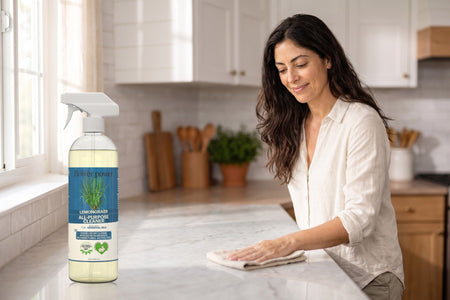
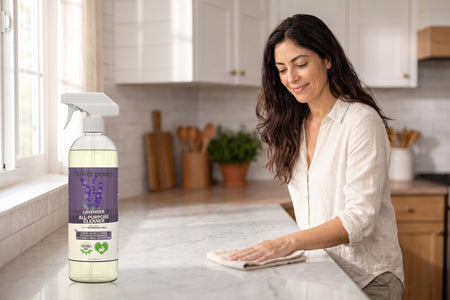
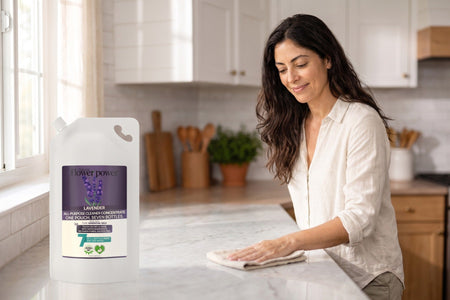
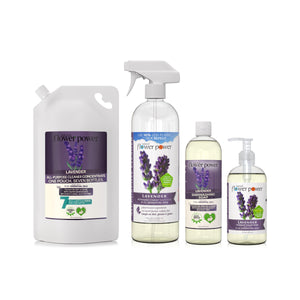
Natural Flower Power uses purified water as the base ingredient in its all-purpose cleaners, hand soaps, dish soaps, and air fresheners.
We use purified water rather than standard tap water because mineral content matters. Hard water interferes with surfactant performance and can cause cloudiness or instability in the finished product. By starting with purified water, we get consistent results from batch to batch regardless of seasonal or regional variations in our local water supply in Cameron Park, California. This is a behind-the-scenes detail that most consumers will never think about, but it directly affects whether the product in the bottle performs the same every time.
Related Ingredients
SD Alcohol 40B serves as a co-solvent in NFP's air freshener formulas alongside water, helping essential oils disperse more evenly. Sodium gluconate is a chelating agent added to NFP's all-purpose cleaners specifically to counteract hard water minerals that consumers may encounter when diluting or using the product. Citric acid adjusts the pH of the water-based formulations to optimize surfactant performance and product stability.
Sources
- U.S. Environmental Protection Agency. Safe Drinking Water Act (SDWA). epa.gov.
- United States Pharmacopeia (USP). Purified Water Monograph. USP-NF.
- Holmberg, K., et al. Surfactants and Polymers in Aqueous Solution. 2nd ed., John Wiley & Sons, 2003.
