
This ingredient is used in our products.
What It Is
Coco-glucoside is a nonionic surfactant in the alkyl polyglucoside (APG) family (CAS 110615-47-9). It is produced by reacting glucose from corn starch with a blend of fatty alcohols derived from coconut oil, typically ranging from C8 to C16 in carbon chain length. Unlike decyl glucoside, which uses a single C10 fatty alcohol, coco-glucoside uses the full spectrum of coconut-derived fatty alcohols. Its primary function is as a cleanser and foaming agent.
What we make for this
Common Uses
Coco-glucoside is widely used in dish soaps, hand soaps, body washes, baby shampoos, facial cleansers, and household cleaning products. It frequently appears in formulations marketed as "gentle" or "plant-based" because of its derivation from renewable resources and its relatively low irritation potential. The Cosmetic Ingredient Review reports that coco-glucoside is found in hundreds of cosmetic formulations, with concentrations typically between 1% and 10% in rinse-off products (Fiume et al., 2013).
How It Works
Coco-glucoside works through the same fundamental mechanism as other surfactants: its molecules have a hydrophilic sugar head and a hydrophobic fatty tail. Above the critical micelle concentration, these molecules form micelles that trap oils and dirt particles, allowing them to be rinsed away with water.
The key difference between coco-glucoside and decyl glucoside is the carbon chain distribution. Coco-glucoside contains a mix of chain lengths (C8–C16), which gives it different performance characteristics. The longer chains (C12–C16) contribute to foam stability — the foam lasts longer and feels denser. The shorter chains (C8–C10) contribute to initial foam generation and cleaning action. This broader chain range makes coco-glucoside a more versatile single-ingredient surfactant, though it provides less viscosity-building contribution than decyl glucoside in finished formulations.
Safety and Regulation
The CIR Expert Panel assessed coco-glucoside along with 18 other alkyl glucosides in 2013 and concluded these ingredients are safe in current practices of use and concentration when formulated to be nonirritating (Fiume et al., 2013). The same assessment applied to decyl glucoside and other related APGs.
The EPA established exemptions from tolerance requirements for alkyl polyglucosides including coco-glucoside, concluding they present a reasonable certainty of no harm from aggregate exposure (EPA, 70 FR 54281, 2005). Coco-glucoside is readily biodegradable and derived from renewable resources.
Contact allergy to coco-glucoside has been documented, with some clinical studies suggesting higher sensitization rates than initially expected — particularly among patients with existing dermatitis. However, these findings come from clinical patch-testing populations, not general consumer use. For most people using rinse-off products at typical concentrations, sensitization risk is low.
Why Natural Flower Power Uses It
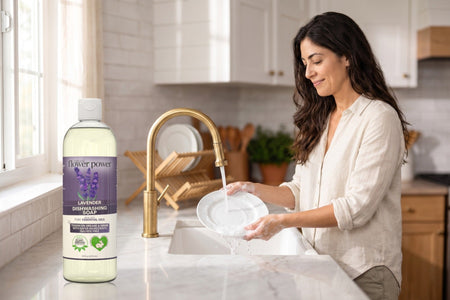
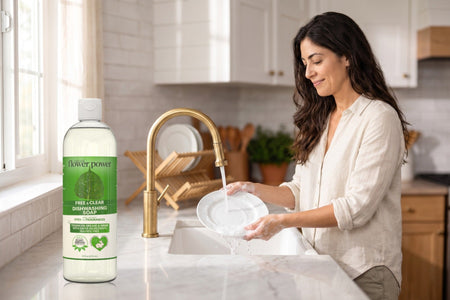
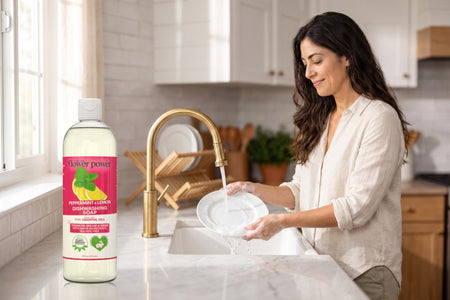
Natural Flower Power uses coco-glucoside in its dish soaps.
We chose coco-glucoside specifically for the dish soap line because of its foam stability. When you are washing dishes, you need foam that holds up in greasy water — not foam that collapses the moment it contacts cooking oil. Coco-glucoside's broader carbon chain range gives it better foam persistence under greasy conditions than decyl glucoside. That is why we use decyl glucoside in our hand soaps and all-purpose cleaners (where viscosity building matters more) and coco-glucoside in the dish soaps (where foam resilience matters more). Each surfactant has a job that matches its chemistry.
Related Ingredients
Decyl glucoside is the most closely related ingredient — also an alkyl polyglucoside, but made from a single C10 fatty alcohol rather than the full coconut fatty alcohol range. Cocamidopropyl betaine is an amphoteric surfactant that works alongside coco-glucoside in NFP's dish soap formulations. Lauryl glucoside is another APG variant with a C12 chain that is sometimes used in similar applications but is not part of NFP's formulations.
Sources
- Fiume, M.M., et al. "Safety Assessment of Decyl Glucoside and Other Alkyl Glucosides as Used in Cosmetics." International Journal of Toxicology, vol. 32, no. 5 Suppl, 2013, pp. 22S–48S.
- U.S. Environmental Protection Agency. "Exemption from the Requirement of a Tolerance for Alkyl (C10–C16) Polyglucosides." 70 FR 54281, September 14, 2005.
