
This ingredient is used in our products.
What It Is
Cocamidopropyl betaine (CAPB) is an amphoteric surfactant synthesized from coconut oil fatty acids and dimethylaminopropylamine (CAS 61789-40-0). It is classified as a betaine — a type of zwitterionic compound that carries both positive and negative charges. Its primary functions are foam boosting, viscosity building, and mildness enhancement in cleansing formulations.
What we make for this
Common Uses
CAPB is one of the most widely used co-surfactants in consumer products. It appears in hand soaps, dish soaps, shampoos, body washes, facial cleansers, baby shampoos, and household cleaners. In nearly all of these products, it serves as a secondary surfactant — paired with a stronger primary cleanser to improve foam quality, reduce overall irritation, and adjust formula viscosity. It is rare to find CAPB used as a sole surfactant because its standalone cleaning power is moderate.
How It Works
CAPB's zwitterionic structure means it carries both a positive and a negative charge simultaneously. This dual charge makes it exceptionally compatible with other surfactant types — anionic, nonionic, and cationic. When blended with a stronger anionic surfactant like sodium alpha olefin sulfonate, CAPB reduces the overall irritation potential of the formula while boosting foam density and stability.
The mechanism behind this mildness improvement is well documented: CAPB molecules intersperse with anionic surfactant molecules at the skin's surface, reducing the overall negative charge density. This lessens the disruption to the skin's natural lipid barrier. CAPB also contributes to viscosity — in many liquid soap formulations, the interaction between CAPB and an anionic surfactant is what creates the thick, pourable consistency consumers expect.
Safety and Regulation
The Cosmetic Ingredient Review (CIR) Expert Panel has reviewed CAPB multiple times and concluded it is safe as used in cosmetics at concentrations up to 4% in leave-on products and higher in rinse-off products, when formulated to minimize impurities (CIR, 2012). The key impurity concern is dimethylaminopropylamine (DMAPA) and amidoamine, which are residual byproducts of the synthesis process. These impurities, not CAPB itself, are the primary cause of contact allergy reactions attributed to CAPB. High-quality manufacturing reduces these residuals to very low levels.
CAPB was named the American Contact Dermatitis Society's "Allergen of the Year" in 2004, which raised public awareness. However, subsequent research clarified that most allergic reactions were caused by impurities rather than the CAPB molecule itself (Fowler et al., 2004). With improved manufacturing standards, sensitization rates have declined.
CAPB is biodegradable and has low aquatic toxicity at typical environmental concentrations.
Why Natural Flower Power Uses It
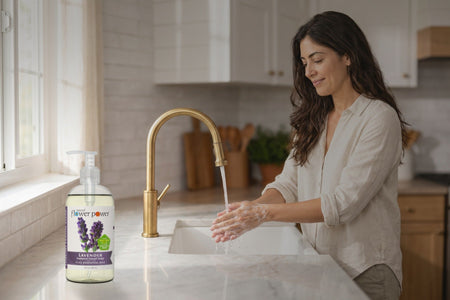
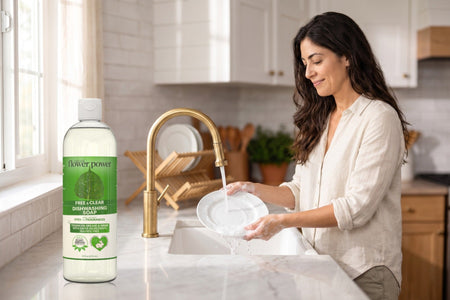
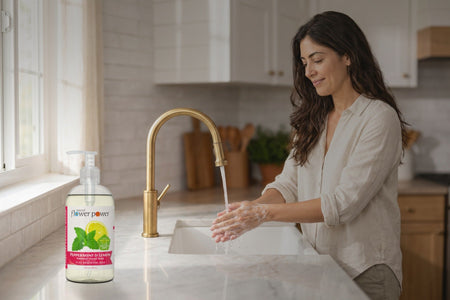
Natural Flower Power uses cocamidopropyl betaine in its hand soaps and dish soaps.
In both product lines, CAPB is the mildness bridge. Our primary surfactant — sodium alpha olefin sulfonate — is a strong anionic cleanser. On its own, it would be effective but too stripping for frequent hand washing. CAPB tempers that by reducing the irritation potential of the blend, thickening the formula, and producing the kind of stable, creamy foam that people associate with a quality soap.
We specifically source CAPB with low residual DMAPA and amidoamine levels to minimize sensitization risk. That costs more than commodity-grade CAPB, but it matters for a product line designed to be used multiple times per day on bare skin.
Related Ingredients
Lauramine oxide is another amphoteric surfactant with a similar foam-boosting function, though it contributes more to viscosity and less to mildness compared to CAPB. Sodium alpha olefin sulfonate is the anionic surfactant Natural Flower Power pairs with CAPB in hand soaps and dish soaps. Decyl glucoside is a nonionic co-surfactant that also appears in NFP formulas alongside CAPB, adding cleaning breadth with minimal irritation potential.
Sources
- Cosmetic Ingredient Review (CIR). "Amended Safety Assessment of Cocamidopropyl Betaine as Used in Cosmetics." International Journal of Toxicology, 2012.
- Fowler, J.F., et al. "Cocamidopropyl Betaine: Allergen of the Year." Dermatitis, 2004.
