
This ingredient is used in our products.
What It Is
Decyl glucoside is a nonionic surfactant in the alkyl polyglucoside (APG) family. It is produced by reacting glucose — typically from corn starch — with decanol, a fatty alcohol derived from coconut oil (CAS 68515-73-1). The result is a 10-carbon chain attached to a sugar molecule. Its primary function is as a cleanser and foaming agent in both household cleaning and personal care products.
What we make for this


Common Uses
Decyl glucoside appears in a wide range of rinse-off products: hand soaps, dish soaps, body washes, facial cleansers, baby shampoos, and all-purpose household cleaners. In these products, it serves as either the primary surfactant or a co-surfactant that boosts foam and improves the feel of the formula. It is one of the most frequently used alkyl polyglucosides in cosmetics, with 492 reported uses in the FDA's Voluntary Cosmetic Registration Program as of 2011, the majority in rinse-off formulations (Fiume et al., 2013).
Decyl glucoside also appears in some leave-on products like cleansing milks and sunscreens, where it acts as a stabilizer or emulsifier.
How It Works
Like all surfactants, decyl glucoside reduces the surface tension of water so it can mix with oils and dirt. Its molecule has two distinct parts: a hydrophilic (water-attracting) sugar head and a hydrophobic (water-repelling) 10-carbon fatty tail. When dissolved in water above a certain concentration — called the critical micelle concentration — these molecules cluster into tiny structures called micelles. The fatty tails point inward, trapping oil and grease particles, while the sugar heads face outward into the water. This allows the trapped oils to be rinsed away.
Because decyl glucoside is nonionic (it carries no electrical charge), it tends to be less irritating to skin than anionic surfactants like sodium lauryl sulfate, which carry a negative charge that can disrupt the skin's lipid barrier more aggressively. The tradeoff is that nonionic surfactants generally produce less foam and have somewhat lower raw cleaning power than their anionic counterparts, which is why decyl glucoside is often paired with other surfactants in finished formulations.
Safety and Regulation
The Cosmetic Ingredient Review (CIR) Expert Panel assessed decyl glucoside along with 18 other alkyl glucosides in 2013 and concluded that these ingredients are safe in current practices of use and concentration when formulated to be nonirritating (Fiume et al., 2013). The Panel noted that glucoside hydrolases in human skin break these compounds down into glucose and their respective fatty alcohols — both well-characterized substances.
The EPA established an exemption from tolerance requirements for alkyl (C10–C16) polyglucosides in 2005, concluding they are chemicals of lower toxicity with a reasonable certainty of no harm from aggregate exposure (EPA, 70 FR 54281, 2005).
In clinical patch testing, decyl glucoside at concentrations up to 2% active ingredient was at most slightly irritating to skin (Fiume et al., 2013). Contact allergy to decyl glucoside has been documented in dermatological literature, though it is uncommon. Among nearly 8,000 consecutively patch-tested patients at one Danish university hospital, contact allergy rates to decyl glucoside were 3.1% in patients without atopic dermatitis and 14.3% among atopic dermatitis patients (Fiume et al., 2013). These figures come from a clinical dermatology setting where patients were already being evaluated for suspected contact allergies — not from the general population. For most people using rinse-off products at typical formulation concentrations, contact allergy to decyl glucoside is not a practical concern. Individuals with known sensitivity to alkyl glucosides should check product labels.
Decyl glucoside is readily biodegradable and derived from renewable resources. It does not produce ethylene oxide or 1,4-dioxane as processing byproducts — a distinction from ethoxylated surfactants like sodium laureth sulfate.
Why Natural Flower Power Uses It
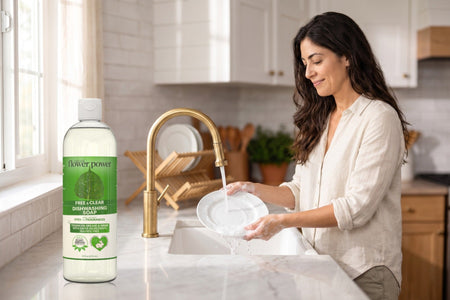
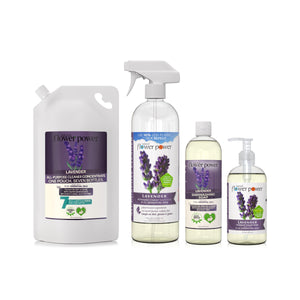
Natural Flower Power uses decyl glucoside in its all-purpose cleaners, hand soaps, and dish soaps.
In the all-purpose cleaners, decyl glucoside is the lead surfactant — the primary cleaning agent in the formula. In the hand soaps and dish soaps, it functions as a co-surfactant alongside sodium alpha olefin sulfonate and cocamidopropyl betaine, where it contributes viscosity and adds cleaning breadth without increasing irritation potential.
We chose decyl glucoside over coco-glucoside (a related APG with a broader carbon chain range) for a specific reason: decyl glucoside performs better as a viscosity builder in our formulations, which matters when you're trying to get a hand soap or dish soap to feel right coming out of the bottle. Coco-glucoside produces more stable foam, but foam stability was not the limiting factor in our formulas — the other surfactants in the blend handle that. The tradeoff was worth it for the better texture and thickness decyl glucoside provides.
Related Ingredients
Coco-glucoside is the most closely related surfactant — also an alkyl polyglucoside, but made from a broader range of coconut-derived fatty alcohols (typically C8–C16), which gives it different foam and solubility characteristics. Lauryl glucoside is another APG with a longer carbon chain (C12), often used where lower foam and higher emulsification are needed. Sodium lauryl sulfate (SLS) is an anionic surfactant that serves a similar cleaning function but with a different irritation profile and a petroleum or coconut origin. Cocamidopropyl betaine is an amphoteric surfactant commonly paired with decyl glucoside in formulations to balance foam, mildness, and cleaning performance.
Sources
- Fiume, M.M., et al. ""Safety Assessment of Decyl Glucoside and Other Alkyl Glucosides as Used in Cosmetics."" International Journal of Toxicology, vol. 32, no. 5 Suppl, 2013, pp. 22S–48S. doi:10.1177/1091581813497764
- U.S. Environmental Protection Agency. ""Exemption from the Requirement of a Tolerance for Alkyl (C10–C16) Polyglucosides."" 70 FR 54281, September 14, 2005.
- U.S. EPA Inert Reassessment Document for Nonyl, Decyl, and Undecyl Glycoside. epa.gov.
