
This ingredient is used in our products.
What It Is
Cocamide DIPA (cocamide diisopropanolamine) is a fatty acid amide derived from coconut oil and diisopropanolamine (CAS 68603-42-9). It belongs to the alkanolamide family of surfactants. Its primary functions are foam stabilization, viscosity building, and emulsification in water-based cleaning formulations.
What we make for this


Common Uses
Cocamide DIPA appears in liquid hand soaps, dish soaps, shampoos, body washes, and some household cleaners. It is typically used as a supporting ingredient rather than a primary cleanser — its job is to improve the feel and performance of the surfactant blend. In dish soaps and hand soaps, it helps create thick, stable foam that holds up during use rather than collapsing quickly.
How It Works
Cocamide DIPA works by stabilizing the foam that other surfactants generate. Primary surfactants like sodium alpha olefin sulfonate create initial foam, but that foam can be thin and short-lived without a stabilizer. Cocamide DIPA inserts itself into the foam's liquid film, slowing drainage between bubbles and creating a denser, longer-lasting lather.
It also increases the viscosity of the overall formula. In liquid soaps, this is what gives the product a thick, pourable consistency rather than a watery one. The thickening effect comes from the interaction between cocamide DIPA's fatty chain and the other surfactants in the blend — it forms larger, more structured micelle networks that resist flow.
Safety and Regulation
The Cosmetic Ingredient Review (CIR) Expert Panel has assessed coconut oil-derived alkanolamides, including cocamide DIPA, and concluded they are safe as used in cosmetics when formulated to minimize the formation of nitrosamines (CIR, 1996; re-reviewed 2015). The nitrosamine concern applies to the class of alkanolamides broadly: under certain conditions, amide compounds can react with nitrosating agents to form nitrosamines, which are carcinogenic. This is managed by formulation practices — specifically, avoiding the combination of alkanolamides with nitrosating ingredients in the same product.
At typical use concentrations in rinse-off products (generally 1–3%), cocamide DIPA has low irritation potential. It is less irritating than most primary surfactants and is often added specifically to improve the skin-feel of a formula.
Cocamide DIPA is biodegradable under standard wastewater treatment conditions.
Why Natural Flower Power Uses It
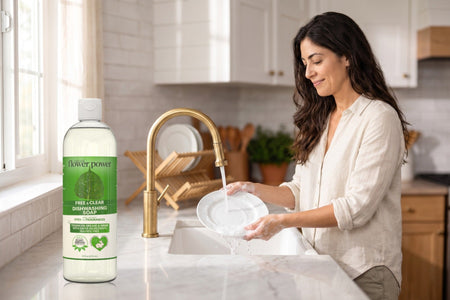
Natural Flower Power uses cocamide DIPA in its hand soaps and dish soaps.
Its role in our formulas is straightforward: it makes the foam feel better and the product pour correctly. Without a foam stabilizer, our surfactant blend would produce lather that collapses too quickly, especially on greasy dishes. And without a viscosity builder like cocamide DIPA, the hand soap would feel thin and watery coming out of the pump — even if the cleaning performance were identical. Product experience matters alongside product function, and cocamide DIPA handles the experience side.
We use cocamide DIPA rather than the more common cocamide DEA (diethanolamine) because DIPA avoids the DEA-related nitrosamine concerns that have drawn regulatory attention. It is a deliberate ingredient-level decision that trades some cost efficiency for a cleaner safety profile.
Related Ingredients
Cocamidopropyl betaine serves a partially overlapping role — it also boosts foam and viscosity — but is a true surfactant with independent cleaning ability, while cocamide DIPA is primarily a foam and viscosity modifier. Diethanolamine (DEA) is the base compound in cocamide DEA, a closely related foam stabilizer that Natural Flower Power does not use due to nitrosamine formation concerns. Lauramine oxide is another foam-boosting and thickening ingredient present in NFP's dish soaps and all-purpose cleaners.
Sources
- Cosmetic Ingredient Review (CIR). "Safety Assessment of Coconut Oil-Derived Alkanolamides as Used in Cosmetics." International Journal of Toxicology, 1996; re-reviewed 2015.
