
This ingredient is used in our products.
What It Is
Lavender oil is an essential oil steam-distilled from the flowering tops of Lavandula angustifolia (formerly Lavandula officinalis), a plant in the mint family native to the western Mediterranean (CAS 8000-28-0). The oil is a pale yellow to colorless liquid with a characteristic floral, herbaceous scent. Its major chemical components include linalool (typically 25%–45%) and linalyl acetate (typically 25%–47%), with smaller amounts of terpinen-4-ol, lavandulol, and various terpenes. Lavender oil functions primarily as a fragrance ingredient in cleaning and personal care products.
What we make for this



Common Uses
Lavender oil is one of the most widely used essential oils in consumer products. It appears in hand soaps, dish soaps, all-purpose cleaners, air fresheners, laundry detergents, body lotions, bath products, candles, and aromatherapy preparations. In cleaning products, it serves primarily as a fragrance, though it has mild documented antimicrobial properties. Lavender oil is also used in traditional and complementary medicine for its reputed calming and sleep-promoting effects. Global production is concentrated in France, Bulgaria, and the United Kingdom.
How It Works
As a fragrance ingredient, lavender oil provides scent through the volatilization of its terpene and ester components. Linalool and linalyl acetate are the primary odor-contributing molecules — linalool gives a fresh, slightly woody floral note, while linalyl acetate contributes a sweeter, fruitier character. These compounds evaporate at room temperature, which is why the scent is perceivable when the product is used.
Lavender oil has documented antimicrobial activity in laboratory studies. Linalool has shown activity against several bacterial strains including Staphylococcus aureus and Escherichia coli, though the concentrations required for meaningful antimicrobial effect are typically higher than those used for fragrance purposes in cleaning products (Cavanagh and Wilkinson, 2002). In a finished cleaning product, the antimicrobial contribution from lavender oil is supplementary at best and not sufficient for disinfection claims.
Safety and Regulation
The IFRA standard allows lavender oil in all product categories with concentration limits specific to application type. The RIFM has evaluated lavender oil and considers it safe for cosmetic and household use at recommended concentrations. The CIR Expert Panel has not published a standalone safety monograph for lavender oil, but linalool and linalyl acetate — its major components — have been individually assessed and found safe at typical use levels.
Linalool and linalyl acetate are listed as fragrance allergens under EU cosmetic regulations (EC No 1223/2009) and must be declared on product labels when present above 0.001% in leave-on products or 0.01% in rinse-off products. Oxidized linalool (formed when lavender oil is exposed to air over time) has a higher sensitization potential than fresh linalool (Sköld et al., 2004). Proper storage — sealed containers, away from heat and light — reduces oxidation and allergen formation.
Lavender oil is toxic if ingested in concentrated form. As with all essential oils, the diluted concentrations present in finished cleaning and personal care products are well below levels of toxicological concern.
Why Natural Flower Power Uses It
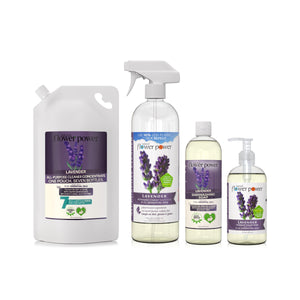
Natural Flower Power uses lavender oil across its entire product range: all-purpose cleaners, hand soaps, dish soaps, and air fresheners.
Lavender is our most broadly used essential oil because it blends well with nearly every other scent in our lineup. It appears as the dominant note in our Lavender scent products and as a supporting note in several other blends. We use Lavandula angustifolia specifically (as opposed to lavandin or spike lavender) because its higher linalyl acetate content gives a softer, more rounded scent profile that works across cleaning products, hand soaps, and air fresheners without becoming sharp or camphorous. The tradeoff is cost — true angustifolia lavender oil costs significantly more than lavandin or synthetic linalool — but the scent quality difference is noticeable enough that we consider it worth it.
We also sell pure lavender essential oil as a standalone essential oil.
Related Ingredients
Lemongrass oil is often used alongside lavender oil in NFP's blended scent formulations. Tea tree oil shares some terpene components with lavender oil and is sometimes combined with it in cleaning products. Eucalyptus oil complements lavender in certain aromatic profiles, contributing a sharper, more medicinal note. Synthetic fragrance blends are the primary alternative to essential oils like lavender — they are cheaper and more consistent, but Natural Flower Power does not use them.
Sources
- Cavanagh, H.M.A., and Wilkinson, J.M. "Biological Activities of Lavender Essential Oil." Phytotherapy Research, vol. 16, no. 4, 2002, pp. 301–308.
- Sköld, M., et al. "The Fragrance Chemical Linalyl Acetate — Air Exposure and Skin Sensitization." Contact Dermatitis, vol. 51, no. 4, 2004, pp. 190–194.
- European Commission. Regulation (EC) No 1223/2009 on Cosmetic Products. Annex III (Fragrance Allergens).
- International Organization for Standardization. ISO 3515:2002. Oil of Lavender (Lavandula angustifolia).
