

When you pick up a bottle of our all-purpose cleaner or liquid soap, one of the first things you'll notice is the scent. Fresh, clean, genuinely pleasant. Most people assume that's what the essential oils are doing—they're in there to make the product smell good. That's partially true, but it's only half the story.
Essential oils aren't just fragrance. They're functional ingredients. Tea tree oil carries antimicrobial properties that actually disrupt bacterial cell membranes. Citrus oils contain limonene, a compound that breaks down grease and cuts through waxy buildup in ways that pure water never could. When we formulate with essential oils instead of synthetic fragrances, we're making a choice that affects how the product cleans, how long it lasts on the shelf, and what you're actually bringing into your home.
Understanding what essential oils do—beyond the obvious pleasant smell—is the key to understanding why we build our line the way we do. It's also the key to understanding the real tradeoffs between plant-derived formulations and synthetic alternatives.
The Chemistry: How Essential Oil Compounds Attack Microbial Cells
Essential oils are complex mixtures of plant compounds—primarily terpenes, phenolics, and aldehydes—that plants produce as natural defense systems against bacteria, fungi, and other microorganisms. When you extract and concentrate these compounds into an essential oil, you're harvesting a plant's own antimicrobial toolkit.
The mechanism is straightforward chemistry. Most essential oil compounds are lipophilic—they prefer to dissolve in oil and fat rather than water. That means when they encounter a bacterial cell membrane (which is made of lipids), they can penetrate it. Once inside, these compounds disrupt the membrane structure, creating leaks. The bacterial cell loses essential materials, can't maintain its internal environment, and dies. It's not a poison. It's membrane damage so severe that the cell can't recover.
Tea tree oil provides a practical example. Its primary antimicrobial compound is terpinen-4-ol, but the oil also contains 1,8-cineole and α-terpineol, which work together to create multiple simultaneous attacks on the bacterial cell. This diversity matters because it means bacteria are less likely to develop resistance—the cell gets hit from several different angles at once. In formulation work, we've observed that tea tree oil is particularly effective against the kinds of bacteria you actually encounter on kitchen surfaces and hands, which is why it appears in multiple products across our line.
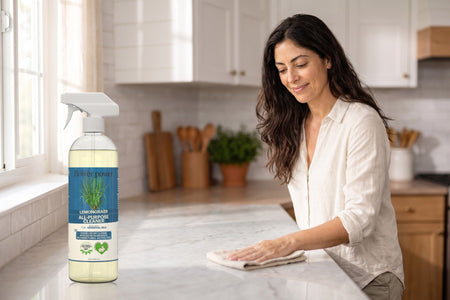
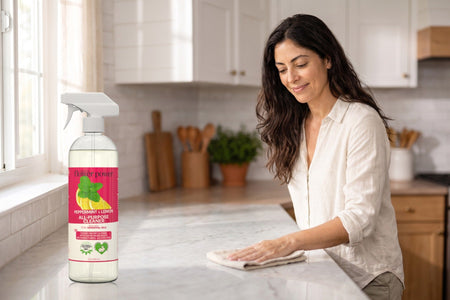
Citrus oils work differently. They contain limonene, which is a solvent as much as it is an antimicrobial. Limonene dissolves greasy, oily residues—the kind that accumulate on stovetops, around handles, or in dishwater. This is why our citrus-based products feel noticeably different from plant-derived all-purpose cleaners without citrus oils. The degreasing happens through actual chemical solubilization, not just mechanical scrubbing.
What we make for this

The Real Tradeoff: Why Plant-Derived Oils Are More Expensive and Less Stable
If essential oils are so functional, why do most cleaning products use synthetic fragrances instead? The answer is practical: cost and consistency.
A synthetic fragrance compound like limonene (yes, it exists synthetically too) can be manufactured in a lab at a fraction of the cost of extracting real citrus oil from actual fruit. It's also chemically identical every single time. You buy a batch and know exactly what concentration of the active compound you're getting. When you buy essential oils from plant sources, you get variability. The terpinen-4-ol content in tea tree oil from a harvest in Australia can differ from oil from the previous year's crop, depending on growing conditions, harvest timing, and extraction methods. Formulators have to test and adjust every batch.
That variability in performance is one reason. Cost is another. High-quality essential oils are expensive because extraction requires real plant material, processing infrastructure, and quality control. A synthetic fragrance costs less per dose, so a manufacturer can either price their product lower or increase margins. Most increase margins.
The bigger issue is stability. Essential oils oxidize. When citrus oil sits in a bottle exposed to light, heat, or simply air over months, the limonene and other volatile compounds gradually break down. The fragrance fades. But more importantly for function, the antimicrobial potency decreases. A bottle of our all-purpose cleaner will still clean at eight months old, but it's not quite as antimicrobially active as it was when fresh. Synthetic fragrances don't degrade this way—they're chemically stable for years.
We've had to build our manufacturing and shelf-life practices around this reality. We manufacture in smaller, more frequent batches than larger competitors do. We recommend using products within a certain timeframe. We're transparent about the fact that shelf life for essential-oil-based products is shorter than it is for synthetically fragranced alternatives. These are operational costs that large manufacturers simply don't incur.
Why Concentration Matters: The Line Between Function and Irritation
If essential oils are antimicrobially active, would more be better? Not exactly. This is where formulation knowledge becomes critical.
Essential oils are concentrated plant extracts. A single drop of pure tea tree oil represents the antimicrobial compounds from many, many tea tree leaves. When used as a cleaning ingredient, these oils need to be diluted into the overall formula—and that concentration matters significantly. Too little, and the antimicrobial effect is negligible. Too much, and you risk irritating skin, especially for people handling the product regularly or applying it to sensitive areas like hands or face.
The research suggests that tea tree oil at concentrations of 0.2% to 0.8% is effective against most bacteria while remaining safe for skin contact. Our formulations stay within that window, but we're also conscious of the fact that some people are sensitive even to essential oils—they're not synthetic, but they're still plant compounds with biological activity. We offer unscented alternatives for exactly this reason: some households simply don't want any fragrance or essential oil concentration in their hand soaps or dish products.
For someone mixing a concentrated all-purpose cleaner, the decision becomes different. A higher concentration of essential oils makes sense when the product will be diluted in water before use. The user adds a small amount to a bucket or spray bottle, and what they're actually applying to surfaces is much more diluted. This is why some of our concentrated products have noticeably higher essential oil loads than our ready-to-use formulas. The end-use concentration is what matters, not the concentration in the bottle.
Building a Formula Around Functional Ingredients, Not Just Fragrance
When we started testing formulations in 2012, we approached essential oils as functional components from the beginning, not as an afterthought to mask the smell of other ingredients. That changes how you think about the rest of the formula.
If you're using synthetic fragrance, the fragrance is just a top note—it sits on the surface and evaporates. It doesn't need to interact with the cleaning system itself. But if you're building with essential oils, you have to think about solubility. Tea tree oil is hydrophobic, so it won't mix cleanly with water on its own. You need an emulsifier to keep it evenly distributed. Citrus oils have their own solubility challenges. The formula has to be engineered so that the essential oils stay evenly dispersed, that they don't settle out over time, and that they maintain their potency through storage.
This is true of every plant-derived ingredient we use. Each one comes with structural constraints that synthetic alternatives don't have. It's more complex to formulate around, more expensive to test, and the result is a product with a shorter shelf life and less predictable consistency. But the payoff is that every cleaning action the product delivers is coming from actual chemistry, not from trade-secret fragrance masking.
We've also learned which essential oils pair well with which cleaning functions. Lavender oil has gentle antimicrobial properties and a scent that people associate with cleanliness, making it suitable for bathroom products where perception and actual performance matter equally. Eucalyptus oil has broader antimicrobial activity and a sharper scent profile, so it works better in kitchen cleaners where stronger scent expectation is common. Lemon oil's natural degreasing action makes it almost essential in a dish soap formula—we'd have to add separate chemical solvents if we removed it, which would defeat the purpose of a plant-derived product.
The Performance Conversation: Why Essential Oils Clean Differently
One question we hear from new customers is: "Does it clean as well as conventional cleaners?" The honest answer is: it cleans differently, and whether that difference matters depends on what you're cleaning.
For most household messes—dust, general grime, food residue on counters, soap scum in bathrooms—our plant-derived formulations perform comparably to conventional cleaners. The limonene in citrus oils does genuine degreasing work. The tea tree oil provides antimicrobial activity. The plant-derived surfactants we use (which help water and oil mix) are effective at lifting dirt and suspending it so it rinses away. Where the difference becomes apparent is with very heavy buildup or industrial-grade soiling. A burnt-on pan or a heavily greasy stovetop might respond better to harsher, more aggressive chemistry. Our products are not built for that extreme end of the spectrum.
That's a deliberate choice, not an accident. We could add more aggressive surfactants or include additional solvent chemicals to increase performance on extreme cases. But doing so would increase irritation potential and move away from the plant-derived philosophy. We've made the tradeoff decision: excellent performance on typical household cleaning, with the understanding that rare extreme cases might need a different tool.
What we have discovered through years of customer feedback is that people who switch to our products often find they don't need to scrub as hard. The scent—which comes entirely from essential oils—has a psychological effect that many people describe as making a space feel cleaner, which in turn changes behavior. Someone reaches for a cloth and genuinely cleans rather than just wiping. That behavioral shift, combined with the actual antimicrobial and solvent properties of the essential oils, often produces results that feel as good as or better than the conventional product they replaced, even if the raw chemistry is technically less aggressive.

Why We Don't Standardize Scent Profiles
If you've used our products for a while, you might have noticed that the scent can shift slightly between batches. A bottle of our all-purpose cleaner from this month might smell marginally different from what you bought six months ago. Some customers love consistency above all else and find that variation frustrating. Others appreciate that it's evidence the product is actually made with real essential oils, not synthetics. We get both reactions, and we're honest about why it happens.
Essential oils are biological products. They vary year to year, batch to batch. We could smooth out that variation by adding synthetic fragrance compounds to standardize the scent, but that would mean reintroducing the very ingredients we formulated without in the first place. Instead, we test every batch to ensure the essential oil concentration is within functional range and antimicrobially effective, and we accept that the exact note profile will shift slightly. It's one of the real tradeoffs of plant-derived formulation, and we think it's worth it.
Understanding Your Cleaning Products at the Ingredient Level
When you read an ingredient list on a conventional cleaner and see fragrance, you're looking at a blank space. You can't know which of the dozens of possible fragrance compounds are actually in there. That opacity is legal, but it's also a choice by the manufacturer.
When you see essential oil names on our ingredient list—tea tree, lemon, lavender, eucalyptus—you're looking at transparency that goes further. You can cross-reference which oils are known to work against which microorganisms. You can look up whether you have a known sensitivity to a specific essential oil. You can understand functionally why each oil is in the formula, not just as fragrance but as an active cleaning agent. If something in the formula doesn't work for your household, you have actual information to act on.
That transparency doesn't require essential oils. Some companies use synthetic fragrances and still name them. But in our experience, the companies most willing to move away from the fragrance loophole are also the ones most likely to be transparent about everything else in their formula. Building without hidden fragrance chemicals creates an operational culture where transparency becomes the norm.
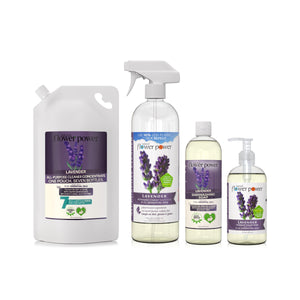
You can explore our full approach to ingredients and transparency at Our Story & Standards. And if you want to see how these plant-derived principles apply in practice, our Essential Oils collection shows the raw materials we work with, and our All-Purpose Cleaners and Dish Soaps show how we apply them in finished products.
Essential oils in cleaning products are not just fragrance. They're antimicrobial compounds, solvents, and functional ingredients that do real chemical work. Understanding what they do—and accepting the tradeoffs they require—is part of understanding why plant-derived products cost more, change over time, and demand more careful handling and formulation on the manufacturer's side. For households that want that level of transparency and function, those tradeoffs are worth making.
