

You wash dishes three times a day. Your hands feel tight, almost papery, within an hour. The skin around your knuckles cracks if you don't apply lotion immediately. A few times a week, small fissures open up and sting.
You've tried keeping them moisturized. You've tried limiting how often you wash. You've even considered wearing gloves every single time—but that feels excessive for washing your own dishes in your own kitchen. What should be a simple task leaves your hands feeling raw, and you're left wondering if there's something wrong with your skin or if the soap is the actual problem.
It's the soap. More specifically, it's how the surfactants in conventional dish soap interact with your skin's protective barrier. This isn't a personal sensitivity issue or a sign that your hands are too delicate. It's what happens when a formulation prioritizes cutting grease without considering what happens to the very thin, very important layer of oil that protects living skin.
How Your Skin Barrier Works (And Why Dish Soap Threatens It)
Your skin's outermost layer is called the stratum corneum. It's not waterproof the way plastic is waterproof. Instead, it's a carefully balanced system of dead skin cells held together by lipids—fats and oils. Those lipids fill the spaces between cells and form a shield against water loss and irritant penetration. This protective layer is what keeps water from washing right through you and what prevents irritants from getting in.
When you use conventional dish soap, the surfactants it contains don't just break down grease on your dishes. They break down the lipids that hold your skin cells together. Surfactants work by positioning themselves at the boundary between oil and water, literally wedging their way in and separating molecules that normally stick together. On your dishes, this is exactly what you want. On your hands, it's the beginning of the problem.
The damage isn't immediate, which is why it sneaks up on you. The first few times you wash dishes, your skin holds steady. But with repeated exposure, the surfactants deplete the lipid barrier faster than your skin can replace it. Water that would normally be bound in the stratum corneum starts escaping—a process called transepidermal water loss. As that water leaves, your hands begin to feel tight and uncomfortable, and the visible damage follows: redness, scaling, sometimes small cracks.
What we make for this

Which Surfactants Are the Most Stripping
Not all surfactants are equally harsh. The most aggressive ones are also the most common in budget dish soaps because they're cheap and extremely effective at cutting through grease. Sodium lauryl sulfate, known as SLS, is one of them. It strips the skin's protective oils so efficiently that it's actually used in dermatological research specifically to damage the skin barrier so researchers can study the damage. In studies where volunteers washed their hands repeatedly with products containing SLS, transepidermal water loss increased by more than 25 percent in the first two weeks—followed by visible scaling, redness, and cracking.
SLES, or sodium laureth sulfate, is a slightly modified version of SLS. It goes through an additional chemical process called ethoxylation that makes it gentler by slightly reducing how aggressively it strips the skin. Many mainstream brands use SLES as a middle ground—still powerful, but less harsh than pure SLS. The drying effect is still real, just less severe.
Beyond those two, there are dozens of other surfactants available to formulators, but SLS and SLES dominate because they're inexpensive, stable, and effective. They've been in use for decades, and the infrastructure to produce them is already in place. Switching to something else costs more and requires different formulation knowledge. Most manufacturers don't bother, especially at lower price points where margins are tight.
What Plant-Derived Surfactants Do Differently
Plant-derived surfactants work by the same basic mechanism as conventional ones—they reduce the surface tension between oil and water—but they interact with the skin barrier differently. Because they're derived from plant materials like coconut oil, sugars, or plant lipids, their molecular structure is closer to the natural lipids your skin already produces. Instead of aggressively displacing your skin's protective layer, they're less likely to disrupt the careful balance that keeps water in and irritants out.
Ingredients like decyl glucoside, derived from plant sugars and fatty alcohols, or coco-glucoside, sourced from coconut oil and fruit sugars, deliver effective cleansing while maintaining the integrity of your skin barrier. Research shows that plant-derived surfactants can reduce irritation by approximately 30 percent compared to SLS, which means noticeably less tightness, less redness, and fewer of those frustrating little cracks that make your hands sting when you wash them again the next day.
The tradeoff is cost. Plant-derived surfactants are more expensive to source and formulate with than SLS or SLES. They require different balancing in the formula because they work slightly differently. They don't lather quite as dramatically—the massive foaming action that makes conventional soaps feel powerful is partly a theatrical effect created by aggressive surfactants, not a sign of better cleaning. Real cleaning power depends on surfactant chemistry, not on how many bubbles you see.
Why This Matters Beyond Comfort
Repeated stripping of your skin barrier doesn't just make your hands uncomfortable in the moment. It creates a cascade of problems. Once the lipid layer is compromised, your skin has to work harder to maintain hydration. It becomes more permeable to irritants—meaning that even gentle soaps might trigger irritation now because the barrier that normally keeps them out is already damaged. You develop a vicious cycle where your hands feel worse, you want to fix it by moisturizing more aggressively, and the barrier keeps degrading because the soap you're using several times a day is still stripping it.
For people with existing eczema, dermatitis, or other skin conditions, this becomes critical. A barrier that's already compromised by a skin condition cannot tolerate an aggressive surfactant. The inflammation pathway in your skin is already activated, and stripping away the lipid layer accelerates that inflammation. This is why dermatologists recommend switching to gentler cleansers for people with sensitive skin—not because the skin is fragile, but because aggressive surfactants actively worsen the underlying condition.
Even for people with completely healthy skin, there's a question worth asking: why accept hand drying and discomfort from a dish soap if you don't have to? You're not asking your dish soap to do anything dramatically different from a gentler formula. You're asking it to clean your dishes. That's all. A formula that does that without damaging your skin barrier is simply a better choice.

How We Formulate Dish Soap at Natural Flower Power
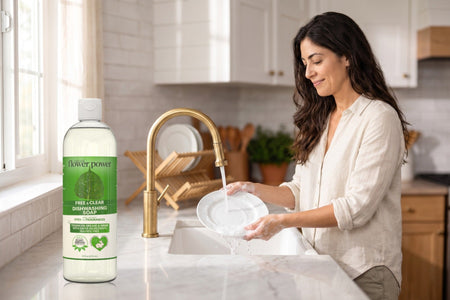
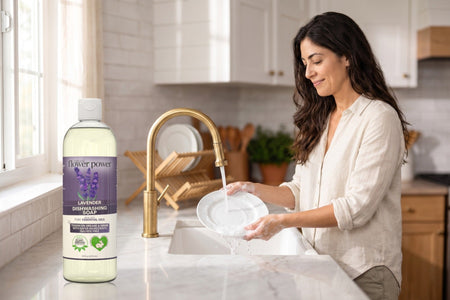
When we started making dish soap in 2012, we built from the same question: why should a product that touches your hands multiple times a day be designed to damage them? Our approach was to start with gentler plant-derived surfactants as the foundation, then layer in additional plant-derived cleaning agents that would give us real performance without requiring harsh ingredients to compensate.
This means our soaps cost more to produce. Decyl glucoside and the other plant-derived surfactants we use come from suppliers with smaller production volumes than the massive petrochemical operations making SLS. The lipid profile we use—including plant-derived conditioning agents—requires more careful balancing during formulation. We've chosen this approach not because it's easier, but because our customers' hands are worth it.
The result is noticeable when you use it. Your hands don't feel tight afterward. The skin around your knuckles stays soft. If you have any existing dryness or irritation, you'll see improvement within days, because you're no longer actively damaging your barrier three times a day. This isn't about a more luxurious feel—though the soap does feel notably better than bargain brands—it's about a formulation choice that respects the simple fact that your hands are skin too, and they deserve to be treated accordingly.
Beyond the Surfactant: Other Drying Culprits
Surfactants are the primary cause of drying, but they're not the only one. Some dish soaps include additional ingredients that compound the problem. Sodium hydroxide, used to adjust pH, can be irritating in concentrations that are too high. High water temperature accelerates lipid depletion—warm water opens the stratum corneum's structure, making it more permeable to everything, including surfactants. Some formulations include fragrance compounds that themselves can irritate or dry the skin, which we addressed in detail in our guide to fragrance labels.
A well-formulated gentle soap addresses all of these. The pH should be close to your skin's natural pH of 4.5 to 5.5. The fragrance, if present, should be essential oils only—or absent entirely. The surfactant package should be balanced toward gentleness. All of these choices compound. A soap that makes only one of these decisions doesn't solve the drying problem; you'll still feel the drying effect. A soap that makes all of them creates an experience where your hands actually feel better, not worse, after washing.
What You Can Do Right Now
If your hands are already dry and damaged from conventional dish soap, there are immediate steps you can take while you transition to a gentler formula. Use warm water instead of hot—the hotter the water, the faster your lipids deplete. Wear gloves while you transition, not forever, but long enough to let your barrier repair itself. Apply a rich moisturizer while your skin is still damp from washing, which helps lock water into the stratum corneum. But the fastest way to resolve the problem is simply to stop using an aggressive surfactant.
If you haven't experienced hand drying from dish soap yet, this is preventative knowledge. You don't have to wait until your hands are uncomfortable. Choosing a formula with gentler plant-derived surfactants from the start means you'll never develop the problem. Your hands will feel the same at the end of a day of washing dishes as they do at the beginning. That's not a luxury. It's what should be standard.
