

In 2012, when we started formulating cleaning products, synthetic fragrances were the obvious choice. They cost a fraction of essential oils. They're stable for years. They don't degrade or change scent profile over time. They're powerful—a tiny amount creates a strong smell that stays consistent from the first use to the last drop. From a manufacturing standpoint, they make everything simpler: lower costs, longer shelf life, predictable performance, higher margins. Almost every cleaning product company uses them, and there's a reason.
We chose not to.
That choice wasn't ideological. It was operational. We started testing products with customers immediately, and a pattern emerged quickly: people with sensitive skin, respiratory sensitivities, and chemical sensitivities kept asking for the same thing. Not a different product. A different kind of product—one that worked without triggering reactions. So we built our formulations around essential oils only, no synthetic fragrance compounds, and accepted all the manufacturing complexity that came with it. Looking back, that decision shaped everything else we do. It's also the decision I get asked about most often, usually by people who want to understand why we're willing to pay for something most competitors give away cheaply.
The Chemistry Difference: Synthetic Fragrance vs. Essential Oil
A synthetic fragrance is a lab-formulated mixture of aroma chemicals designed to smell like something—lemon, lavender, ocean breeze, fresh cotton. These aren't natural at all; they're molecules synthesized to mimic the scents found in plants, but made entirely in a chemical facility. Common ones include limonene (which smells citrusy), linalool (floral and woody), and dozens of aldehydes, esters, and ketones that when blended together create the scent profile the manufacturer wants.
The appeal is straightforward. A fragrance chemist can dial in exactly the right smell, adjust the strength, and guarantee that every bottle of product will smell identical because the formula never changes. The cost is low because synthetic chemistry is mature—scaling production of aroma chemicals is well understood and inexpensive. And crucially, synthetic fragrances are stable. They don't break down. They don't react with other ingredients over time. A bottle of cleaner scented with synthetic fragrance will smell almost identical in year one and year three.
Essential oils are the opposite. They're concentrated extracts from plants—steam-distilled, cold-pressed, or solvent-extracted from leaves, flowers, seeds, or fruit peels. Real lemon oil comes from lemon peel. Real lavender oil comes from lavender flowers. Each oil is a complex mixture of hundreds of naturally occurring compounds, and those compounds are reactive. They oxidize when exposed to oxygen. They degrade in sunlight. They interact with preservatives and other ingredients. Over time, an essential oil loses its scent intensity and the scent profile shifts. A lavender oil that smells pure and floral at bottling may smell slightly woody or herbaceous six months later, because the volatile compounds have degraded differently.
From a formulation standpoint, this is a problem. Consumers expect consistency. They want their dish soap to smell the same every time they use it. But that consistency comes at a cost, and most cleaning product makers decided long ago that synthetic chemistry is worth the tradeoff.
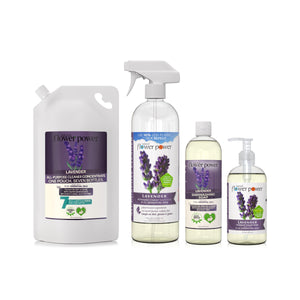
What we make for this



The Cost and Shelf-Life Reality
Let's be specific about money, because this is where the real decision gets made in manufacturing.
Synthetic aroma chemicals cost roughly 90% less than essential oils. A liter of synthetic citrus fragrance might cost $3 to $5. A liter of genuine lemon essential oil costs $40 to $80, depending on the source and purity. When you're formulating at scale, this difference compounds. If your all-purpose cleaner uses 1% fragrance, that's a cost difference of $0.30 per liter for synthetic versus $0.40–0.80 for essential oil. Multiply that across millions of bottles, and you're talking about decisions that affect the entire business economics.
The shelf-life issue is equally real. Synthetic fragrances remain stable for 3–5 years or longer in a properly sealed container. Essential oils degrade faster—typically 1–3 years depending on the specific oil and storage conditions. This matters directly to how we manage inventory. We can't stockpile large quantities of essential oil-scented products the way competitors can. We have to rotate more frequently. We're more exposed to waste if a batch doesn't sell before the oils start degrading noticeably. We have to invest in better storage conditions—temperature control, light protection, sealed containers. All of this costs more than the simple economy of a synthetic fragrance supply chain.
When we choose essential oils, we're choosing a more expensive supply chain, higher carrying costs, and greater inventory risk. We accept that because it's consistent with the decision we made: we're formulating for the people who get reactions from synthetic fragrance compounds, and that decision ripples through every part of how we operate.
What Synthetic Fragrance Actually Hides
Most people don't realize that the word "fragrance" on a label legally conceals up to 50 or more chemicals. A company can list "fragrance" as a single ingredient and never disclose the aroma chemicals, carriers, solvents, fixatives, and preservatives that make up that fragrance blend. Diethyl phthalate (DEP), musks, aldehydes, and other compounds are standard in synthetic fragrance formulations, and they're legal to hide under one word.
For customers with sensitivities, this is the core problem. When they have a reaction, they can't figure out which chemical in the fragrance caused it because the company doesn't have to tell them. They can avoid one brand and switch to another, only to hit the same "fragrance" and get the same reaction. They're essentially buying blind.
By using only essential oils—and naming them specifically on the label—we remove that opacity. Our bottles list "lemon essential oil," "lavender essential oil," not "fragrance." If a customer reacts to our lemon scent, they can identify lemon as the culprit and avoid it with other brands. They're not guessing. That transparency is impossible if you're using synthetic fragrance compounds, because you don't even want your own customers to know what's in the blend.
The Scent Consistency Problem and Why We Accept It
Here's the part that costs us directly: our scents aren't perfectly consistent batch to batch.
When we formulate a lavender-scented hand soap, the lavender essential oil we receive from our supplier varies slightly depending on the growing season, harvest timing, and extraction method. The lavender from May's harvest smells slightly different from the lavender from September's harvest. We blend and adjust, but we're working with a natural product that isn't identical every time. Additionally, the oil oxidizes over time, so a product manufactured in month one and a product manufactured in month twelve will have slightly different scent profiles, even if we use the same oil batch. Neither one is wrong—they're just different.
Synthetic fragrance companies would call this unacceptable. They can ship a synthetic fragrance formula that smells identical across thousands of bottles, across months, across regions. It's one of the key advantages of their system. We don't have that advantage. Our customers who have sensitive noses might notice a subtle shift in our lavender scent from one purchase to the next. Some like this—they appreciate that the scent is real and variable. Others find it frustrating.
We accept this tradeoff because the alternative—using synthetic chemicals we don't believe in—costs more in integrity than it saves in manufacturing consistency. That sounds principled in the abstract, but in practice it means we have to educate customers about this. We have to explain that essential oil variations are normal and actually a sign that the fragrance is real. Not every customer will buy that explanation, and some will switch to a competitor who guarantees perfect consistency. That's the cost of the choice we made.
Free & Clear: The Sensitivity Solution
Even with essential oils only, we realized that some customers—those with multiple chemical sensitivities, MCS, or severe fragrance reactions—wouldn't tolerate any fragrance, plant-derived or otherwise.
So we formulated an entire line without any fragrance at all. Our Free & Clear hand soaps, dish soaps, and all-purpose cleaners contain no essential oils, no fragrance of any kind. They're scent-free. We use the same plant-derived base ingredients, the same preservatives, the same surfactants. We just remove the scent entirely.
This is an important operational point: Free & Clear isn't a compromise or a cheaper alternative. It's a completely separate formulation. For sensitive customers, it's often the right choice. For customers who want a gentle product with a subtle plant-based scent, one of our essential oil-scented options is better. Different people need different things, and pretending one product can serve everyone—or that transparency somehow means "one size fits all"—would be missing the point.
What This Decision Means for You
If you're reading this because you've had reactions to cleaning products, here's what it means operationally: we chose a supply chain that costs us more money and involves more complexity specifically so that sensitive customers could use our products without guessing what might trigger a reaction. We named every ingredient. We limited fragrance to essential oils only. We created a fragrance-free option for people who can't tolerate any scent. We accept inconsistency in scent profile because that inconsistency is a sign of authenticity.
If you're reading this because you're sensitive to cleaning product chemicals and you've been living with the fragrance loophole for years—where you avoid one brand and get the same reaction from another because you can't see what's actually in the fragrance—here's what changes: you can see exactly what scent we're using. You can make an informed decision about whether that specific essential oil is a problem for you. And if all fragrance is a problem, our Free & Clear line gives you access to effective cleaning products without any of it.
This isn't a health claim. It's not a "safe" guarantee. It's specificity. We're being specific about what's in the bottle, and we're asking that specificity be enough to help you make a real choice. For the customers we built these products to serve, it is. For mass-market consumers who expect the cheapest possible price and the strongest possible smell, we're not the fit—and we're okay with that. We're built for a smaller group of people who are willing to accept real tradeoffs in exchange for transparency. That's the decision we made in 2012, and it's still the decision we make every time we formulate a new product.
To understand more about how we think about ingredient selection and manufacturing standards, visit Our Story & Standards. And if you're interested in how to read fragrance on labels more critically, we have a companion guide on what the word "fragrance" actually hides.
