


TL;DR: Tea tree oil has more published antimicrobial research behind it than almost any essential oil, and more overclaiming stacked on top. In a petri dish, most bacteria tested are inhibited at 1 percent or less; in a diluted cleaner on a soiled surface those numbers don't transfer, and the same studies show why — organic matter and surfactants both cut the oil's measured activity. Our products are cleaners, not disinfectants, and we make no germ-kill claim. Tea tree also carries the best-documented pet risk of any common essential oil, and a sensitization profile that worsens as the oil oxidizes. Which is the short version of why we don't use it in anything we make.
Of all the oils people ask us about, tea tree is the one that arrives pre-loaded with expectations: antibacterial, antifungal, antiviral, a mold treatment, a substitute for bleach. Some of that comes from real published work. Most comes from a game of telephone played between supplement blogs, DIY cleaning recipes, and brands that would rather imply a benefit than test for one.
So this article is about the gap. The lab evidence is genuinely there. But the distance between a laboratory result and a bottle of diluted cleaner on your counter is wide enough that we won't pretend to bridge it — the same discipline behind our look at what essential oils actually contribute beyond scent: name the mechanism, then name its limits.
What tea tree oil actually is
Tea tree oil is the steam-distilled oil of Melaleuca alternifolia, an Australian shrub. It isn't one compound but a mixture of monoterpenes whose composition is defined by an international standard, ISO 4730, setting minimum and maximum levels for more than a dozen individual components. The one carrying most of the documented activity is terpinen-4-ol, a terpene alcohol. The standard requires a minimum of 30 percent terpinen-4-ol; the 2006 review in Clinical Microbiology Reviews by Carson, Hammer and Riley — still the reference paper on this oil — puts a typical commercial oil near 40 percent.
That standard exists because Melaleuca alternifolia produces several distinct chemotypes, and only one is the terpinen-4-ol type sold as tea tree oil. An oil labeled "tea tree" without a certificate of analysis against ISO 4730 could be a different chemical animal entirely — which is why how we choose our essential oil suppliers comes down to paperwork more than romance.

What we make for this
The lab evidence is real. It is also a lab.
Here is the honest version of the antimicrobial research. In vitro, most bacteria tested against tea tree oil are inhibited at 1 percent or less, with minimum inhibitory concentrations across the literature spanning roughly 0.03 to 8 percent depending on the organism. Yeasts and dermatophytes are more susceptible, typically 0.03 to 0.5 percent, with a notable exception in the mold Aspergillus niger, which can require up to 8 percent. That's real documented activity, and we're not interested in talking it down.
The fine print comes from the same researchers. A 1999 study asked what happens when you stop testing in clean broth and start adding what the oil meets in the real world. Organic matter at 1 percent or more compromised activity against Staphylococcus aureus and Candida albicans at every oil concentration tested. Non-ionic surfactants shifted minimum inhibitory and cidal concentrations by two or more dilutions, and the proposed mechanism is simple: surfactants form micelles, the oil's lipophilic components get solubilized inside them, and they're partitioned out of the water where the bacteria are.
Read that twice, because it describes a cleaning product. A cleaner is surfactants in water, applied to a surface covered in organic soil. Both conditions shown to blunt tea tree oil's activity are the normal operating conditions of the bottle. Add that the oil sits at a fraction of a percent — a scent-level inclusion, not a therapeutic dose — and the claim that tea tree in a household cleaner is disinfecting your counters is one nobody has tested and we won't make.
Why we make no disinfectant claim
There's a regulatory line here too, and it's a clean one. In the United States, a product claiming to kill or reduce germs, bacteria, or viruses on a surface isn't legally a cleaner — it's a pesticide, regulated by the EPA under the Federal Insecticide, Fungicide, and Rodenticide Act, and it must be registered before being sold with those claims. Sanitizer and disinfectant registrations require demonstrated reductions of named organisms in standardized efficacy tests.
We haven't done that, because we don't make disinfectants. Our products are cleaners: they lift soil, grease, and residue off surfaces so you can rinse or wipe it away. If you need to disinfect — after raw chicken, during an illness in the house — reach for an EPA-registered disinfectant and follow its stated contact time. We'd rather say so than let an essential oil on our ingredient list quietly imply something we can't support, the same discomfort behind what "non-toxic" actually means.
So why would anyone use it?
Two honest reasons, and one we're going to deflate. The first is scent. Tea tree has a sharp, medicinal, camphor-adjacent character that reads as "clean" without smelling like a candle aisle, and it blends well with citrus and eucalyptus. Scent isn't a shameful motive; pretending scent is function is.
The second is solvency, with a caveat. Tea tree oil is a terpene mixture, and terpenes are lipophilic — they dissolve oily soils, which is why terpene solvents have a long history in industrial degreasing. But the terpene doing that job in cleaning products is overwhelmingly limonene from citrus peel, used at levels chosen for exactly that purpose. At the fraction of a percent where tea tree sits in a scented formula, its grease-cutting contribution is real chemistry and a rounding error in practice. The surfactants are doing the cleaning.
The one we'll deflate: tea tree is not a mold remediation product. Inhibiting fungal growth in an assay isn't the same as fixing a mold problem in a bathroom, and one of the molds most often blamed for household trouble is among the least susceptible organisms in the literature. Fix the moisture. Where tea tree oil earns a place in a cleaning formula, it's for scent and character — the properties anyone can actually stand behind — and it belongs named on the label rather than hidden inside a manufactured fragrance oil.
Why it isn't in anything we make
We don't use tea tree oil in any of our products, and we don't sell it on its own. Since we've just spent several sections explaining that the research is real, that deserves a straight answer rather than a shrug.
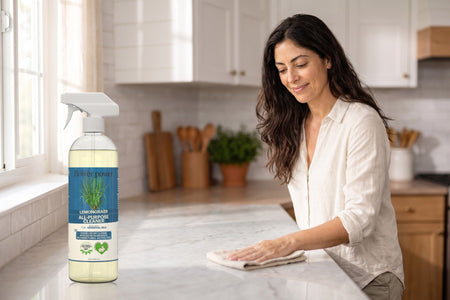
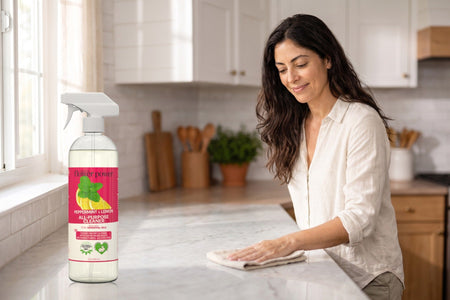
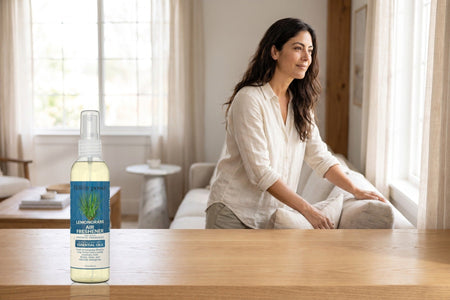
Strip away what the oil can't promise in a diluted cleaner and what's left is scent. That's a legitimate reason to use an essential oil — it's the reason we use most of ours. But scent is a comparison, and on that comparison tea tree loses: it arrives with a moderate-sensitizer classification from the EU's scientific committee, the clearest companion-animal toxicity record of any common essential oil, and an oxidation profile that makes it measurably more allergenic the longer the bottle sits. We can get a clean, bright, recognizable scent from lavender, lemongrass, peppermint, and cold-pressed citrus without carrying that particular set of tradeoffs.
The other half of it is that we'd be buying a reputation. Tea tree's commercial appeal in this category is the implication of disinfection — and we hold no pesticide registration and make no germ-kill claims, so that implication is worth exactly nothing to us. An ingredient whose main contribution is a suggestion we're not allowed to make is an ingredient we don't need. That's the same test we apply to everything in a formula, and it's why how we choose our essential oil suppliers starts with paperwork rather than romance.
If tea tree ever does earn a place in something we make, it will be named on the label for what it contributes — scent — and nothing more.
The pet caution is the best-documented one
Tea tree oil has the clearest published toxicity record of any common essential oil in companion animals, and it comes from poison control data, not speculation.
A retrospective case series in the Journal of the American Veterinary Medical Association in 2014 (Khan, McLean and Slater) reviewed ten years of ASPCA Animal Poison Control Center records, January 2002 through December 2012, and found 443 cases involving undiluted tea tree oil: 337 dogs and 106 cats. In 395 of them — 89 percent — the oil was applied on purpose, by an owner trying to help. Reported signs included drooling, lethargy and central nervous system depression, ataxia, tremors, and partial paralysis, with the most severe cases reaching coma. Signs typically appeared within 2 to 12 hours and could persist up to 72 hours, and cats were more likely than dogs to become seriously ill. No deaths were reported in that series, but "survivable with veterinary care" is not the standard anyone is aiming for.
Cats are the sharper edge of this for a metabolic reason: they lack a liver enzyme pathway other species use to conjugate and clear compounds like these. Pet Poison Helpline draws the line at concentration — pet products formulated below roughly 1 to 2 percent tea tree oil are generally not considered a poisoning concern when used according to their labels, while a few drops of the concentrated oil applied topically or ingested can cause severe poisoning. The danger lives in the little amber bottle, not in a diluted product used as directed.
If you share your home with animals, our guide to safer cleaning around cats, dogs, and other pets covers the routine that matters more than any single ingredient: dilute as directed, let surfaces dry before paws and tongues arrive, ventilate, and keep concentrates out of reach.
Skin sensitization, and why oxidation is the real variable
Tea tree oil is a documented skin sensitizer. The EU's scientific committee on consumer products concluded in 2008 that neat tea tree oil is a sensitizer in humans, and that neat oil and formulations at 5 percent or more can irritate skin and eyes. In its October 2025 opinion, the successor committee called tea tree oil a moderate skin sensitizer while judging it acceptable for specific cosmetic uses at capped levels — up to 2.0 percent in shampoo, 1.0 percent in shower gel and face wash, 0.1 percent in face cream. Routine patch-test clinics report positive reactions in roughly 0.1 to 3.5 percent of tested patients.
The more useful finding is what makes it worse. Tea tree oil oxidizes on exposure to air, light, and heat, and the oxidation products — peroxides, epoxides, and in particular an endoperoxide called ascaridole — carry much of the allergenic load. In a 2014 Contact Dermatitis study, 319 eczema patients were patch tested with ascaridole at 1, 2, and 5 percent, producing positive reactions in 1.4, 5.5, and 7.2 percent respectively; every patient who reacted to oxidized tea tree oil also reacted to ascaridole. Old, badly stored oil is a worse ingredient wearing the same name.
That's a formulator's problem, and we treat it as ours for every oil we do buy: buy against specification, buy quantities we'll actually use, store cool and sealed, and make in batches instead of warehousing finished goods for years. Making everything ourselves in Cameron Park, California — as we have since 2012 — is what lets us know how old the oil in a given batch is.
Where to start
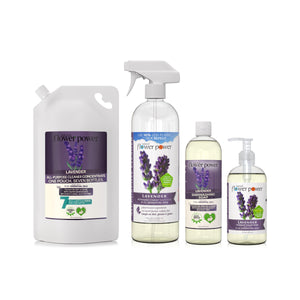
If you want scent from named oils and nothing synthetic, our essential oils collection lists which oils are in each product, so you can check them against anything you've reacted to before instead of guessing behind the word "fragrance." Every oil has its own page in our ingredient library, including the essential oils in cleaning guide.
If you have cats, or anyone in the house reacts to fragrance, start with no added fragrance instead. Our Free & Clear all-purpose cleaner is 99% plant-derived and bio-based, sulfate-free, with no added fragrance and no dyes, and the Free & Clear dish soap is the same idea for the sink. Neither is a disinfectant, and neither pretends to be.
Every NFP product is backed by our 90-Day Love-It Guarantee — if it doesn't work for your household, for any reason, we make it right. That's the only claim we'll make without a study attached.
