


TL;DR: Pets meet cleaning products differently than you do: bare feet on wet floors, a nose inches from the surface, and a tongue that grooms the residue back off. Cats are a real metabolic exception, lacking a liver enzyme other species use to process phenolic compounds, and the families with the clearest documented animal-toxicity records are phenols and pine-oil cleaners, quats, and concentrated bleach. Our scented products use essential oils, several of which appear on veterinary poison-control lists, so for cautious households — especially with cats or birds — we recommend fragrance-free Free & Clear. Nothing is "pet-safe" in an absolute sense; ask your vet about your species.
If you have ever mopped a kitchen floor and turned around to find a cat walking across it, you already understand the problem this article is about. You clean a surface, you leave, and a small animal who cannot read a label walks over it, lies on it, and licks its feet clean.
That is the real exposure route in homes with animals, which makes this less a conversation about what is in the bottle than about the twenty minutes after you put the bottle away. Usefully, this corner of toxicology is well documented: the ASPCA Animal Poison Control Center, Pet Poison Helpline, the AVMA, and the Merck Veterinary Manual all publish checkable guidance. Almost none of it reaches product marketing, where you get the phrase "pet-safe" and no evidence behind it.
Why pets meet cleaning products differently than you do
Grooming. A person who touches a damp counter wipes their hand on a towel. A cat licks the residue off, turning skin contact into an oral dose. Merck names grooming as the reason dermal exposures in cats so often become ingestions.
Proximity. Your nose is five feet above a freshly mopped floor. Your dog's nose is six inches above it, and your cat sleeps on it. Floor products and sprays therefore deserve more thought than a toilet cleaner — the same reasoning we walk through on cleaning products and indoor air quality.
Dose. The same smear of residue is a much larger dose per kilogram for a nine-pound cat than for an adult human, and smaller still relative to a parakeet. That is not a claim about any ingredient; it is how dosing works, and the margin narrows as the animal shrinks.
For scale: the ASPCA Animal Poison Control Center fielded calls about more than 376,000 items pets were exposed to in 2025, household products eighth at 6.4 percent.

What we make for this
Cats are a genuine metabolic exception
Of all the claims circulating about pets and cleaning products, this is the one that holds up best, so the specifics are worth getting right. Cats are deficient in glucuronidation, a phase II liver pathway most mammals use to conjugate and excrete foreign compounds. The gene encoding UDP-glucuronosyltransferase 1A6, the enzyme most species rely on for phenol detoxification, is a pseudogene in the domestic cat, which also lacks UGT1A9. Research in PLOS ONE traced the defect across the Felidae and linked it to the history of an obligate carnivore with little dietary exposure to plant phenolics.
The translation is narrow but important: cats clear phenolic compounds slowly, so a dose a dog would process without incident can accumulate in a cat. The AVMA says it plainly in its household hazards guidance, noting cats can be particularly sensitive to certain ingredients such as phenols, and Merck ties feline sensitivity to phenolic constituents directly to the missing enzyme. Two things it does not mean: that dogs are fine, since they lack the deficiency but are still well represented in poison-control data; and that every plant-derived compound is phenolic.
The ingredient families with documented concern
Here is where the literature gets specific enough to act on. We left out families where we found only speculation.
Phenols and pine-oil cleaners. The clearest case. A Veterinary Information Network article by Dr. Jacqueline Brister and Dr. Sharon Gwaltney-Brant groups phenols, including pine-oil products and some antiseptics, as a class cats are especially sensitive to, with tremors and incoordination among reported signs. If you have a cat, that is the single substitution most worth making.
Quaternary ammonium compounds. Quats are the cationic disinfectants in most sanitizing sprays and wipes, and they have an unusually well-characterized feline record. A 2024 case report in Acta Veterinaria Scandinavica notes cats have long been reported as more sensitive than dogs to quats, with oral ulceration, stomatitis, and pharyngitis observed at concentrations of 2 percent or lower — and the route in that case is the one we opened with: the kitten stepped in the product, then licked itself clean. A review of 245 benzalkonium chloride exposures reported to the UK Veterinary Poisons Information Service found hypersalivation in 53.9 percent and tongue ulceration in 40.4 percent, fatal in 1.2 percent, with onset averaging 6.4 hours and ranging out to two days — so a cat who seems fine at bedtime may not be by morning. More on quats.
Bleach and chlorine. This one is about concentration more than category. Merck describes household bleach as 3 to 10 percent sodium hypochlorite, classifies hypochlorite below 10 percent as a mild irritant, and reserves corrosive injury for products above pH 11 or below 3.5 — the range that includes pool chemicals at 70 to 80 percent. The AVMA notes bleach can disinfect safely when used properly, while listing drooling, vomiting, severe burns if swallowed, and respiratory irritation among the risks if a pet reaches the product. Dr. Tina Wismer of the ASPCA Animal Poison Control Center puts it simply: the more diluted it is, the less toxic it is.
Birds are their own category. Merck attributes their heightened risk to the countercurrent structure and physiology of the avian lung, and states caged birds face an increased risk of death after exposure to fumes from bleaches and other cleaning agents; its bird-owner guidance is blunt that avian respiratory tracts are very sensitive to chemical fumes. The ASPCA advises getting veterinary advice specifically before using cleaning products around birds, which is why we wrote a separate guide on cleaning around birds; there, aerosols and confined spaces are the risk, not just ingredients.
One more that cuts close to home. Merck reports that cats grooming after products containing sodium lauryl sulfate have been applied to their coat can develop moist respiratory sounds, cyanosis, and difficulty breathing within one to three hours, possibly through interference with normal pulmonary surfactant. That literature concerns undiluted products applied directly to an animal, not dish soap on your sink, and we will not stretch it. But we have been sulfate-free since 2012, and this is one more documented context where that ingredient is a problem.
Where we have to be honest: our scented products use essential oils
We sell essential-oil-scented cleaning products, and several of those oils appear by name on veterinary poison-control lists. We would rather say so ourselves.
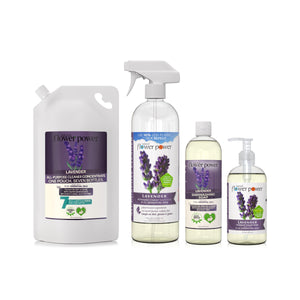
Pet Poison Helpline names wintergreen, sweet birch, citrus (d-limonene), pine, ylang ylang, peppermint, cinnamon, pennyroyal, clove, eucalyptus, and tea tree among oils toxic to cats, plus a shorter overlapping list for dogs. Citrus and peppermint overlap with scents we make, including our Peppermint & Lemon line. Merck sorts it further: birch tar, cassia bark, cinnamon, pennyroyal, and tea tree carry hepatotoxic potential, while birch, cedar, eucalyptus, sage, and wintergreen are associated with seizures. Pet Poison Helpline calls tea tree the most common essential-oil offender in dog toxicities, which is why we keep a page on tea tree oil.
Now the part the alarming version of this story leaves out, because honesty runs both directions. Nearly every documented poisoning in that literature involves concentration and route, not the mere presence of an oil. Pet Poison Helpline's guidance is that concentrated essential oils should never be applied directly to cats or dogs, and that a few concentrated drops can cause severe poisoning — while noting in the same breath that pet products containing less than 1 to 2 percent tea tree oil are generally considered non-toxic when used per label directions. The dose is doing the work.
Diffusers are the other distinction worth internalizing. Merck separates passive diffusers, such as reed and candle types, which mainly cause respiratory irritation unless the oil is spilled, from active nebulizing and ultrasonic diffusers, which emit microdroplets that settle on fur and feathers and set up both dermal absorption and oral dosing when the animal grooms. Continuously aerosolizing oils into a closed room your animals live in is a different act than wiping a counter, and the higher-risk one. More in what essential oils do beyond scent.
So here is our position, which costs us sales and we are publishing anyway. If you have a cat, a bird, an animal with a respiratory condition, or you simply do not want to make this judgment call, use our fragrance-free Free & Clear line instead of a scented one. If you do use scented products around animals, treat them as wipe-off rather than lingering, ventilate, and keep animals off surfaces until dry. And ask your vet: a Maine Coon, a cockatiel, and a rabbit are three different situations.
Habits that matter more than the label
Let surfaces dry before animals return. The closest thing to consensus across every source we checked. The AVMA's guidance is that if a label says keep pets and children away until dry, you should do that. The ASPCA applies the same logic across product types: enzyme cleaners dry before a pet is let back in, diluted vinegar rinsed and dried, bleach diluted, thoroughly rinsed, and the odor allowed to dissipate. Shutting a door for twenty minutes is the highest-yield habit here.
Rinse what mouths touch. Bowls, chew toys, and crate floors are direct-to-mouth surfaces. Wash, rinse with plain water, dry, and treat the rinse as non-optional.
Ventilate, and wipe rather than spray. Open a window or run the fan, and where a trigger sprayer is the tool, spray onto the cloth instead of into the air — especially in small rooms and near a bird.
Store products like medication. The AVMA recommends a secure cabinet out of reach, in original packaging or a clearly labeled, tightly sealed container. Most serious poison-control cases are not residue exposures; they are an animal getting into the bottle.
Know the number before you need it. The ASPCA Animal Poison Control Center runs a 24-hour hotline at (888) 426-4435; Pet Poison Helpline is the other national option. With mean onset over six hours in the quats data, you may notice a problem long after a question would have helped.
Room by room
Kitchen and bathroom. Do floors when animals can be shut out, give counters a plain-water pass if a cat patrols them, and move bowls off the floor first. In the bathroom the hazard is the toilet: a dog who drinks from it after an in-bowl product is drinking the product. Close the lid, or skip those products.
Laundry and litter. Fabric softeners are one place quats show up, and residue sits on bedding your animal sleeps on all night. Pods are a swallowing hazard and belong behind a latch. Wash litter boxes with soap and water, rinse, and dry before refilling; a scented cleaner in an enclosed box is a small chamber your cat then stands in.
Bird rooms. Move the bird elsewhere with the door closed, clean, ventilate thoroughly, and let everything dry before it comes back. No aerosols in a room a bird occupies. Given how fast avian fume exposures escalate, this is the room where we would ask your vet rather than reason from a blog post.
Why we won't call anything "pet-safe"
"Pet-safe" is not a defined or regulated term. Nobody audits it, no threshold has to be met, and it tells you nothing about which species, which route, or which dose. It belongs to the same family as "non-toxic," which we cover in what "non-toxic" actually means, and which mostly functions as reassurance rather than information.
What we can say is comparative and checkable. Our products contain no phenolic disinfectants, no quaternary ammonium compounds, no bleach, and no sulfates, and every ingredient is listed on the product page, so you or your vet can read the actual list instead of trusting an adjective. Our all-purpose cleaners are 99% plant-derived and bio-based. Those are removals of specific documented concerns, which is real. It is not the same thing as safety.
It also matters that our all-purpose cleaners are cleaners, not disinfectants: we make no antibacterial claims and are not registered to kill germs. Most household cleaning is soil removal, so that is usually fine — but if you genuinely need to disinfect, choosing a registered product for a cat or bird household is a conversation for your vet. Ingredient by ingredient, see which cleaning ingredients to avoid in pet households and our ingredient library.
Where to start
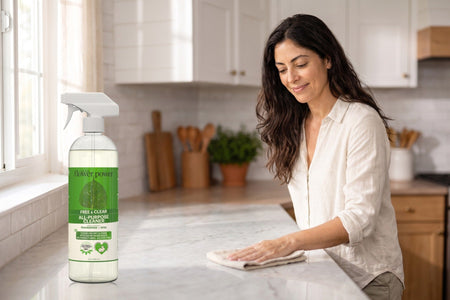
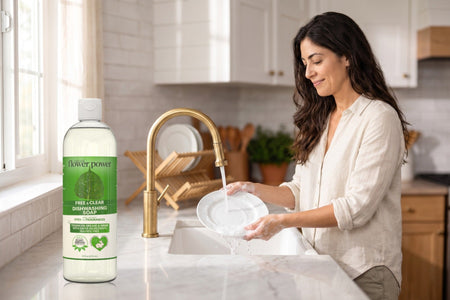
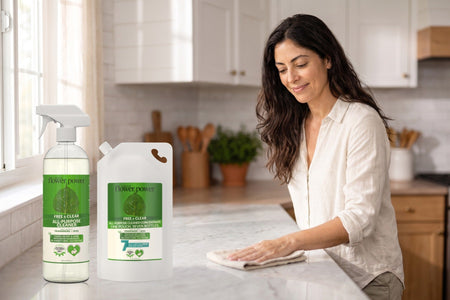
If you have a cat or a bird, or you would rather not make a judgment call about aromatic compounds in a home with animals in it, start fragrance-free. The Free & Clear all-purpose cleaner is what we would swap in first, because floors and counters are where animals make contact, and it is 99% plant-derived and bio-based with no added fragrance. Pair it with the Free & Clear dish soap for bowls and toys, rinsing those with plain water afterward. Our hand soaps include a Free & Clear option too, and the refill concentrates use 78% less plastic than bottles, ready to use after adding water.
We formulate and make everything ourselves in Cameron Park, California, and have since 2012, which is why we can tell you exactly what is in a bottle when your vet asks. Being independently owned means we get to publish an article that talks our own scented line down.
Every order is backed by our 90-Day Love-It Guarantee: if it does not work for your household, animals included, we make it right. And to be direct about the limits of anything written here, we are a cleaning-products company, not your vet. If your animal has a known condition or has already reacted to something, ask your veterinarian before changing what you clean with. If you think an exposure has already happened, call your vet or the ASPCA Animal Poison Control Center at (888) 426-4435.
