


TL;DR: Conventional air fresheners can release dozens of volatile organic compounds, and most of those compounds never appear on the label because US law lets the single word "fragrance" stand in for the whole scent formula. Independent testing has also found phthalates, chemicals used to make scents last longer, in air fresheners that never listed them, including products marketed as "all-natural" and "unscented." Essential-oil sprays are the more transparent option, but they're not risk-free: they're still fragrance, and some households are better off with none at all. And no spray of any kind removes an odor. Find the source first, then decide whether you want to add scent back into the room.
Walk down the air care aisle and you'll see aerosol cans, plug-in warmers, gel cones, and automatic misters, most of them promising something like "fresh linen" or "Hawaiian breeze." What you won't see, on almost any of them, is a full list of what's actually being released into your living room. Air fresheners are one of the least transparent product categories in the home, which is strange when you consider that their entire job is to put chemicals into the air you breathe.
We make essential-oil air fresheners, so we're not a neutral bystander here, and we won't pretend to be. But we can do something most brands in this category can't: walk you through the research on what conventional air fresheners contain, be honest about the limits and tradeoffs of essential oils too, and tell you the one piece of advice that applies no matter whose product you buy. Let's take those in order.
What a conventional air freshener actually releases
The most cited research in this area comes from Dr. Anne Steinemann, an environmental engineering researcher who has spent years running fragranced consumer products through gas chromatography and mass spectrometry to see what they emit. In one widely referenced study published in Environmental Impact Assessment Review, her team analyzed 25 common fragranced products, including air fresheners, and identified 133 different volatile organic compounds (VOCs) being emitted, an average of about 17 per product. In an earlier analysis of six bestselling products, three of them air fresheners, nearly 100 VOCs were identified, and not one of them was listed on any product label.
That matters because of where these products are used. The EPA lists air fresheners among the household sources of indoor VOCs, and its research has found that levels of about a dozen common organic pollutants run two to five times higher inside homes than outdoors, with many VOCs consistently higher indoors regardless of whether the home is in a rural or industrial area. Depending on the compound and the concentration, VOC exposure is associated with eye, nose, and throat irritation and headaches, which is part of why the EPA's general guidance is to choose low-VOC or fragrance-free products where practical, favor pump sprays over aerosols, and ventilate when you use anything that emits.
None of this means a single spritz of a conventional air freshener will harm you. Concentration, ventilation, frequency of use, and individual sensitivity all matter, and the research doesn't support scare headlines any more than it supports the "nothing to see here" position. What it does support is a simpler claim: with a typical synthetic air freshener, you cannot know what you're releasing into your air, because most of it isn't disclosed anywhere. If indoor air is something you think about, and we'd argue it should be, that's a real problem. It's the same reason we wrote about how cleaning products affect indoor air quality: what goes into the air of a closed room deserves more scrutiny than what goes down the drain.

What we make for this


The "fragrance" umbrella: why the label tells you so little
Here's the regulatory gap that makes all of this possible. In the US, no federal law requires companies to disclose the individual ingredients that make up a fragrance. The word "fragrance" (or "parfum") is allowed to stand in for the entire scent formula, which can contain dozens of individual aroma chemicals, and the formula itself is treated as a protected trade secret. We've broken down what "fragrance" actually means on a label before, and the short version is: it's a sealed box, and the manufacturer holds the only key. Often even the brand doesn't know exactly what's inside, because the scent comes premixed from a fragrance house.
There has been movement. California's Cleaning Product Right to Know Act now requires manufacturers of designated cleaning products sold in the state to disclose certain hazardous ingredients and fragrance allergens online (since 2020) and on labels (since 2021), with fragrance allergens disclosed when present at 0.01 percent or more. It's a genuine step forward, and it's telling that it took a state law to force even partial disclosure. But air care products don't all fall neatly under these rules, the disclosure lives mostly on websites rather than the package in your hand, and shoppers in the other 49 states get whatever the manufacturer volunteers.
This is the core of why we don't use synthetic fragrances in anything we make. It's not that every compound in the synthetic fragrance family is dangerous; most people use fragranced products for years without obvious issues. It's that the umbrella term makes independent evaluation impossible. You can't research an ingredient you're never told about, and we don't think "trust us" is an ingredient list.
The phthalate question
One family of chemicals deserves its own section, because it shows exactly how the fragrance umbrella works in practice. Phthalates are a group of compounds used, among other things, as fragrance carriers: they help scents disperse and make them last longer. Because they're considered part of the fragrance, they typically don't have to be listed on the label.
In 2007, the Natural Resources Defense Council tested 14 common household air fresheners and found phthalates in 12 of them. None of the 12 listed phthalates on the label, and the positives included products marketed as "all-natural" and "unscented." Concentrations varied enormously, from trace levels to thousands of parts per million, and the NRDC's concern was primarily about repeated long-term exposure, since some phthalates have been studied for potential hormone-disrupting effects. That study is nearly two decades old now, and some manufacturers have since reformulated, but the structural problem it exposed hasn't changed: the label gave shoppers no way to know which products contained phthalates and which didn't. "All-natural" on the front of the can told you nothing about what was inside it.
If you want the deeper dive on this family, where phthalates show up, which ones are restricted, and what the research does and doesn't say, we keep a full profile in our ingredient library: the phthalates family hub. For this article, the takeaway is narrower: phthalates are the clearest documented example of undisclosed chemistry riding into your home inside the word "fragrance."
Masking vs. removing: the part most air freshener marketing skips
Now for the honest advice, and it applies to our products just as much as anyone else's: an air freshener does not remove odors. Not a synthetic one, not an essential-oil one, not ours. A spray adds scent molecules to the air; it doesn't subtract the molecules causing the smell. If your kitchen smells like last night's fish, a lavender mist gives you lavender-plus-fish, and once the mist settles, the fish is still winning.
Some products claim to "neutralize" or "eliminate" odors with trapping or counteracting chemistry, and there's real chemistry behind some of those claims. But even then, the source is still there, still producing odor. The EPA's indoor air guidance is built around a principle called source control: the most effective way to deal with an air quality problem is to find and remove what's causing it, with ventilation as the supporting act. That principle applies directly to smells.
So before you reach for any spray, including ours, run the short checklist. Take out the trash and rinse the can. Check the garbage disposal, the drain, and the dishwasher filter. Wash the towels and anything the dog sleeps on. Empty the vacuum. Open two windows on opposite sides of the room for ten minutes; moving air does more for a stale room than any product. If a smell keeps returning to the same spot, that's information, and possibly a leak, mildew, or something growing where you can't see it, which no amount of fragrance should be allowed to hide from you.
Once the source is handled, the question changes from "how do I cover this smell?" to "do I want this room to smell like something?" That's a preference, not a problem, and it's the only question an air freshener can honestly answer.
What essential-oil sprays do differently
If your answer is yes, you'd like the bathroom to smell like lavender, the essential-oil route fixes the specific failures we've covered so far, and it's worth being precise about which ones.
First, disclosure. An essential-oil air freshener worth buying tells you exactly which oils are in it: lavender oil, lemongrass oil, peppermint oil, lemon oil. These are single, nameable ingredients with their own research histories, not a sealed umbrella term. If you know you react to a particular oil, you can check for it and choose accordingly, which is impossible when the label says "fragrance." (If you're not sure how essential oils differ from the "natural fragrance oils" that show up on some labels, we've written a plain-English comparison of essential oils vs. fragrance oils, and our ingredient library has a full guide to essential oils in cleaning.)
Second, no phthalates doing invisible work. Our air fresheners are scented with essential oils only, with no synthetic fragrance and no phthalate carriers, and because we formulate and make everything in-house in Cameron Park, California, as we have since 2012, we can tell you what's in the bottle down to the last ingredient. Our air fresheners are 99% plant-derived and bio-based. Not "up to," not "made with natural essences." That's the actual number, and being independently owned with our own production floor is what lets us stand behind it.
Third, the delivery format. Ours are non-aerosol pump sprays, the format the EPA's own guidance nudges consumers toward over aerosols: no propellant gases, no ultra-fine aerosolized mist hanging in the air, just a coarse spray that does its job and settles. A 4 fl oz bottle is over 700 sprays, and a mist or two in a bathroom is the intended dose. This is not a product you fog a room with.
The honest caveat: essential oils aren't risk-free either
Here's where we could stop and let you conclude that plant-derived scent is simply the safe choice. We're not going to, because it wouldn't be true, and this is the tradeoff we accept by selling scented products at all.
Essential oils are still fragrance. Chemically, they're concentrated mixtures of volatile compounds, which means an essential-oil spray also adds VOCs to your air; terpenes like limonene and linalool are VOCs by definition, plant-derived or not. The compounds are named and disclosed, which we'd argue matters enormously, but "disclosed" is not the same as "inert." Some people get headaches from any strong scent regardless of its origin. Essential oils also contain known contact allergens, and those allergens can become more potent as the oils oxidize with age and air exposure. We covered that research honestly in our guide to scented vs. fragrance-free cleaning products, and the same logic applies to air care: for households with fragrance allergies, asthma triggered by scents, or a history of reactions, the right amount of added fragrance may be zero, and no air freshener, including ours, belongs in your cart.
So the comparison isn't "risky synthetic spray vs. harmless plant mist." It's "undisclosed fragrance chemistry vs. disclosed fragrance chemistry, in a category you may not need at all." We think that's a comparison essential oils win on the merits, but we'd rather you make it with clear eyes than buy on a halo.
How to choose, in practice
Put together, the decision looks like this. Start with source control, always; it's free, and it's the only thing that actually removes an odor. If scent-sensitive people share your home, consider stopping there, with fragrance-free cleaning and good ventilation, and skipping air fresheners entirely. That's a complete, legitimate answer.
If you do want scent, choose products that name every scent ingredient, so you can see exactly what you're breathing and skip anything you know you react to. Prefer pump sprays over aerosols and plug-ins; a spray happens when you decide it does, while a plug-in emits continuously into a room whether anyone needs it or not. Use less than you think: the goal is a pleasant trace, not an announcement. And treat any product that hides behind "fragrance" while marketing itself as "natural" with the skepticism the NRDC's testing suggests it has earned.
Where to start
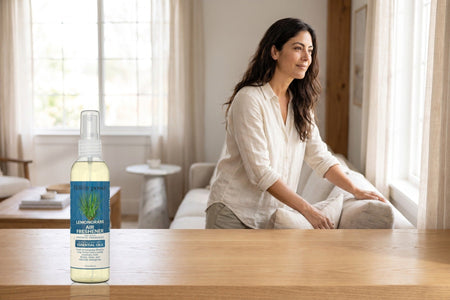
If you've handled the source and still want a room to smell like something worth walking into, our essential-oil air fresheners come in four scents: Lavender, Lemongrass, Citrus & Spice, and Peppermint & Lemon. Each is a 4 fl oz non-aerosol pump bottle with over 700 sprays, scented only with named essential oils, 99% plant-derived and bio-based, with the full ingredient list on every product page. When a bottle runs out, a 16 fl oz refill pouch refills it four times, so the sprayer you already own keeps working instead of heading to a landfill.
Every bottle is covered by our 90-Day Love-It Guarantee: if it doesn't work for your household, whether the scent is too much, not enough, or just not you, we make it right. That's the honest way to try a category this personal: on your terms, in your air, with nothing hidden on the label and nothing to lose if it isn't the right fit.
