


TL;DR: Refilling takes about two minutes per bottle and cuts your cost per ounce by roughly a third on dish soap and more than half on hand soap and all-purpose cleaner, using our current prices. Our hand and dish soap refills pour straight into your empty bottle with no mixing, while the all-purpose cleaner is a concentrate that's ready to use only after adding water — and the bottle itself is the measuring tool, so there's nothing to calculate. Label your bottles, store pouches capped and out of the sun, and remix anything that looks or smells off. The tradeoffs are real but small: a minute of effort, a bottle you have to keep, and a dilution step you might get wrong exactly once.
We've already written about why we offer refills and how the system works — the reasoning, the tradeoffs, and who benefits most. This article is the other half of that conversation: the how. If you've got a refill pouch on the counter and an empty bottle in your hand, this is the walkthrough, product by product, with the dilution details that actually matter and the per-ounce math laid out honestly.
One thing worth saying up front: refilling isn't complicated. The whole process takes about two minutes, and we're spelling out the steps mainly because the two failure modes we see — a soap bottle that wasn't rinsed and a concentrate mixed at the wrong strength — are both completely avoidable. Everything here is made in-house at our facility in Cameron Park, California, where we've been formulating since 2012, so when we describe how a product behaves after refilling, that's direct knowledge, not a guess about someone else's formula.
First, know which kind of refill you're holding
We make two kinds of refills, and they work differently.
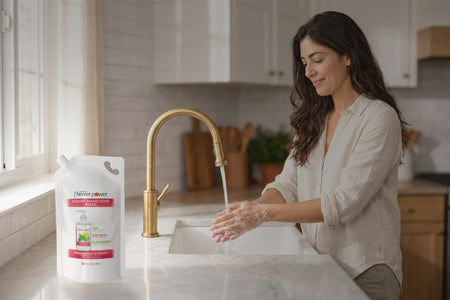
Pour-and-go refills — our hand soap and dish soap refills — are the finished product in a larger pouch. A 66 fl oz pouch with a spout and screw-on cap, containing exactly the same soap that came in your original bottle. Nothing to mix, nothing to dilute. You pour it in and use it immediately. The pouch refills a 12 fl oz hand soap bottle about five times, or a 16 fl oz dish soap bottle about four times.
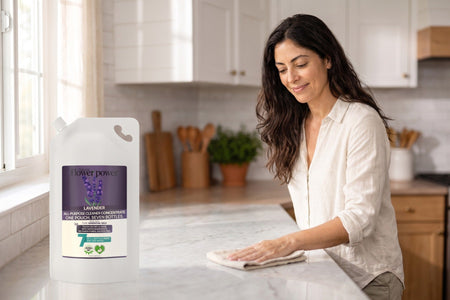
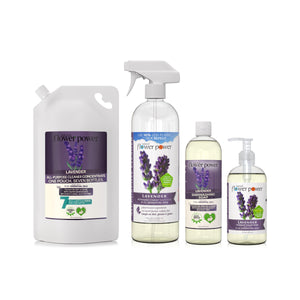
Concentrate refills — our all-purpose cleaner — are a different animal. The pouch holds concentrated formula with most of the water left out, and the product is ready to use only after adding water at home. That's not a footnote; it's the whole design. Shipping water that comes free from your tap is the core inefficiency of ready-to-use cleaners, and we've covered what concentrates reduce beyond plastic — shipping weight, packaging layers, and manufacturing energy across the whole supply chain — in its own article. One 31.5 fl oz concentrate pouch refills your 32 fl oz spray bottle seven times.
The label on the pouch tells you which kind you have. If it says "concentrate," water is part of the recipe. If it doesn't, pour and go.

What we make for this
Refilling hand soap and dish soap, step by step
These are the easy ones:
Step 1: Finish the bottle. Use up what's left rather than topping off — finishing first gives you a clean baseline and makes the rinse step meaningful.
Step 2: Rinse the bottle and pump. Warm tap water, a few swirls, pump some water through the dispenser until it runs clear, and let everything drain upside down for a few minutes. You're rinsing out residue and any grime that's collected around the threads — a soap bottle lives next to a sink, and sinks are not clean places. You don't need to sterilize anything; a thorough rinse is the appropriate level of care for a rinse-off product with a proper preservative system.
Step 3: Pour from the pouch. Unscrew the spout cap, pour slowly until the bottle is filled to its original level — not to the brim, or the pump will overflow when you reinsert it. The spout is designed to pour controllably without a funnel, but if you have shaky hands or a narrow-necked bottle, a small funnel makes this spill-proof.
Step 4: Cap the pouch and put it away. The screw-on cap keeps the remaining soap fresh between refills. Store the pouch upright, somewhere cool and out of direct sunlight — under the sink is fine, a sunny windowsill is not.
That's it — maybe ninety seconds. The soap in your bottle is identical to what a brand-new bottle would contain, because it is the same product from the same tanks.
Refilling the all-purpose cleaner: dilution done right
The all-purpose cleaner concentrate is where people expect complexity, so we designed the complexity out. There are no measuring cups, no ratios to remember, no math at the sink. Your spray bottle is the measuring tool: the label on the bottle marks the fill lines.
Step 1: Empty and rinse your 32 fl oz spray bottle. Same logic as the soaps — finish what's in it, rinse with warm water, drain.
Step 2: Pour concentrate to the bottom edge of the label. Unscrew the pouch cap and fill the bottle with concentrate up to where the label begins. That's the entire measuring step. Then screw the cap back onto the pouch — one pouch is seven refills, and pouring it all in at once is the single most common concentrate mistake.
Step 3: Add tap water to about one inch above the label. Ordinary tap water is exactly what the formula is designed for. Fill slowly to keep foaming down.
Step 4: Attach the sprayer and shake gently. A few slow inversions, not a cocktail shake. Now — and only now, after adding water — it's a full bottle of cleaner, ready to use. Never use the concentrate straight: it's not more effective at full strength, it's just wasteful and can leave residue.
What if you get the dilution wrong? Nothing dramatic. Too much water and the cleaner performs weakly — you'll wipe twice instead of once. Too little and you may see streaking or a slightly sticky film on shiny surfaces, and you'll burn through the pouch faster than seven refills. The formula is buffered to hold the same pH across the intended dilution range, so it's forgiving of label-line imprecision. If your first attempt streaks, add a splash more water and shake again. By the second refill, the whole thing is muscle memory.
Label your bottles
This step gets skipped because it feels fussy — and six months later there are two identical spray bottles under the sink and nobody remembers what's in either, or how old it is. Thirty seconds with a marker prevents this.
On a piece of masking tape or directly on the bottle base, write three things: what's in it (product and scent — and remember our scented line uses names like Peppermint & Lemon, so "P&L dish" is plenty), the date you refilled it, and for the all-purpose cleaner, a tally mark per refill so you know when the pouch should be running out. The tally is more useful than it sounds: if you hit refill seven and the pouch still feels half full, you've been under-dosing concentrate; if it's empty at refill five, you've been over-dosing. The pouch count is a free audit of your dilution habits.
If you decant our products into your own dispensers — a ceramic pump, an amber glass bottle — labeling stops being optional. An unlabeled bottle of anything is a small household hazard. Write down what it is and when it went in.
How long refilled product keeps
The honest answer has two parts, because the two kinds of refills age differently.
The pouches themselves hold finished, preserved product in a sealed container. Capped between uses and stored cool and dark, a pouch you work through over several months is well within its comfortable life. Our formulas rely on a modern preservative system to stay stable — the same category of chemistry we explain in our preservative systems guide — and that system doesn't stop working because the container is a pouch instead of a bottle.
A bottle you've refilled at home is a slightly different situation, and we won't pretend otherwise. Our filling lines are clean in a way a kitchen counter isn't, and once you've mixed concentrate with your own tap water, the product in that bottle is partly your handiwork. The preservative system is designed with home dilution in mind, but the sensible habits still apply: rinse the bottle at each refill, mix one bottle at a time rather than batching ahead, and use what you mix within a few months rather than shelving it for a year. And trust your senses — if a refilled bottle ever turns cloudy, separates, or smells off, don't negotiate with it. Dump it, rinse well, and remix. You'll lose a few cents of product and gain certainty.
None of this is a reason to avoid refilling. It's the same judgment you already apply in your kitchen: reasonable care, reasonable timelines, no heroics.
The math: what refilling actually saves
Here are the numbers, using our own current prices — no hypotheticals. (Prices as of this writing; check the product pages for current figures.)
Hand soap: a 12 fl oz bottle at $8.49 works out to about 71 cents per ounce. The 66 fl oz refill pouch at $18.99 works out to about 29 cents per ounce — roughly 59% less. The pouch refills your bottle five-plus times, so one pouch replaces what would otherwise be five and a half bottle purchases.
Dish soap: a 16 fl oz bottle at $6.99 is about 44 cents per ounce. The same-priced 66 fl oz refill pouch is about 29 cents per ounce — roughly a third less, with four bottle-fills per pouch.
All-purpose cleaner: this is where concentrate math gets fun. The first bottle costs $6.99 and, after adding water, gives you 32 fl oz of cleaner — about 22 cents per ounce. The 31.5 fl oz concentrate refill pouch costs $20.99 and refills that bottle seven times: 224 fl oz of mixed cleaner, or just under $3 per bottle-fill — about 9 cents per ounce once diluted. That's less than half the per-bottle cost of buying new.
Two honest caveats on the math. First, the upfront cost is higher: $18.99 or $20.99 leaves your wallet at once, versus $6.99 for a single bottle. You're pre-buying four to seven bottles' worth, which is only a bargain if you'll actually use it — for a soap you go through monthly, you will. Second, the savings are real but they won't transform your budget; cleaning products are a small line item, and we'd rather you choose refills with accurate expectations than inflated ones. The bigger long-run lever is the one we've written about in the real cost of cheap cleaning products: what a product costs per ounce matters less than what it costs per job done, and per year.
Then there's the part of the math that isn't on your receipt. Our refill pouches use 78% less plastic than the equivalent bottles they replace, and the all-purpose concentrate pushes further — one pouch versus seven new pre-diluted bottles works out to 96% less plastic, because you're not shipping seven trigger sprayers and seven rigid bottles full of water across the country. Lighter shipments mean less fuel burned per ounce of actual cleaning delivered. Those savings are measurable and modest, and they compound with every refill.
The honest tradeoffs
Refilling is a good system, not a magic one. Here's what it asks of you.
It takes effort — a small, recurring amount. Two minutes per refill, plus remembering to reorder before you run dry. If you'd rather finish a bottle, recycle it, and buy fresh, that's a legitimate preference and we say so plainly in the why-refills article.
You have to keep the bottle. The whole model depends on the empty staying in your possession, rinsed and ready. Households short on storage, or people who use products across multiple locations, feel this friction most.
Bottles and pumps wear out eventually. Not quickly — our trigger sprayer is rated for 500,000 squeezes and designed to be refilled for years — but pumps are mechanical, threads wear, and a bottle dropped on tile enough times will crack. When that happens, buy one new bottle and start the cycle again. The system assumes durable containers, not immortal ones.
Dilution errors are possible. The label-line method makes them rare and low-stakes, but "rare and low-stakes" is not "impossible." Your first concentrate refill might streak or underperform while you calibrate. We think a one-time learning curve is a fair price for paying 9 cents an ounce instead of 22, but that's a judgment you get to make, not one we make for you.
If you're weighing all this as part of a bigger change, our guide on how to switch to plant-derived products makes the same argument at the whole-routine level: change one product at a time, when the old one runs out, and let each swap earn the next.
Where to start
Start with whichever product your household empties fastest — that's where the refill habit forms easiest and the math pays back soonest. For most people that's hand soap or dish soap, and the pour-and-go pouches are the gentlest introduction: no dilution, no learning curve. Browse the full lineup in our refills collection, and if you want the system explained end to end — formats, bundles, how the pieces fit — our all-about-refills page walks through it.
If you already own our 32 fl oz all-purpose cleaner bottle, the concentrate refill is the strongest value in our entire catalog: seven bottle-fills for just under $3 each, mixed with water from your own tap in about a minute. Keep the bottle, keep the sprayer, and let the pouch do the traveling.
Every NFP product is backed by our 90-Day Love-It Guarantee — if it doesn't work for your household, for any reason, we make it right. That includes the refill formats: if the pouch, the pouring, or the dilution genuinely doesn't fit your routine, tell us. The point of refills is that they work in your real life, not just in our math.
