


TL;DR: The cheapest cleaner on the shelf is rarely the cheapest one to use. Once you account for concentration and cost-per-use, refills, and the medical bills tied to dermatitis and respiratory irritation, the math often reverses. Shelf price tells you almost nothing on its own. The real comparison is true cost-per-use plus the hidden health and environmental costs a cheap bottle can quietly add over years of daily cleaning.
You reach for the spray bottle under the kitchen sink, notice it's running low, and grab the least expensive option at the store. It's a rational choice in the moment. The bottle costs three dollars less than alternatives, and you reason that cleaning is cleaning: the job gets done, the budget stays intact. This logic holds until your child develops a persistent rash from repeated exposure, or someone in the household develops a chronic cough that takes months to trace back to daily chemical exposure. That's when the actual cost of cheap cleaning products becomes visible.
What looks like savings at checkout is often the beginning of hidden expenses elsewhere. This guide explains where those expenses hide and how to calculate true cost-per-use rather than just shelf price.
Shelf price versus cost-per-use
A conventional all-purpose cleaner might sell for three to five dollars. A plant-derived alternative from Natural Flower Power or a comparable brand runs five to eight dollars. That thirty to thirty-five percent premium catches attention. It's easy to stop the analysis there and conclude that natural products are simply more expensive.
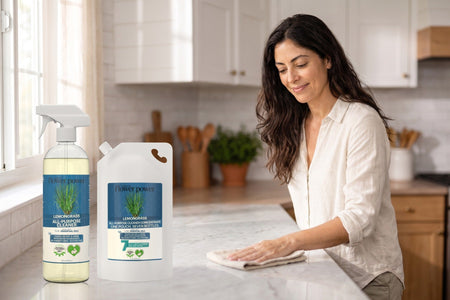
The error is comparing shelf prices rather than cost-per-use. Most ready-to-use conventional cleaners come pre-diluted at maximum concentration for convenience. Many plant-derived cleaners, particularly concentrates, require dilution before use. A concentrate that costs sixteen dollars per gallon, diluted at a 1:128 ratio (one part concentrate to 128 parts water), yields approximately 128 gallons of usable cleaner. That works out to roughly twelve cents per thirty-two-ounce spray bottle, versus three to five dollars for a ready-to-use conventional alternative. When dilution is factored in, the cost-per-use reverses.
This matters because manufacturers typically design concentrated formulas to require less product per application. When we calibrate our concentrates, the goal is to minimize per-use volume without sacrificing cleaning performance, which is part of how we formulate our products. Plant-derived cleaners, when properly formulated, can match conventional products with less volume thanks to higher active ingredient concentrations and efficient surfactants. The combination of lower per-bottle cost and reduced volume per application means the economic advantage often belongs to the plant-derived product.
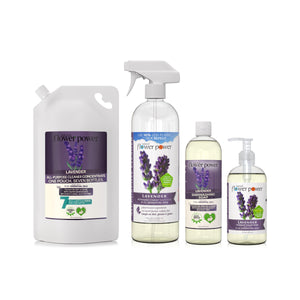
The math shifts further if you use a refill program. We offer refill options precisely because refilling lowers per-unit cost compared to buying a new bottle every time. Over a year of household cleaning, these differences compound.

What we make for this


Health costs that don't appear on your receipt
An average U.S. household spends roughly 800 to 850 dollars annually on housekeeping supplies. That's a legitimate expense, and most families watch it carefully. What's harder to track are the medical costs associated with prolonged exposure to cleaning chemicals.
Contact dermatitis (inflammation of the skin caused by repeated contact with irritants) represents one of the clearest connections between cleaning product ingredients and health outcomes. When we formulate products, ingredient selection is the primary control point for skin reactivity risk, which is why some households find that switching to gentler formulas helps their sensitive skin settle down. Many conventional cleaners rely on harsh synthetic surfactants such as sodium lauryl sulfate, which can strip and irritate skin with repeated contact. The medical data shows the scale of the problem: contact dermatitis is among the most common skin conditions in the United States and carries direct medical costs estimated in the billions annually. In studies of professional cleaners, a meaningful share developed skin allergies or dermatitis. For individuals who develop product-related dermatitis severe enough to require ongoing management, annual treatment costs can run into the thousands, easily exceeding several years of cleaning product spending for most households.
Respiratory effects are more subtle but potentially more consequential, and this is where formulation choices matter most. Many conventional cleaners release compounds that can irritate airway function during application and contribute to sensitization with repeated exposure. A ten-country study of roughly 3,500 individuals found that people using spray cleaners weekly had a meaningfully increased risk of developing asthma over the study period. The compounds most often implicated (quaternary ammonium compounds and sodium hypochlorite, common in disinfectants) are exactly the ones formulation choices can avoid. Asthma treatment is a multi-billion-dollar annual cost nationally, and cleaning-related exposure accounts for a measurable portion of that burden.
These health costs don't appear in household budget spreadsheets. They show up instead as doctor visits, prescription costs, and missed work days. If your child develops respiratory irritation or a family member experiences dermatitis triggered by household cleaning products, the medical expenses can quickly exceed any savings from cheaper bottles.
Why plant-derived ingredients cost more
Understanding cost differences requires knowing where cleaning product ingredients come from. We work directly with plant-derived surfactants, specifically alkyl polyglucosides (APGs) extracted from vegetable oils such as coconut. That choice reveals why plant-derived products cost more. APGs cost roughly two and a half to three times as much as the petroleum-derived surfactants (such as SLES and LAS) used in conventional cleaners. The reason is structural: plant-derived materials carry volatile pricing tied to agricultural cycles and commodity markets, rather than benefiting from the stable industrial supply chains of petroleum refining. The extraction and processing methods are more complex than petrochemical synthesis, requiring specialized equipment and trained technicians. Purchasing power is constrained by agricultural supply rather than the decades of industrial economies of scale that petroleum refining offers. The higher cost is not temporary or market-driven; it's fundamental to how the supply chains work.
This cost structure is not going away. The plant-derived surfactant market is growing, but conventional products still hold the large majority of market share. That scale advantage means petroleum-derived surfactants will remain cheaper for the foreseeable future, unless regulatory pressure or environmental costs shift the economic calculation at the industrial level. For now, the higher ingredient cost is structural, not temporary.
Indoor air quality and hidden environmental costs
Volatile organic compounds (VOCs) are molecules that evaporate at room temperature, and many conventional cleaning products release them continuously. Concentrations of VOCs indoors are often far higher than outdoors, and people spend approximately ninety percent of their time inside. Cleaning products are one of the major household sources of VOCs, competing with paints, air fresheners, and personal care products.
Short-term exposure can cause eye, nose, and throat irritation, headaches, and dizziness. Long-term exposure has been linked to a range of effects, and some VOCs have been associated with more serious health concerns. The risk is elevated for people with asthma or chronic obstructive pulmonary disease, whose symptoms can worsen with VOC exposure.
Plant-derived cleaners formulated without synthetic fragrance and volatile additives release far less to breathe in. This means cleaner indoor air, which is particularly important in households with children, elderly relatives, or anyone with respiratory sensitivity. The benefit is difficult to quantify in dollars, but over years of daily use, the cumulative effect on household air quality is substantial.
Environmental costs are similarly diffused. Many conventional cleaning products contain synthetic surfactants that degrade slowly in anaerobic conditions (deep water, sewage sediments) and can persist in aquatic ecosystems. Detergent and disinfectant residues have been detected in a large share of tested streams, and wastewater treatment removes only a portion of these chemical concentrations. Fish populations, aquatic microbial ecosystems, and photosynthetic efficiency can all suffer from surfactant accumulation. Plant-derived surfactants tend to biodegrade more readily across varying environmental conditions, reducing this burden. For households that factor environmental impact into purchasing decisions, this reduction in aquatic persistence adds another economic argument for plant-derived products, beyond personal health and immediate cost-per-use.
Why ingredient transparency matters
Federal law does not require disclosure of all ingredients in cleaning products, with California being a notable exception after enacting the Cleaning Product Right to Know Act in 2017. That regulatory gap is significant. A brand can often omit ingredients present at very low concentrations, meaning manufacturers may have no legal obligation to list certain allergens or compounds that trigger skin reactions if they're used sparingly. A fragrance allergen might be included at well under one percent and legally withheld from the label, leaving a consumer to discover the sensitivity only through use.
The term "natural" has no enforceable legal meaning in the cleaning industry. A product containing primarily synthetic ingredients with a single plant extract can legally be labeled natural, and consumers have no straightforward way to verify claims. This is exactly the kind of greenwashing worth learning to spot before you pay a premium for a word.
We manufacture all our products in-house at our facility in Cameron Park, California, where we've made everything ourselves since 2012. We control formulation, sourcing, production, and packaging directly. That structural choice means every ingredient is traceable, every batch is consistent, and every claim we make can be verified through our supply chain. We publish full ingredient lists and allergen information, not because federal law requires it, but because our customers (particularly parents making decisions for their homes) need to know exactly what's in the bottle.
This transparency addresses a real cost of cheap alternatives: the risk of switching to a product only to discover it contains an ingredient that causes a reaction. That discovery costs time, money from wasted product, and potentially medical expenses if the exposure was significant. A transparent ingredient list and traceable supply chain eliminate that guessing game.
The total cost of ownership decision
Calculating true cost means assembling several numbers that don't typically appear together. Start with shelf price, adjust for concentration and application volume, add estimated annual health costs based on your household's risk profile, and factor in environmental externalities if that influences your values. For a typical concerned parent household, the calculation usually looks like this:
Conventional products at three to five dollars per bottle, used at full strength because that's how they come, amount to roughly fifteen to twenty-five cents per application for an average cleaning task. Plant-derived concentrates at around eight dollars per bottle, diluted appropriately and requiring less product per use, cost approximately twelve cents per application. The per-use savings looks modest at first: a few cents. Over a year of daily or near-daily cleaning, that's tens of dollars. For a household watching every dollar, those savings matter. For a household with a child prone to skin sensitivity or respiratory irritation, the health cost avoidance matters more than direct cost savings. Either way, the economic advantage shifts when hidden costs are calculated.
Add avoidance of potential dermatitis or respiratory costs, neither of which is certain but both of which are possible. Add improved indoor air quality and reduced environmental accumulation. For a household with a child prone to skin sensitivity or respiratory irritation, the financial case for plant-derived products becomes straightforward. Even for households without those sensitivities, the total cost-per-use is often equivalent or lower, with the added benefit of reduced health risk and environmental impact.
That's the real cost of cheap cleaning products. Not the three dollars saved at checkout, but the hundreds or thousands of dollars in hidden expenses that can accumulate over years of use. When you factor those in, the choice becomes less about preference and more about rational household economics.
How to evaluate and switch
If you're comparing products, start by checking the label for active ingredient concentration or dilution instructions. A cleaner that requires a 1:10 dilution is much more concentrated (and typically cheaper per use) than one that comes ready-to-use. Look for full ingredient lists, including fragrance components. If a product lists only "fragrance" or "parfum," that's a red flag indicating hidden synthetic fragrance chemicals. Ask whether the company manufactures in-house or outsources production, because that affects their ability to verify claims and maintain consistency.
When switching, do it gradually. Replace one product at a time, usually when the old one runs out. This avoids waste, prevents overwhelm, and lets you test whether the new product performs for your specific needs before committing to a full change. Track how long a concentrated product lasts compared to what you'd expect, because that gives you real data on your actual cost-per-use.
Check whether the company offers refill programs. Refills typically cost significantly less than buying new bottles and reduce packaging waste. For deeper understanding of which ingredients actually matter for your household, the Ingredients & Transparency hub breaks down specific compounds and their effects.
Where to start
If you want the simplest way to test the cost-per-use math for yourself, start with a small set that covers most of your cleaning. Our Home Cleaning System starter kit pairs the everyday workhorses (hand soap, dish soap, and an all-purpose cleaner) so you can see how far a concentrate actually goes, and our bundles do the same at a lower per-bottle price than buying singles. When a bottle runs low, our refills drop the per-use cost again while cutting packaging waste, which is where the long-run savings really show up.
Every NFP product is backed by our 90-Day Love-It Guarantee—if it doesn't work for your household, for any reason, we make it right. That's the honest way to run the cost comparison in your own home: try it against your real cleaning, track how long it lasts, and decide based on your numbers, with no risk if it isn't the right fit.
