

Most cleaning companies don't make their own products. They license a formula from a third-party lab, or they contract with a manufacturer who has a catalog of base formulas ready to fill and label. Some of the biggest brands you see in grocery stores are made by a handful of large contract manufacturers on behalf of dozens of different companies. The brands are different. The formulas are nearly identical. The manufacturer handles everything: formulation, mixing, bottling, fulfillment.
We've never done it that way. From the beginning in 2012, we've formulated and manufactured our own products in our own facility — in California from the start, and in Cameron Park since 2017. Everything happens under one roof: the thinking, the testing, the mixing, the quality control, the packaging, and the shipping to customers and retailers. This decision shapes every part of how we operate, what we're able to promise, and what we can know about our own products with absolute certainty.
Why In-House Formulation Matters
When you formulate your own products, you can't hide behind a supplier or a contract manufacturer. If something goes wrong with a batch, you know about it because you made it. If a customer reports a reaction to something they can't identify, you have direct access to every ingredient and every decision that went into that formula. You can explain exactly why each ingredient is there, what it does, and why you chose it over alternatives.
That accountability changes how you think about formulation. We don't start with what's cheap. We start with what works. We test plant-derived surfactants and builders against conventional ones, not to win a marketing argument, but to understand whether the performance gap is real and how wide it actually is. We work with our own skin—washing our hands hundreds of times with different formulas, watching how they feel, whether they leave residue, how long the lather lasts. We bring in customers early, not at the end of a development cycle, but in the middle of it. If something isn't working, we know before we've invested in packaging or labels.
In-house formulation also means we can control the entire supply chain backwards. We know our ingredient suppliers. We can reach out directly if we have questions about sourcing, processing methods, or purity. We're not buying from a catalog of pre-made bases. We're building formulas from botanical extracts and plant-derived surfactants that we've evaluated ourselves.
What we make for this
The Formulation Process: Specificity Over Templates
Our formulation process isn't a straightforward path. It's iterative and granular, which means it's slower than the contract-manufacturer model but far more intentional.
We start with a functional goal: what do we want this product to do? Dish soap needs to cut grease and rinse clean without leaving a film. Hand soap needs to clean without over-drying skin. All-purpose cleaner needs to handle everyday household messes without requiring dilution or excessive effort. Once that goal is clear, we work backwards through ingredients that can deliver it.
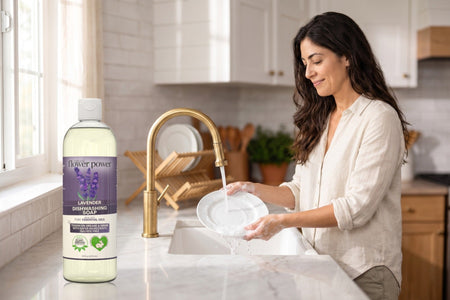
We choose plant-derived surfactants—typically from sugars or coconut oil—because they clean effectively and biodegrade more readily than conventional synthetics. But different surfactants have different properties. Some create voluminous lather. Others rinse more quickly. Some are gentler on skin at the same concentration; others require different pH ranges to work. We test combinations, not just single ingredients. A formula isn't just a list of what to add; it's an understanding of how each ingredient affects the others.
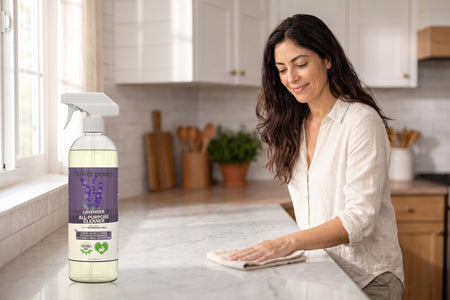
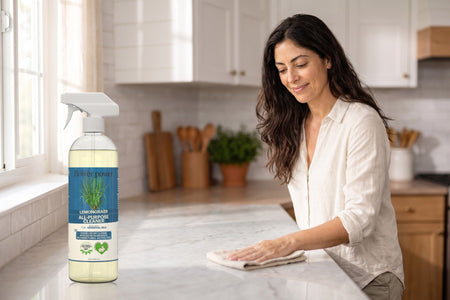
Our all-purpose cleaners, for example, use a combination of plant-derived surfactants and alcohol from corn to dissolve oils and cut through grime. We add water and thickening agents to get the right viscosity so the product spreads without running off surfaces. We use plant extracts where they genuinely serve a purpose—not because they're trendy, but because they improve the formula. Our liquid hand soaps use plant-derived ingredients plus glycerin to maintain skin moisture, and some versions use aloe vera extract because testing showed it reduced post-wash dryness.
None of this is complicated from a chemistry standpoint, but it is time-consuming. Each change to a formula requires new testing. Does it still clean? Does it still feel right? Does it still fit our shelf-life requirements? If we change suppliers for a plant extract, does that change the color or scent subtly enough that we need to reformulate around it?
Small-Batch Production: What It Actually Means
Once a formula is locked—which can take weeks or months—we move into production. Small-batch manufacturing doesn't mean we make ten bottles at a time. It means we produce in quantities that allow us to maintain quality control and freshness while meeting customer demand.
Our team measures and combines ingredients in batches, mixes them to ensure consistency, tests pH and clarity, and then fills bottles. The same people who formulated the product are often the people producing it, which creates a direct feedback loop. If we notice a batch seems slightly different—different viscosity, different scent intensity—we can pause, investigate, and adjust.
This is where the tradeoffs become visible. A large contract manufacturer can produce thousands of liters per day because the process is completely automated and the formula never changes. They achieve economies of scale. We can't. Our per-unit cost is higher because we're not amortizing equipment costs across millions of bottles. Our production run is slower. But we know every batch. We see quality issues before they reach customers.
Shelf life is also a real constraint. Essential oils oxidize. Plant-derived surfactants don't have the same synthetic preservatives, so we use natural alternatives and limit shelf life accordingly. This means we can't produce six months of inventory in advance. We make what we need when we need it. That limits our growth speed, but it ensures that when someone buys our products, they're buying them at peak freshness.
Quality Testing: Accountability Built In
Before a batch ships, we test it. We check pH to ensure it's in the safe range for skin contact. We verify clarity and consistency. We smell it—genuinely, not as a marketing exercise—to make sure the essential oils haven't oxidized. We test cleaning performance against our own benchmarks. An all-purpose cleaner needs to actually cut through oil and grime, not just smell like it did.
We also document everything. Every batch has a record of which suppliers' ingredients went into it, when it was made, what tests it passed, what the results were. If a customer ever reports an issue, we can trace it back to the specific batch, the specific suppliers, the specific production date. We can explain what happened.
This kind of traceability is standard in industries like pharmaceuticals and food, but it's rare in cleaning products because most companies don't have direct control of their supply chain. They're buying from a contract manufacturer who's buying from ingredient suppliers who are buying from processors. By the time a problem surfaces, the trail is too long to trace quickly.
Packaging and Fulfillment: The Final Accountability Layer
We fill and package our products ourselves. We label them. We pack them into boxes for retail and direct-to-consumer orders. The same facility handles everything. That means if packaging breaks during shipment, we know immediately. If a label falls off, we see it. If inventory numbers don't match, we can audit the entire trail.
We also handle our own fulfillment to customers who buy direct through our site and our retail partners. We've built refill relationships with some of our retailers, so they can return empty bottles that we collect and refill. This kind of closed-loop system only works if a single company controls both ends of it.
Again, the tradeoff is obvious. Fulfillment at scale usually gets outsourced to third-party logistics companies because that's how you achieve warehouse automation and low shipping costs. We haven't done that, which means our overhead is higher and our scaling is slower. But we also control the entire customer experience, from the moment a product leaves our facility to the moment it arrives at someone's home.
The Business Model Constraint: Growth vs. Control
This entire structure—formulation, manufacturing, packaging, fulfillment in-house—makes us slower to grow than companies that outsource. A brand that licenses formulas and uses contract manufacturers can expand to ten new product lines in a year because they're just changing labels and placing orders. We expand when we've formulated something we believe in, tested it thoroughly, and confirmed we can produce it consistently in our facility.
Our per-unit costs are higher. We can't compete on price with mass-manufactured alternatives. We've never tried to. We compete on specificity: we know our products intimately, we can explain every choice, and we can back it up with traceability and consistency.
We also accept that this model limits our reach. We're in 700+ retail locations across the US, which is substantial, but we're not on every shelf. That's intentional. Our growth strategy is built around customers who value what vertical integration enables—transparency, accountability, consistency—not around becoming ubiquitous.
Why This Matters When You Buy From Us
When you buy a Natural Flower Power product, you're buying something made by a company that owns the entire process. We can tell you exactly which surfactants we use and why we chose them over alternatives. We can explain what happens in our facility and why. We can hand you a refill option because we're the ones filling it. We can acknowledge that plant-derived ingredients have tradeoffs—shelf life, oxidation, batch-to-batch variation in essential oils—because we're not hiding behind a manufacturer's claims.
You can read more about our standards and how we think about formulation decisions in our Our Story & Standards page. And if you want to see how ingredient transparency shows up in practice, we've written extensively about specific ingredients: what we put in our products goes into detail about our surfactants, and why we don't use synthetic fragrances walks through that specific decision.
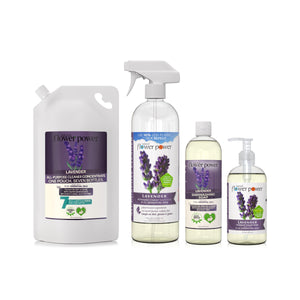
Our product lines are built around this philosophy. Our liquid dish soaps, liquid hand soaps, and all-purpose cleaners all reflect the same commitment: plant-derived, formulated in-house, produced in-house, and backed by the people who made them.
The choice to make your own products instead of licensing formulas or outsourcing manufacturing isn't efficient. It's intentional. It costs more per bottle. It limits how fast we can grow. And it gives us the ability to stand behind everything we make with the specificity and confidence that only comes from making it yourself. That's the process behind the bottle.
