

When we started Natural Flower Power in 2012, we didn't have a choice about manufacturing. We had a small facility in Cameron Park, California, and the decision to make products ourselves wasn't strategic—it was just the only way forward with the capital we had. You don't outsource when you're bootstrapped. You make things yourself.
Fourteen years later, when outsourcing would actually make business sense, we're still making everything ourselves. That's not nostalgia. That's a deliberate structural choice that shapes every decision we make, and it means trading off scale for control in ways that matter to how we operate.
What "In-House" Actually Means
In-house manufacturing for a cleaning products company means we handle every step of the journey from raw ingredient to finished product on your shelf. We source plant-derived base materials and essential oils. We test formulas in our own lab space, running stability tests and performance trials. We manufacture the actual product—mixing, heating, testing again. We package it into bottles. We manage inventory. We fulfill orders and ship them out. It all happens in one facility, under one operational structure, with one team understanding the entire system.
This is not the industry standard. Most cleaning brands—especially the ones marketed as "natural" or "sustainable"—outsource manufacturing to contract facilities. The brand company designs a formula, sends it to a manufacturer, the manufacturer makes it at scale, and the finished product comes back with the brand's label applied. It's economical. It's fast. It's how the category works.
We don't do that. The tradeoff is built into how we operate.
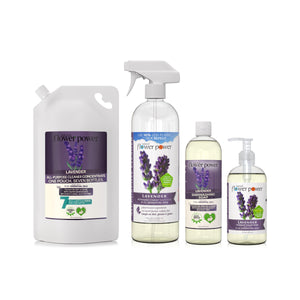
What we make for this



Why Most Brands Don't Manufacture In-House
Contract manufacturing exists for good reasons. If you want to scale quickly, outsourcing is the logical move. A manufacturer with a shared facility can spread fixed costs across dozens of brands, which means per-unit costs stay low even on modest production volumes. They have economies of scale that a single-brand facility can't match. They have technical expertise in large-scale production, mixing systems, quality testing equipment, and regulatory compliance that a small company would have to build from scratch.
More importantly, outsourcing frees up capital. Manufacturing facilities are expensive. Equipment is expensive. Quality testing is expensive. Regulatory expertise is expensive. If you're a brand focused on marketing and distribution, outsourcing lets you redirect that money into growth, advertising, and developing new products. The mathematics are clear: outsource, grow faster, build market share, then scale back to in-house production once you're large enough to justify the investment.
We run the opposite calculation. Fast growth isn't the goal. Understanding exactly what's in every bottle, and knowing why every decision was made, is worth the cost of staying small.
What In-House Manufacturing Actually Gives Us
Ingredient traceability. We know where every ingredient comes from because we sourced it ourselves and watched it arrive at our facility. When a customer asks whether our coconut-derived cleansing agent is actually from coconuts or synthesized in a lab, we don't have to call a manufacturer and wait for an answer. We know. We have the supplier documents. We have the testing data.
Formula control and iteration. In 2015, we realized our original hand soap formula was leaving some customers' hands feeling tight. We adjusted the ratio of conditioning agents, ran stability tests, and had a revised formula in production within weeks. That speed of iteration—being able to identify a problem, adjust the formula, test it, and implement the change without involving a contract manufacturer's schedule—is core to how we improve products.
Batch-level transparency. Every batch of product we make gets tested and logged. We have records of what's in that specific bottle, when it was made, what the test results were. If a customer calls with a concern, we can pull data on that specific production run rather than relying on a manufacturer's records. That level of detail matters for sensitive customers who are trying to identify triggers.
Honest constraint. When we can't scale past our facility's capacity, that's a real limitation. But it's also clarifying. We can't promise overnight growth. We can't chase every retail opportunity. We make what we can make, we sell what we make, and if demand exceeds supply, we restock when production allows. That honesty—not overpromising and then disappointing—builds a different kind of trust than a company that contracts with manufacturers and assures customers of unlimited supply.
The Real Costs We Accept
In-house manufacturing means slower growth. When a retailer wants to add our all-purpose cleaner to 500 locations and we're already running at 85% capacity, we can't suddenly triple production. We can talk about it next year, maybe. For a company trying to maximize growth and market share, this is a dealbreaker. For us, it's a feature, not a bug—but it's still a cost.
It means higher per-unit production costs. A contract manufacturer spreading costs across ten brands can price ingredients and equipment usage at a fraction of what a single-brand facility pays. Our all-purpose cleaner costs more to make than an equivalent outsourced product. Some of that cost gets passed to customers. Some of it is just absorbed as a margin pressure we choose to live with.
It means we're geographically constrained. We're in Northern California. Our facility is here. Logistics costs for shipping heavy liquid products to the rest of the country are real and growing. A company with multiple contract manufacturing partners could have facilities on different coasts, optimizing shipping and response time. We have one facility.
It means staffing a facility through slow seasons. When demand dips in summer, we still need people. We still need to maintain equipment, run cleaning cycles, keep everything operational. A contract manufacturer can adjust capacity with demand. We can't, not at our scale. That overhead is a real cost.
None of this is offset by some hidden advantage. In-house manufacturing doesn't make products inherently better. It doesn't make them cheaper. It's expensive, it's constraining, and it limits how fast we can grow. We do it anyway because we believe the operational transparency and quality control are worth the constraint.
What This Means for You
When you buy a Natural Flower Power product, you're buying something made by people who can tell you exactly why it's formulated the way it is, because they made that choice. You're not buying a product that was designed remotely and then manufactured by someone else following a specification. You're buying something from a company that owns the entire operation.
That means there's no gap where mistakes hide. There's no contractor to blame. There's no "the manufacturer changed something" excuse. If something's different, we know why. If something needs to change, we change it ourselves. We can iterate faster on product quality than outsourced competitors, and we can do it without involving contract negotiations or minimum order volumes from manufacturing partners.
It also means we're honest about constraints. We can't promise unlimited supply. We can't guarantee the same price in five years if our facility costs go up. We can't scale as fast as venture-backed startups that outsource everything and burn through capital on growth. We grow as fast as we can afford to, using profit to invest in the business rather than using outside funding to artificially accelerate.
If you're looking for a brand that grew 300% in the last year and is expanding into thirty new retail locations, we're not it. If you're looking for a brand where someone actually formulates the product you're using, knows every ingredient, can explain the tradeoffs in the formula, and stands behind the choice to manufacture it in-house—that's us. Our website is full of this kind of detail. Our Story & Standards page covers our approach to sourcing, standards, and quality. Our dish soap line, hand soap line, and all-purpose cleaners are all made here. The choice to keep manufacturing in-house shapes every product we make.
In-house manufacturing isn't a marketing angle for us. It's how we ensure that the products we're willing to put our name on actually meet the standard we set. It costs us growth. It costs us margin. It costs us the ability to respond instantly to every opportunity. And we do it anyway, because the alternative—outsourcing to optimize for speed and scale—would mean accepting someone else's judgment about what happens to the ingredients we care about. For a company built on the belief that these decisions matter, that trade isn't worth it.
