


TL;DR: Most cleaning damage to natural stone isn't from scrubbing too hard; it's from pH. Acidic cleaners like vinegar and lemon juice etch calcium-based stones such as marble, and harsh alkaline products like ammonia and bleach can dull surfaces over time. Granite and true quartzite tolerate far more, but the stone-care playbook is the same for all of them: a mild cleaner and warm water for daily wipe-downs, quick attention to spills, and no acids, bleach, or abrasive powders. Our own cleaners contain a small amount of citric acid, so we'll tell you exactly what that means for stone instead of slapping a "granite-safe" badge on the bottle.
"Is this safe for granite?" is one of the most common questions people type into a search bar before buying a cleaning product, and it almost never gets a straight answer. Brands either dodge the question or stamp "safe on stone" on the label without explaining what that means. Meanwhile, the internet's favorite DIY advice, a spray bottle of vinegar and water, happens to be one of the most reliable ways to ruin certain countertops.
The confusion is understandable, because "natural stone" isn't one material. Granite, marble, quartzite, limestone, and travertine behave very differently under the same cleaner, and the difference comes down to what the stone is made of and how the cleaner's chemistry interacts with it. This guide walks through that chemistry in plain language: why pH matters more than scrubbing power, how the major stones differ, what sealing actually changes about your routine, and, honestly, where our own products fit and where they don't.
Why pH is most of the story
There are three ways a cleaning routine damages stone: etching, scratching, and staining. Scratching is mechanical, which is why abrasive scouring powders are off the list. Staining is absorption, which is what sealing addresses. Etching is the one people misunderstand, and it's the one where your cleaner's pH does the damage.
Etching is a chemical reaction, not a stain. Stones built on calcium carbonate, primarily marble, limestone, and travertine, react with even mild acids. Lemon juice, vinegar, tomato sauce, wine: each one dissolves a microscopic layer of the polished surface on contact. The result is a dull, lighter mark that no amount of cleaning will remove, because nothing is sitting on the stone; the stone itself has been eaten away. Stone-care guidance from the Natural Stone Institute is blunt about this: products containing lemon, vinegar, or other acids can dull or etch calcareous stones, and fixing an etch means refinishing the surface, not cleaning it.
The other end of the pH scale isn't automatically better. Strongly alkaline cleaners, the category that includes ammonia and bleach, don't trigger the same fizzing reaction with calcium carbonate, but the Natural Stone Institute notes that frequent use of ammonia solutions can eventually dull the surface of some stone types, and industry guidance is consistent that stone cleaners should contain neither acid nor bleach. Harsh alkalinity is also hard on the sealer that's protecting the stone, which we'll get to below.
That's why nearly every fabricator and stone-industry body lands on the same recommendation: for routine cleaning, use a neutral or near-neutral cleaner, a stone soap, or a mild dish soap in warm water. Not because stone is impossibly delicate, but because the pH extremes on both ends are where the damage lives.

What we make for this
Granite, marble, and quartzite are not the same stone
Here's where the "safe for granite" question gets its real answer, because the three most popular countertop stones sit in very different places on the vulnerability scale.
Granite is an igneous rock made mostly of quartz and feldspar, silicate minerals that don't react with household acids the way calcium carbonate does. This is why granite earned its reputation as the practical kitchen stone: a splash of lemon juice wiped up promptly is unlikely to leave a mark. That resistance isn't invincibility, though. Acidic spills left sitting for extended periods can still mark some granites, and the resin treatments and sealers applied to many slabs are less acid-tolerant than the stone itself.
Marble is the opposite case: it's calcium carbonate through and through, and it reacts to acids as mild as sliced tomatoes. If you own polished marble, assume every acidic cleaner and most "natural DIY" recipes are off the table permanently. This is chemistry, not fussiness.
Quartzite is the interesting one. True quartzite is a metamorphic rock formed from sandstone, made of quartz, extremely hard (around 7 on the Mohs scale, harder than granite), and resistant to acid etching. The catch, documented in the Natural Stone Institute's own technical bulletin on quartzite, is that slabs are commonly mislabeled: some stones sold as "quartzite" are actually marble or dolomitic marble, which etch readily. The industry's own test is refreshingly simple: a drop of vinegar on an inconspicuous spot or offcut. True quartzite won't etch; a mislabeled slab will. If you're not sure what you own, that one test on a hidden edge tells you more than the receipt does.
The practical takeaway: if you know you have real granite or true quartzite, you have more margin for error. If you have marble, limestone, travertine, or a "quartzite" you've never verified, treat every cleaner as guilty until proven innocent, and prove it on a hidden spot first.
What sealing actually does (and doesn't do)
Sealing is the most misunderstood part of stone care, mostly because people assume a sealed countertop is a protected countertop. It's protected against exactly one thing: absorption.
Most countertop sealers are impregnating sealers. They soak into the stone's pores and make it much harder for water, oil, and staining agents to penetrate below the surface, which is what buys you time to wipe up the red wine before it becomes a permanent souvenir. The Natural Stone Institute suggests that a quality sealer should repel both water- and oil-based stains and have a life expectancy of ten to fifteen years, though real-world resealing intervals vary with the stone and the product; your fabricator's guidance beats any rule of thumb.
What sealers do not do is prevent etching. An impregnating sealer lives inside the stone; etching happens on the polished surface above it. Acid on sealed marble etches just as surely as acid on unsealed marble. This is the single most common false sense of security in stone care.
Sealing changes your cleaning routine in one more way: the sealer itself is now part of what you're maintaining. Harsh cleaners, strong alkalis, and solvents can degrade a sealer faster than the stone around it, which quietly shortens the interval before water starts soaking in again. A mild, well-rinsed cleaning routine protects the sealer along with the stone. If you notice water no longer beads on the surface and instead darkens the stone quickly, that's a reasonable prompt to ask your fabricator whether it's time to reseal.
The daily routine (and the deep clean)
Day to day, stone care is genuinely simple. The Natural Stone Institute's recommendation for routine cleaning is a neutral cleaner, stone soap, or a mild liquid dishwashing detergent with warm water, applied with a soft cloth. Wipe, rinse, dry. That's the whole ceremony.
Two details make the difference between a routine that works and one that slowly builds problems. First, less soap than you think: stone-care guidance specifically warns that too much cleaner or soap leaves a film and causes streaks, so a little product and a thorough rinse beat a heavy spray-down. Second, speed on spills. Even on sealed granite, the sooner citrus, wine, tomato, coffee, and oil come off the surface, the less chance they have to mark either the stone or its sealer. Blot rather than wipe, so you're not spreading the spill across more surface area.
For heavier kitchen messes, the answer is more dwell time and more passes with the same mild chemistry, not a stronger bottle. Grease films around a cooktop come off with surfactants, which surround and lift oily soil so it rinses away; we've written about how surfactants actually clean and whether plant-derived cleaners handle grease, and the short version is that patience plus a mild surfactant beats aggressive chemistry on stone every time. The same logic drives our approach to deep-cleaning a kitchen without harsh chemicals: let the cleaner sit and work, then rinse well so nothing is left behind on the surface.
What to keep away from stone
The avoid list is short and specific, and every item on it earns its place for a concrete reason.
Vinegar, lemon, and acid-based cleaners. These are etching agents on marble, limestone, and travertine, full stop. On granite and true quartzite they're less immediately dangerous, but they gain you nothing over a mild cleaner and they're hard on sealers, so there's no upside to using them on any stone.
Abrasive powders and scouring creams. Stone-care guidance warns that scouring products often contain abrasives that can scratch softer stones, and scratches in a polished surface scatter light the same way etching does: as a dull patch you can't clean away.
Bleach. Industry guidance says stone cleaners should never contain bleach, and sodium hypochlorite brings its own baggage anyway: it's corrosive, it's hard on sealers, and it solves a disinfection problem that a countertop wipe-down usually doesn't have. Marble shows up in bathrooms as often as kitchens, and the same reasoning behind cleaning a bathroom without bleach applies doubly to a marble vanity top.
Ammonia. Occasional use won't destroy anything, but frequent use can gradually dull some stones. And never combine it with bleach; the two react to form toxic gas, a warning the Natural Stone Institute prints in bold.
Rust removers. The sleeper hazard on this list. Many contain hydrofluoric acid, which attacks silicate minerals, meaning it damages every kind of stone, including granite. If a stone surface has a rust stain, that's a call to a stone professional, not a hardware-store bottle.
Where our cleaners honestly fit
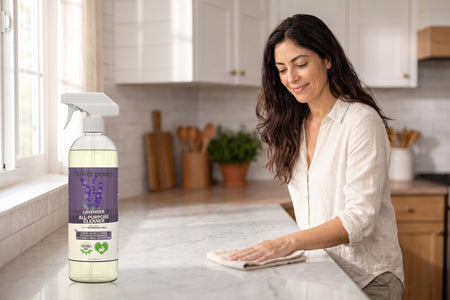
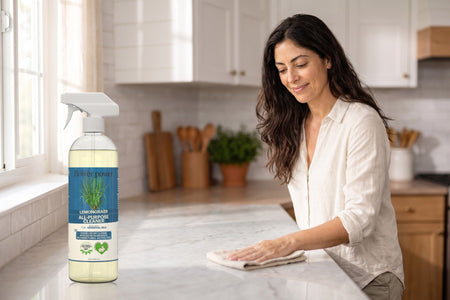
Now the part most brands skip. We make surfactant-based cleaners: our all-purpose cleaner is 99% plant-derived and bio-based, built on gentle sugar-based surfactants like decyl glucoside rather than harsh alkalis, solvents, or bleach. Nothing in the formula belongs to the categories that stone care warns about most loudly. By the logic of everything above, that puts it in the mild end of the spectrum where stone cleaning should live.
But here's the honest wrinkle: citric acid appears in every one of our formulas, including the all-purpose cleaner. It's there as a pH adjuster, at a small fraction of the formula (typically well under 1 percent in finished products like ours), keeping the surfactants and preservative working in their proper range. That is a very different thing from a vinegar spray or a citric-acid descaler, where acid is the active ingredient. Still, it means we won't tell you our cleaner is chemically identical to a dedicated pH-neutral stone soap, because it isn't quite, and pretending otherwise is exactly the kind of vague label copy we criticize.
So here is our actual guidance, the same thing we'd tell a friend. On granite and verified quartzite, a mild surfactant cleaner used normally, sprayed, wiped, and not left to pool, is the use case these stones handle comfortably. On polished marble, limestone, or travertine, be more conservative: if you want zero acid content of any kind touching the surface, a dedicated stone soap or plain warm water is the strictest answer, and we'd rather say that plainly than oversell. In every case, spot-test first in an inconspicuous corner, ours included, and treat your stone fabricator's care instructions as the final word over any label, because they know your specific slab, its sealer, and its finish. We don't claim our products are stone-certified or sealer-safe in absolute terms; no honest brand can, because "stone" covers too many different materials.
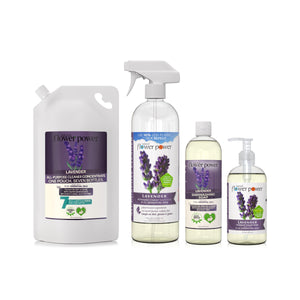
One more practical note: our refill concentrates are ready to use only after adding water, and dilution matters on stone. A properly diluted mild cleaner, rinsed after use, is a very different exposure than concentrate sitting on a surface. Follow the dilution directions, and rinse; that habit protects the sealer as much as the stone.
Where to start
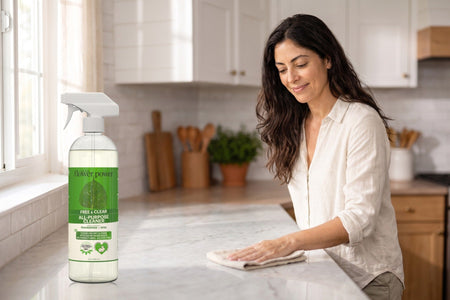
If your counters are granite or verified quartzite and you want one bottle for the kitchen, start with our all-purpose cleaners. The Free & Clear all-purpose cleaner is the simplest place to begin: no added fragrance, no dyes, gentle plant-derived surfactants, and a full ingredient list on the page, so you can check every component against your fabricator's care sheet before it ever touches the stone. Spot-test in a hidden corner, use it with a soft cloth, and don't let any cleaner pool on the surface.
If you're the type who wants to know what every ingredient is doing before it meets a surface you paid thousands of dollars for, and on this topic that's the right instinct, our ingredient pages document each component in every formula, including the citric acid discussed above, with sources.
And every NFP product is covered by our 90-Day Love-It Guarantee: if it doesn't work for your household or your countertops, for any reason, we make it right. Stone is a long-term investment; the cleaner you use on it should be the easiest, lowest-risk decision in the room.
