


TL;DR: When you buy a ready-to-use spray, you're mostly paying to ship water — RTU products are 90 to 98 percent water. Concentrates strip that water out before shipping, which cuts transportation emissions, manufacturing energy, and packaging layers across the whole supply chain, not just the bottles in your trash. The catch is dilution: the environmental benefit only materializes if the product actually gets used, which is why a refill you add to a bottle you already own is the format that drops the friction to zero.
When you buy a ready-to-use trigger-spray cleaner, you're paying to ship water. Most RTU products are between 90 and 98 percent water, which means you're loading bottles full of something that comes out of your tap at home. A single truckload of concentrate equals roughly 17 trucks of standard 32-ounce RTU bottles. This isn't a feature difference — it's a fundamental inefficiency in how the cleaning products industry has chosen to operate for decades.
We've been making concentrated cleaners since we started formulating in 2012, not because concentrates were trendy, but because manufacturing in-house gave us the ability to control what we shipped and why. Over the past decade, we've watched customers use concentrates in ways that matter: fewer trips to the store, longer-lasting bottles, and a measurable reduction in the amount of plastic entering the household. But plastic reduction is only part of the story. The environmental case for concentrates runs through the entire supply chain, from the weight in trucks to the energy required to fill bottles in the first place.
The weight problem with ready-to-use
Start with transportation. A standard all-purpose cleaner at retail is typically 24 to 32 ounces of mostly water, packaged in plastic with a label and a trigger spray. Concentrated cleaners remove that water before shipping. Since water is heavy and takes up space, this changes everything about logistics.
Independent lifecycle analyses estimate that concentrated products can reduce the carbon footprint of cleaning products by up to roughly a third when measured by what actually matters: the amount of cleaning you get from what you buy, not the weight of a single bottle. This isn't a theoretical number. It comes from comparing how many surfaces one bottle of concentrate cleans versus how many surfaces you'd need to buy if you went RTU. When you factor in manufacturing emissions, packaging materials, and fuel burned moving these products across the country, the advantage flips decisively. A concentrate reduces carbon emissions because you're not paying to move water thousands of miles.
We see this directly at our Cameron Park, California facility, where we've made everything in-house since 2012. When we ship a gallon of concentrate, it replaces a large multiple of the RTU bottles you'd otherwise buy for the same amount of cleaning. That concentration means one pallet of our product does the work that would require many pallets of standard RTU bottles. Those saved pallets represent fuel that stays in the ground and carbon that doesn't enter the atmosphere.

What we make for this



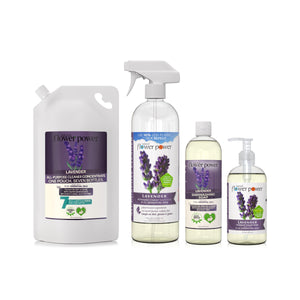
Plastic reduction happens earlier in the supply chain than you'd think
The conversation about plastic usually focuses on what you throw away. Consumers see a concentrate bottle and assume the savings come from having fewer bottles in the trash. That's real, but it's the obvious part. The material savings actually compound across the entire production and distribution chain.
Consider all the packaging layers involved in a single RTU product: the plastic bottle itself, the label, the trigger spray mechanism, the box it ships in, the secondary packaging for retail display, sometimes even the corrugated case. Each of those gets manufactured, warehoused, and transported. When you concentrate the product, you reduce or eliminate some of those layers entirely. One concentrate bottle can serve the same function as dozens of RTU bottles. The label area is smaller. The trigger mechanism might be simpler. The secondary packaging for refills might be a lightweight pouch instead of a rigid bottle.
The direction is consistent across the industry: concentrate systems use dramatically less plastic than RTU products, with the exact figure depending on formulation choices and refill format. Every concentrated product shipped saves multiple layers of plastic that never have to be manufactured, printed, or moved.
We don't outsource manufacturing to a distant facility and then run a separate supply chain for refills. We formulate, fill, and ship everything from California. That vertical integration means we see the full material picture. When we made the decision to offer concentrates, we could optimize not just the product but the packaging that surrounds it — smaller bottles, simpler mechanics, no secondary branding boxes needed for refills. Every choice reduced material usage. It's the same logic behind why we offer refills and how the system works.
The water you're not shipping
There's a specific inefficiency in RTU products that most labels don't make obvious. You buy a cleaner that is mostly water, transport it across the country, and then the first thing you do at home is dilute it further with more water before using it — which means you're paying freight charges and fuel emissions to move H₂O that comes from your tap. That's water-shipping at its most direct. Concentrates eliminate this problem entirely.
When you dilute a concentrate at home, you're combining the active cleaning ingredients with water that was already there. The math is straightforward: if RTU products are 90 to 98 percent water, and concentrates cut most of that out of the supply chain, the weight and volume reduction becomes dramatic.
This creates a dual environmental benefit. You're not burning fuel to move water. You're also not manufacturing, filling, capping, labeling, and boxing water. Those processes require energy and equipment. Every step in the filling line, every heated seal, every label applied costs energy. When you concentrate the product, you perform those steps once per gallon of concentrate instead of many times over for the RTU equivalent. The manufacturing carbon footprint drops accordingly. Those active cleaning ingredients are plant-derived surfactants — the same molecules whether they arrive concentrated or pre-diluted, so concentrating them costs you nothing in performance.
The dilution barrier: where concentrates actually fail
Everything above assumes proper dilution. That's where the real-world story becomes more complicated.
Properly diluted concentrates perform as well as or better than RTU products, because a concentrate can be formulated with precise active-ingredient ratios designed for maximum cleaning efficiency. When more active cleaning molecules are present in a solution, they interact more frequently with dirt and grime — which is also why plant-derived cleaners work on grease when they're dosed correctly. In theory, this makes concentrates superior.
In practice, dilution is a friction point. Some customers over-dilute, creating weak solutions that leave soapy residue, cause streaking, and require more effort to use. Some under-dilute, making solutions strong enough to leave sticky residues. Many estimate dilution by eye or by smell rather than following instructions. Research consistently points to this as the primary barrier to concentrate adoption — not cost or availability, but the perceived inconvenience and risk of getting the dilution wrong.
We address this directly in our formulation. We keep our dilution ratios within a range that is forgiving of typical consumer error, and our concentrates are formulated to maintain consistent concentration throughout shelf life. But we're honest about the limitation: concentrates require a small amount of attention during initial use. RTU products eliminate that friction entirely. The environmental benefit of concentrates doesn't matter if customers abandon them because measuring feels like one more task.
This is where our refill programme becomes part of the solution. For customers who own an empty bottle and order a concentrate refill, there's no measuring at all: add the concentrate to your existing reusable bottle, fill with water, and use. The barrier drops to zero. In this format, concentrates move from being an environmental choice that requires minor effort to being the obviously more convenient option.
Why refill systems have built-in environmental trade-offs
Refill systems sound like a perfect environmental solution: buy once, refill forever. The reality is more nuanced. Not all refill approaches save carbon equally.
Refill pouches use far less plastic than rigid bottles and generate meaningfully fewer greenhouse gas emissions during production. They work well because they don't require return shipping. You receive a pouch, add it to a bottle you already own, and the empty pouch enters recycling. No additional transportation is needed. Convenience is built in.
In-store refill stations sound good conceptually but often fail in practice for a specific reason: the added trip. If customers make a special journey to refill at a retail location, the transportation emissions from that trip can eclipse the savings from reduced packaging. If refilling happens during a shopping trip they were already making, the benefit is real. If it requires a separate visit, the carbon cost often outweighs the plastic savings. That's why many in-store refill programs struggle to achieve meaningful participation.
Returnable bottle systems create a different trade-off. The burden of transporting empty bottles back to the distributor, washing and refilling them, and shipping them out again may actually exceed the impact of a single-use bottle that gets recycled. This depends heavily on distance, the frequency of returns, and whether the facility has efficient washing and refilling infrastructure.
Our refill programme sidesteps these problems by delivering refills directly to customers. You place an order, we ship a concentrate to your home, you add it to an existing bottle. No return trips. No special errands. The model eliminates the most common failure mode of refill systems: convenience friction that cancels out the environmental benefit.
What the full environmental case actually includes
When you see claims about concentrated cleaners reducing carbon footprint or plastic packaging, those claims rest on specific measurements. Understanding what's included — and what's left out — separates legitimate claims from greenwashing.
The legitimate case rests on lifecycle analysis: comparing the total environmental impact of one bottle of concentrate to the total impact of the RTU equivalent it replaces. This includes manufacturing emissions, packaging material, transportation weight, and the fuel burned moving products from facility to retailer to home. The carbon-reduction figures you see for concentrates come from this type of analysis across multiple product categories.
What's often left out of competitor claims: the role of packaging format. A concentrate by itself is useful. A concentrate paired with a reusable bottle has a break-even point of about two to three refills, after which environmental benefit accumulates with every subsequent use. But a concentrate delivered in a single-use plastic bottle has less advantage than one delivered in a lightweight pouch or used with an existing bottle.
Also often unclear: the water content of the concentrate itself. Some products labeled "concentrate" still contain significant water and only moderately reduce their footprint compared to RTU versions. A concentrate that is 20 percent water has less advantage than one that is 5 percent water. This is part of what "bio-based" and similar label terms can obscure when the actual numbers aren't published.
We publish the specifics of our formulations because transparency is the only defense against greenwashing. Our concentrate formulations, water content, active-ingredient choices, and the dilution ratios we recommend are available on our label and our website, so customers can verify claims independently rather than trusting marketing language.
Why in-house manufacturing gives us a clearer view of the whole chain
Many cleaning product brands formulate, fill, and pack at different facilities across different continents. They purchase concentrates from one supplier, handle distribution through another, and manage retail relationships through a third company. That fragmented model means no single entity sees the full environmental story.
We control formulation, manufacturing, packaging, and fulfillment from our facility in Cameron Park, California. When we formulate a new product, that decision cascades immediately to our filling lines — we don't wait for an external manufacturer's production schedule. If we identify a packaging optimization, we test it within weeks, not months. This structure has deliberate tradeoffs. It limits how quickly we can scale, and it means we turn down some retail opportunities because we can't match the volume and speed of outsourced manufacturers. But it gives us something more valuable for this conversation: direct visibility into the environmental impact of every decision.
When we formulate a concentrate, we understand immediately how that formulation affects manufacturing energy, packaging requirements, shipping weight, and customer behavior. We can see how many customers refill versus repurchase, how frequently they reorder, and how long they keep their bottles before replacement. This data informs the next iteration of formulation.
We also know our supply chain. We know the energy sources used in our facility and the waste generated in production. We can reason, with real data rather than industry averages, about a customer's true environmental impact when they choose our concentrate over an RTU alternative. That's the kind of transparency that shouldn't require an apology or a qualification. It's what happens when a company controls its own production.
The environmental case still requires customer behavior
All of the numbers above assume that concentrates actually get used as intended and that refill systems achieve reasonable participation. Neither is guaranteed.
Concentrated cleaners sit in a market where ready-to-use is the established norm. Customers grew up with RTU products and know how they work. Switching requires learning a new product, potentially measuring dilution, and trusting that the product will perform. Many consumers will only adopt a sustainable cleaning product if it's price-competitive with conventional alternatives. For many of the rest, perceived inconvenience is the barrier.
Refill programs add another step. Even when refills are convenient, customers may accumulate new reusable containers instead of reusing existing ones (the "rebound effect"), or simply prefer the simplicity of buying something pre-filled and ready to use.
This isn't a weakness of concentrates or refill systems. It's a reality of consumer behavior. The environmental benefit is real and significant, but it only materializes when products actually get used. That's why education matters, why transparent labeling matters, and why designing refill systems to minimize friction matters. The carbon savings don't happen because of marketing claims. They happen because a product gets used consistently over time.
Where to start
The research shows that customers who successfully switch to concentrates tend to do it one product at a time, replacing an item only when the existing one runs out. That avoids waste, avoids overwhelming yourself with too many new products at once, and lets you actually assess whether a concentrate works before moving to the next item. Start with something you use frequently — an all-purpose cleaner is a practical entry point. Our liquid (not spray) Free & Clear all-purpose cleaner is fragrance-free with a complete ingredient list, and if you already have an empty bottle, a concentrate refill that fits your existing container eliminates the dilution friction entirely.
Plan to keep your bottles — the environmental math for concentrates includes reusing the same bottle multiple times, and a reusable bottle breaks even after about two to three refills, with every subsequent refill pure environmental gain. You can see exactly how the system works on our all-about-refills page. We've offered concentrates and a refill programme for over a decade; that's not a marketing angle but a reflection of how we believe cleaning products should be made and used.
Every NFP product is backed by our 90-Day Love-It Guarantee — if it doesn't work for your household, for any reason, we make it right. That's the honest way to try a concentrate for the first time: test it against your own routine, with no risk if it isn't the right fit.
