


TL;DR: Your asthma doesn't care whether a cleaning product is "natural." It reacts to specific irritants and sensitizers: bleach, ammonia, quaternary ammonium compounds (QACs), ethanolamines, and airborne fragrance compounds — including essential oils. "Fragrance-free" is not the same as "unscented," and the real tool isn't a marketing label but a complete ingredient list you can cross-reference against your own known triggers. This guide shows you which chemicals matter, why, and how to choose products that fit your breathing.
Updated September 2026 with study attribution and clearer guidance on using trigger sprays.
If you've had an asthma flare during or after cleaning, you know the feeling: the tightness in your chest, the cough, the need to step outside. You also probably know the frustration of being told, "Just use a safer product," without anyone explaining which product, or which specific chemical in it is actually triggering your airways.
The truth is simpler than most product labels suggest. Your asthma doesn't care whether a chemical comes from a plant or a lab. It responds to irritants and sensitizers that cause your airway to narrow. Once you understand which chemicals actually trigger your symptoms, you can make decisions based on that reality instead of marketing claims.
Which cleaning chemicals trigger asthma, and how
Not all cleaning product ingredients affect asthma equally. The ones that matter most are those that directly irritate your airways or trigger an immune response.
Bleach and ammonia are the strongest offenders. Both are highly alkaline irritants that damage the protective layer of your airways directly. If you mix them—as some people do thinking it makes a stronger cleaner—you produce chlorine gas, which can trigger asthma symptoms so severe that it causes new-onset asthma in people who never had it before. Even without mixing, bleach and ammonia alone cause inflammation that lasts hours after use.
Quaternary ammonium compounds, or QACs, are disinfectant chemicals found in many hospital-grade and antimicrobial cleaners. They're classified as occupational asthmagens. Over time, repeated exposure can cause your immune system to develop a sensitivity to them, making your asthma worse with each exposure, not better. The reaction can be immediate or develop slowly.
Ethanolamines (monoethanolamine, diethanolamine, and triethanolamine) are used to control pH and improve cleaning performance in many products. They're asthmagens too. You'll rarely see them on a label because companies often don't disclose them—they're treated as "processing agents" that help formulation but aren't listed as functional ingredients. This is one reason full ingredient transparency matters.
Then there are the volatiles: fragrance compounds, including essential oils, that evaporate and become airborne when you clean. This is where the distinction between "synthetic" and "natural" becomes almost meaningless for asthma.

What we make for this
Why "natural fragrance" and "synthetic fragrance" aren't opposites for your asthma
You've probably read that essential oils are safer than synthetic fragrances. The logic sounds good until you understand what actually triggers asthma.
Synthetic fragrances are complicated mixtures of petrochemical compounds that manufacturers don't have to disclose. Essential oils are concentrated plant extracts whose composition depends entirely on which plants, which parts of the plants, and which extraction method was used. Both are volatile organic compounds, or VOCs. Both are fragrant because both contain terpenes—the chemical compounds that give citrus its smell, mint its cool effect, lavender its calming aroma.
And terpenes, whether they come from a lemon or a lab, irritate airways when you breathe them in. The mechanism is identical. The Asthma and Allergy Foundation of America says plainly that there's no good evidence essential oils help asthma, and that breathing in their airborne particles can trigger attacks. This isn't because essential oils are "too strong"—it's because your airway reacts to the compound itself.
Worse, when terpenes react with ozone in your home (which is always present in indoor air), they break down into formaldehyde, glycol ethers, and other secondary irritants. This happens whether the terpenes came from a lavender field or a synthesis reactor. The ozone doesn't know the difference.
This isn't an argument against plant-derived products. It's an argument for understanding what you're actually choosing. It's also why we don't hide behind synthetic fragrance and list every scent ingredient by name—so you can avoid the specific one that bothers you. If you switch from a synthetic-fragrance cleaner to an essential oil cleaner because you've been told it's safer, but you still react, the problem isn't that you chose the wrong plant—it's that fragrance of any kind isn't the right choice for your breathing.
Fragrance-free isn't the same as unscented
Here's where transparency becomes practically useful. The words "unscented" and "fragrance-free" are not interchangeable, but retailers and manufacturers treat them that way.
Fragrance-free means no fragrance was added, period. Unscented means fragrance was added specifically to mask the smell of other ingredients. Both can claim they're unscented, because "unscented" describes how the product smells, not what's in it. A product labeled "unscented" might contain fragrance compounds; they're just masking something else so the overall smell isn't noticeable.
This matters when you're trying to track what triggers your symptoms. If you buy "unscented" thinking you're avoiding fragrance, and you still react, you now have no way to know if the problem was fragrance, ammonia, or something else. (This is the same loophole we unpack in what "fragrance" actually means on a label.)
Fragrance-free products force manufacturers to be honest in a way "unscented" doesn't. They can't hide ingredients behind a masking fragrance, so the label has to reflect what's actually in the bottle.
Why ingredient transparency is the real tool
You've been told to "check the label," but most cleaning product labels don't actually tell you what's in them. Legally, fragrance mixtures can be listed simply as "fragrance" without disclosing the dozens or hundreds of chemicals inside. Many ingredients are treated as "trade secrets." The result is a label that looks transparent but isn't.
We formulate and manufacture Natural Flower Power products in our own facility in Cameron Park, California, where we've made everything in-house since 2012. That choice (to keep formulation in-house rather than outsource to a contract manufacturer or sell private-label products) was deliberate. It means we control every raw material, every sourcing decision, every manufacturing step. And it means we can tell you exactly what's in every bottle.
When you have a full ingredient list, you can use what you know about your asthma. If you've noticed you react to citrus scents, you know to look for limonene on the label. If you react to lavender-scented products, you know to avoid lavender essential oil. If you react to almost all conventional cleaners, you can cross-reference your triggers against ingredient lists and start isolating which chemical or combination is the culprit. This is how you move from "my asthma is triggered by cleaning products" to "my asthma is triggered by bleach, specifically" or "my asthma worsens with terpene exposure."
That shift from guessing to knowing is what ingredient transparency enables. It's not because plant-derived is automatically safer. It's because when you know what you're using, you can make decisions based on your actual body, not on marketing.
What actually helps when you're cleaning with asthma
Finding the right product is the first step. The second is using it in a way that minimizes airway exposure.
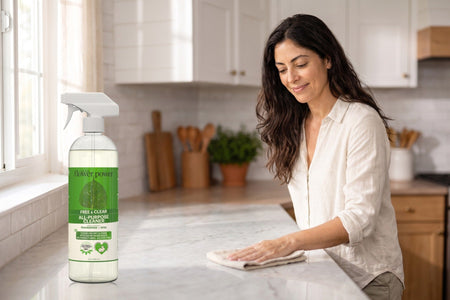
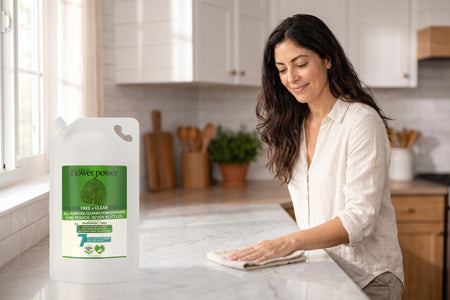
Spray cleaners are worse than liquid cleaners because spraying aerosolizes everything—the water, the volatiles, the particles. If you're choosing between spray and liquid versions of the same product, choose liquid. The difference in airborne chemical concentration is dramatic enough to affect your symptoms. Our own all-purpose cleaner ships as a concentrate with a trigger-spray bottle, so here's the honest guidance for it and every other trigger spray: spray the cloth, not the surface or the air. You get the same clean with a fraction of the aerosol — and it's the single easiest habit change on this list.
Ventilation during and after cleaning reduces the concentration of irritants in the air. Opening windows and running exhaust fans for 15 to 30 minutes after you finish is worth the trouble—it's one of the simplest things you can do for your indoor air quality. Understanding how products travel through air also shapes how we approach fragrance: we avoid volatile fragrance compounds entirely in our fragrance-free products. Even with open windows, volatiles persist longer in air than water-based residues do.
If someone in your household doesn't have asthma, consider letting them do the cleaning. This isn't surrender—it's protecting your respiratory system from repeated exposure. A 20-year University of Bergen study following more than 6,000 adults, published in the American Journal of Respiratory and Critical Care Medicine (2018), found that women who cleaned regularly showed a decline in lung function comparable to smoking a pack a day for 10 to 20 years. That's the cumulative effect of repeated exposure, not a one-time reaction.
If you do clean, wearing a mask helps. A basic latex-free face mask traps larger particles and reduces the amount of volatile compounds you inhale. It's not perfect protection, but it's better than unprotected exposure. That said, our formulations are designed to be used without respiratory protection. If a product requires a mask to apply safely, it's fighting against how people actually clean, and that's not a product we'd make.
Finally, if you're switching to new products, patch-test on a small area first. Let one product run out before introducing another. This way you can actually tell which product works without overwhelming your system with multiple changes at once.
The things that don't matter as much as the label suggests
If a product is plant-derived, that's interesting. It might mean the preservatives and cleaning agents come from botanical sources rather than synthetic chemistry. It might mean the company has chosen less harsh ingredients. But plant-derived doesn't mean fragrance-free, asthma-safe, or even necessarily safer than conventional products. Many plant compounds are potent irritants. Many synthetic compounds are gentle.
If a product is labeled "non-toxic," that label usually means nothing. Non-toxic isn't a regulated claim. Everything is toxic at the wrong dose, and many products can be entirely safe at normal use concentrations even if they would harm you if you drank a bottle. The label plays on anxiety, not on actual product safety—which is exactly why we don't use the word "non-toxic" ourselves.
If a product is green, eco-friendly, or natural, the same caveat applies. These are marketing language, not regulatory categories. A green-labeled product could contain bleach. A natural-labeled product could contain terpenes that trigger your asthma immediately. Read the actual ingredients.
What does matter: Does the label list the complete ingredients? Does it avoid the known irritants that personally trigger your symptoms? Can you identify which ingredients are doing the actual cleaning? If the answer to all three is yes, you have what you need to make a decision.
Making the choice that works for you
Your asthma triggers are individual. The threshold that causes your airways to react might be different from someone else's. Some people can tolerate a fragrance-free product with ethanolamines; others react. Some tolerate essential oils at low concentrations; others don't. Some need completely unscented products; others prefer a specific scent they've tested and know they can manage.
There's no such thing as a product that's universally asthma-safe. Because everyone's triggers are different, ingredient transparency isn't optional—it's how you discover which product actually works for your airways.
Use ingredient transparency as your starting point. If a product doesn't list ingredients, move on. If it does, cross-reference against what you know triggers your symptoms. If you're not sure what your triggers are, start by eliminating the biggest irritants: no bleach, no ammonia, no spray formulas. Stick with fragrance-free unless you've tested a specific scent and know it's safe. As you eliminate products and track what does and doesn't work, your pattern will emerge.
We've spent 14 years formulating products with complete ingredient transparency specifically because of conversations like this one—customers telling us they finally found something that worked because they could see exactly what was in it and confirm it didn't contain their known triggers. That's the real competitive advantage of how we work: not claiming to be safe for everyone, but being honest enough about our ingredients that you can decide if we're safe for you. When you've isolated your triggers, you'll know exactly what to look for in a new product, and you'll have a way to compare options without guessing.
Where to start
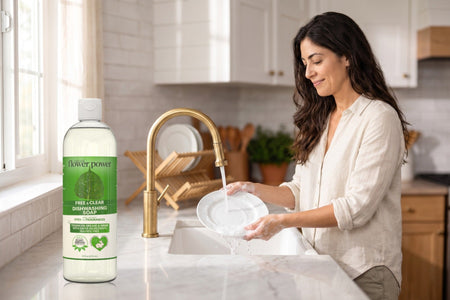
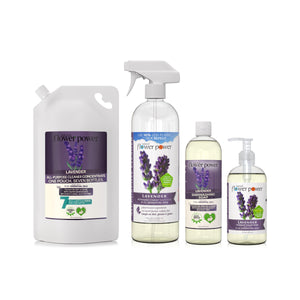
If you want products with nothing volatile to breathe in, our Free & Clear line is the place to begin: no added fragrance, no essential oils, no dyes, plant-derived surfactants, and a complete ingredient list on every page. Most people managing asthma start with the Free & Clear hand soap and Free & Clear dish soap—the products your hands and airways meet most often—then add the Free & Clear all-purpose cleaner for counters and surfaces, spraying the cloth rather than the air, as covered above. If a tested scent is fine for you, our Ingredients & Transparency hub lists exactly what's in every scented option so you can check it against your triggers first.
Every NFP product is backed by our 90-Day Love-It Guarantee—if it doesn't work for your household, for any reason, we make it right. For asthma-sensitive homes that's the honest way to try something new: test it against your own airways, with no risk if it isn't the right fit.
