


TL;DR: Conventional cleaning products release VOCs and synthetic fragrance compounds into the air for hours after use, measurably affecting indoor air quality. This walks through what gets released, why ventilation alone isn't a full fix, and how switching to plant-derived cleaners with essential-oil scents reduces airborne irritants without giving up on cleaning performance.
You finish cleaning the kitchen, and within minutes the room smells like artificial flowers or citrus or mountain air. You open a window to get fresh air, then realize something: you opened a window specifically to clear out the air you were trying to purify with the cleaning product. The paradox sits there, unspoken, but most parents notice it eventually. We spend time making sure our homes are clean and germ-free, but in the process, we're changing what our children breathe.
The question that usually follows is straightforward: Am I making the air better or worse?
What Happens When You Use a Conventional Cleaning Product
When fragrance hits the air, it's not just a smell. The fragrance component of a conventional cleaning product—whether it's labeled as "fragrance," "parfum," or "fresh scent"—consists of volatile organic compounds, or VOCs. These are chemicals that evaporate easily at room temperature, which is why you can smell them so quickly and from across the room. Once airborne, these compounds don't just dissipate harmlessly. They interact with other chemicals already in your indoor air, including ozone from outdoor air and light.
Scientific studies have found that when certain VOCs (particularly terpenes like limonene, which give cleaning products that citrus smell) react with ozone in your home, they produce secondary pollutants. The result can include formaldehyde—a known carcinogen—plus fine particles small enough to enter deep into the lungs. This reaction happens in seconds to minutes, so by the time you smell the pleasant scent, the chemical reaction is already occurring.
What makes this difficult to perceive is that the reaction feels clean. The smell is intentionally engineered to trigger an association with cleanliness in your brain. You've been trained, through millions of advertising impressions, to interpret that smell as safety. But your respiratory system is experiencing something chemically different from the narrative your nose is telling you.

What we make for this

The Scale of the Emission Problem
A typical conventional cleaning product emits somewhere between five and twenty-two chemicals into your home's air, depending on its formulation. Recent analysis of products available in US stores found that the average conventional cleaner releases seventeen volatile organic compounds per use. Roughly half of these are classified by the EPA as toxic or hazardous air pollutants. When researchers tested green or plant-derived products without added fragrance, the average dropped to four chemicals. The same plant-derived products with added fragrance emitted approximately fifteen—a fourfold increase from the unscented baseline.
This means the scent itself is the primary driver of air quality impact. Remove the fragrance, and you remove the majority of what's being released into your air. The other ingredients in a cleaner—surfactants, water, preservatives—contribute far less to the problem than the aromatic compounds.
What complicates the picture further is that these emissions don't stop once the smell fades. Some VOCs linger in your air for hours or days. Some are absorbed into soft furnishings—your sofa, your curtains, your child's stuffed animals—and then slowly re-released. This is why people who clean regularly in conventional ways report that their homes eventually have a persistent background odor, even when freshly cleaned.
Why This Matters More for Children Than You Might Expect
If you have young children in your home, the impact of what you're cleaning with becomes more significant. Children breathe approximately twice as much air per unit of body weight as adults. A toddler playing on a freshly cleaned floor is breathing more of that air, breathing it closer to the source where the concentration is highest, and their lungs are still developing—they're not yet the fully formed, robust respiratory systems of adults.
The developing lung is more vulnerable to chemical irritation and to repeated exposures that condition the tissue toward inflammation or sensitivity. A parent who cleans with a conventional fragrance-heavy product and notices their child develops a cough after cleaning may be seeing a direct response. Many parents I've spoken with over the years describe exactly this pattern: respiratory symptoms in young children that improve when they switch to simpler, unscented products.
Concentration matters too. If you're cleaning a kitchen with the windows closed on a winter day, the chemicals release into a finite volume of air. The concentration peaks quickly, which means the brief exposure is more intense. This is why the same product might not trigger a reaction in a large, well-ventilated space but will in a small, closed room.
What We Learned From Making Products Our Own Way
When we started formulating in 2012, we weren't trying to optimize for air quality. We were trying to solve a direct customer problem: people with sensitive skin needed products that didn't cause reactions. But as we worked with real households over years, we discovered that the fragrance question kept coming up alongside the formulation question.
We tested two approaches. The first was the obvious one: use the same plant-derived surfactants and cleaning agents that everyone uses, but switch the fragrance to essential oils. This worked, but it had constraints. Essential oils are expensive, less stable than synthetic fragrances, and they shift in composition over time. A bottle of our lavender hand soap made in January smells slightly different in July because the essential oil profile has aged.
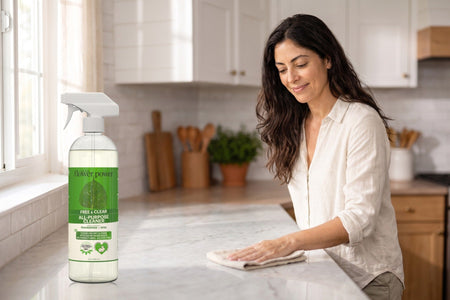
The second approach was to offer a completely fragrance-free option—our Free & Clear line. No essential oils, no scent contribution to the air at all. For people who are multiply sensitive, or who prefer not to add any aromatic compounds to the air in their homes, this eliminates the fragrance emission problem entirely. In our own facility, we noticed that days when we're producing only Free & Clear products are noticeably different from days we're filling scented lines. The air in the production space is cleaner because we're not vaporizing essential oil components into it.
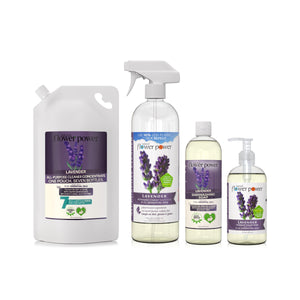
We also chose to make our all-purpose cleaners as concentrates. If you're diluting a concentrate to 10 or 20 times its original strength before using it, you're using a fraction of the product per cleaning session. That means a fraction of whatever is in it—fragrance, surfactants, everything—ends up in your air. A concentrate doesn't guarantee lower emissions because concentration depends on how you dilute, but it does give people the option to reduce exposure by using less.
Making the Right Decision for Your Home
If you're trying to decide what matters when it comes to cleaning products and air quality, start with fragrance. That's where the biggest impact lives. A product labeled unscented or fragrance-free will release dramatically fewer VOCs than the same product with fragrance added. If you see "Free & Clear" or similar labeling, that's a deliberate choice by the manufacturer to eliminate the scent component entirely.
If your family has respiratory sensitivities—asthma, reactive airways, chemical sensitivity—unscented becomes essential rather than optional. The irritation isn't theoretical; it's a direct daily exposure. For everyone else, it's a reasonable precaution, especially in homes with young children or pregnant people who are more vulnerable to irritant exposure.
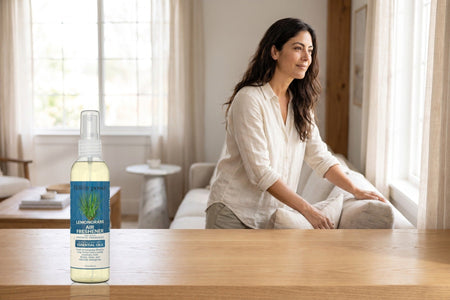
Essential oils in cleaning products are better than synthetic fragrances from an air quality perspective, but they're not zero-impact. An essential oil still vaporizes, still contributes to your indoor air, still reacts with ozone. The difference is that you can see what you're getting—a bottle labeled "lavender essential oil" is telling you explicitly what fragrance compound is being released. That's valuable for people who can identify which scents trigger reactions. But if sensitivity is the concern, unscented is simpler and safer.
The other leverage point is concentration. Concentrated products mean using less product, which means fewer chemicals in the air per cleaning session. This is particularly relevant for all-purpose cleaners and floor cleaners, where dilution is expected. A concentrate you dilute 10:1 before use is inherently lower-emission than a ready-to-use product with the same concentration of surfactants and fragrance already mixed in.
The Honest Tradeoff
Lower-emission cleaning products have real tradeoffs worth acknowledging. They typically cost more—concentrated products because the manufacturing process is less streamlined, and essential-oil-scented or unscented products because those materials cost more than synthetic fragrance. They require slightly more effort from the user; many concentrates need dilution before use. And they deliver subtler sensory experiences. Your nose won't register an unscented cleaner as "fresh" or "clean" because the conditioning that taught you to interpret fragrance as cleanliness won't activate.
This is where trust becomes relevant. You have to believe that the product is actually cleaning even though your nose isn't getting the confirmation signal it's learned to expect. Most people adapt to this quickly once they see that their floors are still clean, their dishes still shine, and their skin stops reacting. The sensory reward shifts from the smell to the results.
For families with young children or members with respiratory sensitivities, the tradeoff is straightforward—the air quality benefit outweighs the additional cost and the subtler scent. For everyone else, it's a reasonable precaution that gets more valuable the longer you take it, because you're reducing the cumulative exposure year after year.
The air in your home is something your family breathes thousands of times per day. The cleaning products you choose to bring into that space have a direct, measurable impact on what's in it. It's not complicated to understand what's happening—fragrance vaporizes, reacts with ozone, and produces secondary pollutants. It's also not complicated to reduce: switch to unscented products, or to products scented only with essential oils you can see listed on the label. You can explore our hand soaps, dish soaps, and all-purpose cleaners to see how plant-derived formulations can work in your home. For more on how we think about ingredients and transparency, see Our Story & Standards. The choice is straightforward enough that you don't need perfect information. You just need to decide whether air quality matters more than the sensory experience of heavy fragrance. Most parents, once they frame it that way, know their answer. Every NFP product is backed by our 90-Day Love-It Guarantee — if it doesn't work for your household, we make it right.
