

TL;DR: Cats can't metabolize phenols — including compounds in some essential oils — and no cleaning product is safety-tested on the animals that walk, sniff, and groom where you clean. The genuinely dangerous ingredients are a short list: phenols, ammonia, bleach, and quaternary ammonium compounds. Here's what to avoid, how we handle it in our own products, and what to do in an emergency.
Updated September 2026 with emergency contacts, ingredient-library links, and quick answers for common situations.
You mop your kitchen floor with your usual all-purpose cleaner. It's the same product you've used for months. Your cat walks across the wet floor, and you think nothing of it until three hours later when she's drooling, refusing food, and moving slowly. By evening, you're at an emergency vet clinic with no clear answer about what went wrong.
The next morning, you read the ingredient label again. Somewhere in that list is something that poisoned your cat—but the label doesn't tell you what it is or why. It just sits there: fragrance. Ammonia. Sodium hypochlorite. Benzalkonium chloride. Words that could mean nothing to most households but mean everything to an animal whose liver can't process the same chemicals yours can.
Over fourteen years of formulating cleaning products and talking with customers, we've heard this story from pet owners dozens of times. Some of them had near-misses. Others lost their animals. Almost all of them had no idea that the product they trusted was dangerous until something went wrong.
The science behind pet toxicity isn't mysterious. It's specific. Different animals have different metabolic pathways—different enzymes, different sensitivities, different exposure routes. Understanding which ingredients are genuinely harmful to which animals, and why, is the foundation of keeping your pets safe.
Why Pets Are More Vulnerable Than You Are
When you clean your kitchen, you spray a surface, let the product dry, and walk away. Your cat walks across that surface minutes later with bare paws, then licks those paws during grooming. Your dog sniffs the floor and absorbs residue through mucous membranes. A bird perches on a just-cleaned countertop. These are fundamentally different exposure scenarios than human use.
More importantly, pets have metabolic limitations that humans don't. Many mammals—including humans—can neutralize harmful chemicals through liver enzymes. Cats, in particular, are missing a critical enzyme that most other animals have. Dogs have different respiratory sensitivities than humans, especially breeds with shortened airways. Birds have lungs so efficient that toxins travel through their systems incredibly fast. The cleaning products safe for human hands may be lethal for animals who are exposed through their paws, lungs, and grooming behavior.
When manufacturers test cleaning products for safety, they test on humans. They do not test on the species that will actually be exposed to the dried residue on your floor.
What we make for this
Phenols: The Ingredient Cats Cannot Process
Cats are deficient in an enzyme called glucuronyl transferase. This enzyme is responsible for breaking down phenol—a chemical compound found in certain disinfectants and essential oils. Without this enzyme, phenol accumulates in a cat's system, damaging the liver and causing neurological effects that can be fatal.
Symptoms of phenol toxicity in cats include excessive drooling, vomiting, tremors, loss of coordination, respiratory distress, and eventually liver failure. Some cats recover with aggressive veterinary intervention; others do not. This is not an allergic reaction or a sensitivity—it's a fundamental metabolic gap. Even small doses matter because the cat's body cannot eliminate the compound.
Phenol appears in some traditional disinfectants, particularly those marketed for serious antimicrobial action. It also appears in certain essential oils that are perfectly safe for humans but potentially lethal for cats. If a product contains phenolic compounds, it should not be used where cats live, eat, or sleep.
To check if a product contains phenol, look at the ingredient list for the words "phenol" or "phenolic compound." Some products will list it directly; others will obscure it under broader fragrance claims. If the label says "phenol" or if you see essential oils listed and have a cat, research that specific oil before using the product in your home.
Essential Oils in Cleaning Products: The Honest Assessment for Cat Owners
Natural Flower Power uses essential oils in our scented products. We use them because they smell good, they perform well as natural antimicrobials, and they let us scent products honestly, with no synthetic fragrance blends. But I need to be direct with you: some essential oils are harmful to cats, and using products that contain them in households with cats requires specific knowledge and precautions.
The same enzyme deficiency that makes cats vulnerable to phenol makes them vulnerable to certain essential oils, particularly those high in phenolic compounds. Tea tree oil, pine oil, citrus oil (d-limonene), wintergreen, eucalyptus, peppermint, and ylang ylang are documented as toxic to cats at concentrated levels. When these oils are used in household cleaning products at full strength, they present a genuine risk.
Here is what makes the assessment complicated: the concentration matters. A drop of undiluted tea tree oil is fundamentally different from trace amounts of d-limonene in a finished cleaning product that's designed to be diluted or applied to surfaces, allowed to dry, and left undisturbed. But I cannot tell you with absolute certainty what concentration of what oil in what application is definitively safe, because cats vary in their sensitivity, and exposure pathways vary by situation.
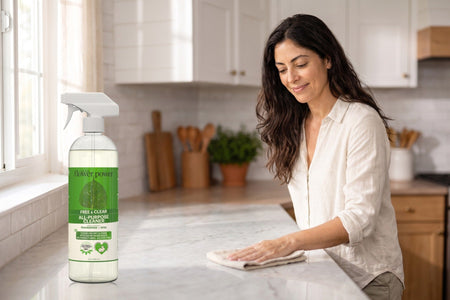
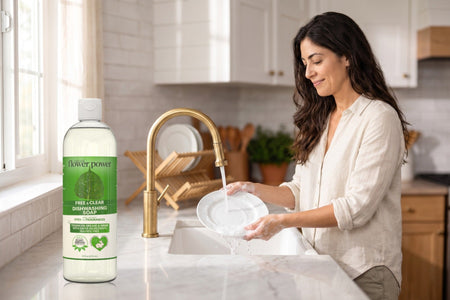
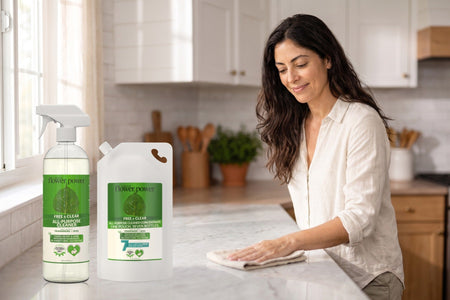
What I can tell you is this: if you have a cat, the safest choice is our Free & Clear product line—all-purpose cleaners and soaps with zero essential oils and zero synthetic fragrance. These are formulated specifically for households where fragrance is a concern, whether that concern is feline toxicity, human chemical sensitivity, or personal preference.
If you use NFP products scented with essential oils in a household with cats, keep the cat away from treated surfaces until they've completely dried. Dried residue on an open surface presents less risk than liquid contact, but wet floors and freshly-sprayed countertops are where ingestion through grooming is most likely. This is the same precaution you'd take with any cleaning product—keep animals away during and immediately after application.
We are transparent about which essential oils are in each product. If you're uncertain whether a particular oil presents a risk for your cat, research that oil specifically—veterinary poison control databases and veterinary toxicology resources will give you dose-specific guidance. And if your cat has already had a reaction to a scented product, switch to Free & Clear or an unscented competitor immediately.
Cat household? We went deeper on all of this — the enzyme gap, the grooming route, a 60-second label check — in our feline deep dive: Cleaning Products Safe for Cats: What to Avoid and Why.
Ammonia and Bleach: Respiratory and Systemic Dangers
Ammonia is a common ingredient in glass cleaners and some all-purpose cleaners. When you inhale ammonia vapor, it burns the tissues in your nose, throat, and lungs. Humans can tolerate brief exposure because we're large and we breathe deeply from the front of our faces. Pets are smaller and breathe closer to the ground, where ammonia vapors concentrate.
Direct ingestion of ammonia-containing products—which happens when a dog licks a freshly cleaned floor or a cat licks a paw that touched ammonia residue—can cause chemical burns inside the mouth and digestive tract, leading to vomiting and gastrointestinal pain. Chronic inhalation of ammonia fumes can cause respiratory irritation and coughing.
Bleach (sodium hypochlorite) is worse. It's one of the strongest airway irritants in household cleaning products, and it releases chlorine gas. It can cause immediate respiratory distress in pets, and ingestion of even small amounts is caustic—it burns tissue on contact. The damage is real and sometimes irreversible.
The most dangerous scenario is mixing ammonia and bleach, which creates chloramine gas—a highly toxic vapor that settles low in the air, exactly where animals breathe. Never use an ammonia-based product after using bleach, and never combine them intentionally. If you've done this in the past by accident, ensure the space is thoroughly ventilated and keep all animals out until the smell is completely gone.
For pet owners, ammonia and bleach are non-negotiable exclusions. There are effective alternatives — plant-derived surfactants and enzymatic cleaners handle everyday household cleaning without either one.
Quaternary Ammonium Compounds: Increasingly Recognized as Dangerous
Quaternary ammonium compounds (QACs), also called quats, are antimicrobial ingredients that became popular during the push for hospital-grade disinfection in household products. Benzalkonium chloride is a common example. These compounds work by disrupting cell membranes, which is how they kill bacteria and viruses.
The problem is that they also disrupt cell membranes in animal tissues. Cats are especially sensitive to QACs. Even at very low concentrations, these compounds can cause corrosive injury to any tissue they contact—skin, mucous membranes, digestive tract. Veterinary toxicologists have documented acute poisoning in cats from exposure to products containing quaternary ammonium compounds, and recent research shows these compounds accumulate in pets' bodies over time with repeated exposure.
Products marketed as "disinfectant wipes" or "antibacterial cleaners" often contain QACs. If the label advertises hospital-grade or clinical-strength disinfection, odds are high that a quat is the active ingredient. For pet owners, this is a category to avoid entirely.
Check product labels for "benzalkonium chloride," "alkyl dimethyl benzyl ammonium saccharinate," or any ingredient name that includes "quaternary ammonium." If you see these, do not use the product in homes where animals live.
Glycol Ethers and Phthalates: The Cumulative Concern
Glycol ethers are solvents used in many glass and surface cleaners to help products dry streak-free and to dissolve oils and stubborn residues. They're absorbed through the skin and lungs relatively easily. Studies by the EPA show that glycol ethers can cause liver, nerve, and digestive damage, particularly with chronic exposure.
Phthalates are plasticizers used to make fragrances smell better and last longer, and they're also used in some product formulations to improve texture or stability. Animals don't just encounter phthalates in cleaning products—they're in air fresheners, some plastic toys, and even dust in homes that use conventional products heavily. Research has linked phthalate exposure in dogs to liver and pancreatic damage, and in cats to reproductive issues and cancer risk, though the dose-response relationship is still being studied.
The concern with both glycol ethers and phthalates is cumulative. A single exposure to a product containing glycol ethers probably won't cause acute poisoning. But a dog or cat chronically exposed to multiple products containing these chemicals, over months and years, can develop organ damage. For pets that lick paws after walking on treated floors every single day, the accumulation is real.
Look for products that disclose their ingredients fully and exclude glycol ethers and phthalates. Many natural and plant-derived cleaning products avoid both. If a label doesn't list ingredients or hides ingredients under vague terms like "fragrance," you have no way to know whether these compounds are present.

What Natural Flower Power Customers Tell Us About Pet Safety
Pet owners who've switched to Natural Flower Power often tell us the same thing: they started with our Free & Clear line specifically because they have cats or dogs and couldn't find products they trusted. Once they confirmed the product worked and their pet didn't have a reaction, many expanded to our scented lines. A number of them keep both—Free & Clear for daily cleaning and our essential oil-scented products for less-frequented areas or for when they can control exposure more carefully.
We also hear from customers who had a scare. Their pet got sick, they switched to our products, and the animal recovered. These are the conversations that reinforce why we formulate the way we do: transparent ingredients, no hidden chemicals, and the option to go completely fragrance-free if you need to.
One thing these customers have in common is that they read labels and they ask questions. They don't assume a product is safe just because it's at the store. They want to know what's in it and why. That approach is exactly right, and it's the foundation of making genuinely safe choices for your animals.
How to Read Labels for Pet Safety
If you're shopping for cleaning products in a home with animals, here's what to look for and what to treat as warning signs.
Ignore "pet-safe" claims without specifics. This is marketing language with no regulatory definition. A product can claim to be pet-safe while containing quaternary ammonium compounds. Look for ingredient transparency instead of claims.
Look for a complete ingredient list. Legitimate brands will list everything. If a label says "fragrance" or "proprietary blend" or "natural disinfectant formula," you cannot evaluate safety. Move on to a brand that shows you exactly what's in the product.
Avoid ammonia, bleach, and phenol. These should appear nowhere on the ingredient list if you have pets. Search for these specific words and their common synonyms (sodium hypochlorite for bleach, ammonia for ammonia, phenol or phenolic for phenols).
Check for quaternary ammonium compounds. Search the ingredient list for benzalkonium chloride, alkyl dimethyl benzyl ammonium saccharinate, or any ingredient containing "quaternary ammonium" or "quat." If it's there, do not use it around animals.
Research essential oils if the product lists them. If essential oils are named specifically—lemon oil, lavender oil, tea tree oil—research that oil in relation to your specific pet species. Some oils are safe for dogs but not cats. Veterinary poison control databases will give you dose-specific guidance. If the label just says "essential oil blend" without specifics, you cannot evaluate it.
Verify what's NOT on the list. Good pet-safe products will be explicit about what they don't contain. Look for statements like "free from phenols," "no ammonia," "no bleach," or "no synthetic fragrances." This shows the company is intentionally addressing pet safety.
Watch for artificial fragrance. If the label contains "fragrance," "parfum," or "fragrance blend," you're back to the same transparency problem we discussed with human cleaning products—dozens of chemicals hidden under one word. For pet safety, artificial fragrance is an automatic reason to skip the product.
The Practical Path Forward
If you're reading this because your pet had a reaction or came close to poisoning, your first step is identifying the product they were exposed to. Look at the ingredient list. Does it contain ammonia, bleach, phenol, or quaternary ammonium compounds? Those are immediate culprits. Was the product used near where your pet sleeps, eats, or regularly touches with paws? Note that for future comparison.
Then make the switch. Choose a product where you can read every ingredient and none of them are known toxins for your species of pet. Our Free & Clear line, designed specifically for pets and people with sensitivities, is one option. Many other brands also make genuinely transparent, pet-safe products. The commonality is transparency and the deliberate exclusion of known toxins.
If you keep essential oil-scented products in your home, apply the exposure-control principle: keep pets away from treated surfaces until they've completely dried. This is especially important for cats, who are highest-risk, and for households with multiple animals or high cleaning frequency.
Keep two numbers where you can find them: the ASPCA Animal Poison Control Center at (888) 426-4435 and the Pet Poison Helpline at (855) 764-7661. Both are staffed by veterinary toxicologists around the clock (a consultation fee applies), and both will want the product's ingredient list — one more reason to buy products that actually print one.
Finally, talk to your vet about the products you use. They can advise on specific products or ingredients based on your pet's individual sensitivities and your household situation. If your pet has already had a reaction to something, your vet can help identify what ingredient was responsible.
Learn more about our formulation standards and why we make the choices we do at Our Story & Standards. And every ingredient we use — or refuse to use — has its own plain-English entry in our ingredient library, so you never have to take our word for it. And if you're choosing between our scented and unscented lines, our all-purpose cleaners and dish soaps are available in both so you can choose based on your household's needs.
Quick Answers for Pet Owners
My cat walked across a freshly cleaned floor. What do I do? Wipe or rinse her paws with plain water right away, before grooming does the ingesting for her, and watch for drooling, vomiting, lethargy, or tremors over the next few hours. If symptoms appear — or the product contained phenols, bleach, ammonia, or quats — call your vet or one of the poison-control lines above, ingredient label in hand.
Are essential-oil cleaners safer around dogs than cats? Generally yes — dogs have the liver enzyme cats lack — but concentration and exposure still matter, and pine and tea tree oils are documented risks for dogs too. The dry-surface rule applies to every species: keep animals off treated surfaces until they're completely dry.
Is "pet-safe" on a label regulated? No. No agency defines it, tests for it, or enforces it. Treat it as decoration and read the ingredient list instead.
Your pet cannot tell you which cleaning ingredient made them sick. They cannot read labels or research compounds. They can only trust that the products in their home are safe. That trust rests on your willingness to look beyond marketing claims and actually know what's in the products you're using. The science is clear about which ingredients are genuinely dangerous. The work is in applying that science to the products you bring home.
