

You've probably seen "sulfate-free" on hundreds of product labels by now—everything from shampoo to dish soap to hand cleaner. The claim is everywhere, which means two things: first, that sulfates exist in a lot of products, and second, that avoiding them has become a market signal. But what sulfates actually do, and why they matter to your hands and skin, isn't always clear. Some of the anxiety about them is legitimate. Some is marketing hype. And the honest answer is more interesting than either extreme.
Sulfates are surfactants—compounds that lower surface tension in water and allow soap to grab oils and suspend them so they can be rinsed away. They're incredibly effective, which is why they've been used in cleaning products since the 1940s. They're also cheap, which is why most major brands still use them. But they have a side effect that matters if your skin is sensitive: they strip oils indiscriminately. That same property that makes them great at cutting through grease on dishes and countertops makes them problematic when they strip away the skin's natural protective oils during hand washing.
At Natural Flower Power, we've made the decision not to use sulfates, and that choice comes from years of listening to customers with sensitive skin and eczema-prone hands who came to us specifically because they needed something gentler. This doesn't mean sulfates are poison, or that conventional cleaning products will harm everyone who uses them. It means we've chosen to solve the same cleaning problem with a different ingredient set—one that works hard but doesn't leave hands feeling tight and dry.
What Sulfates Are and How They Work
A surfactant is a molecule with a split personality. One end loves water (hydrophilic), and the other end loves oil (lipophilic). When you dissolve a surfactant in water and apply it to a greasy surface, those oil-loving ends cluster around the grease particles while the water-loving ends stay connected to the water. This breaks the grease into tiny droplets, suspends them in the water, and allows them to rinse away. That's why soap works at all.
Sulfates are anionic surfactants, meaning they carry a negative electrical charge. This charge is what gives them their power—it creates a strong attraction to oils and soil particles, and it also helps foam form, which is why sulfate-containing products lather dramatically. That visible lather is partly what makes people trust that a product is working, even though lather and cleaning power aren't directly related. You can clean very effectively with almost no lather, but sulfates teach consumers to expect the white foam.
The most common sulfates in household cleaning products are sodium lauryl sulfate (SLS) and sodium laureth sulfate (SLES). SLS is older and more aggressive. SLES is a modified version—the word "laureth" indicates it's been ethoxylated, which adds a chain of water-loving molecules. This makes SLES slightly milder and less likely to irritate skin on contact. Both are derived from natural starting materials like coconut or palm oil, though the manufacturing process is entirely chemical. The plant source doesn't make them less processed or somehow inherently safer—it's just where the raw material begins.

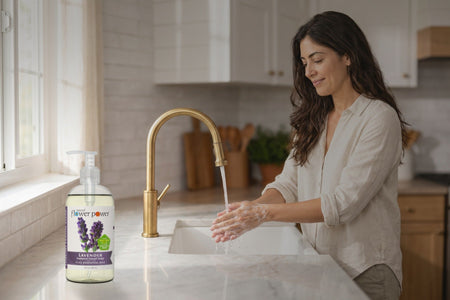
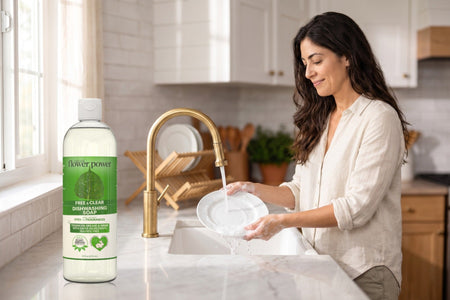
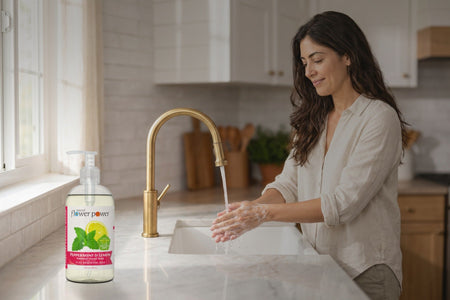
What we make for this
The Two Real Concerns: Irritation and Stripping
People worry about sulfates for different reasons, and it's important to separate what's actually documented from what's marketing fear.
The first concern is dermal irritation. At concentrations above 2%, sulfates irritate skin on contact. This isn't theoretical—it's been documented in dermatology research and is why sulfates are used as a positive control (the intentional irritant) in skin irritation studies. If someone has eczema, psoriasis, or contact dermatitis, washing their hands with a high-sulfate product will often make it worse. For people with sensitive skin, the irritation is immediate and obvious: hands feel tight, dry, and raw after washing. Frequent use creates a cycle where the skin barrier is damaged, becomes more reactive, and becomes sensitized to even smaller exposures. This is a real concern, not hype. But it affects people who are already sensitive, not necessarily everyone.
The second concern is what happens to hands over time. Sulfates strip oils—both the dirt and the skin's natural protective layer. Most people's hands can tolerate this because skin constantly produces new oil. But for people who wash their hands frequently (healthcare workers, parents of young children, food service workers), or who have impaired skin barriers, or who have conditions like dyshidrotic eczema that create cracks in the skin, that constant stripping becomes a problem. The hands never recover. The more you wash with sulfates, the drier and more irritated the skin becomes. This creates a feedback loop where people need to use moisturizer constantly just to maintain baseline comfort.
There's a third concern that gets mixed into conversations about sulfates: the potential for 1,4-dioxane contamination. When SLES (but not SLS) is manufactured through an ethoxylation process, it can be contaminated with 1,4-dioxane, which is classified by regulatory agencies as a possible carcinogen. This is a manufacturing issue, not a formulation choice—responsible manufacturers test for and remove 1,4-dioxane. But it's worth knowing that not all brands do this equally well. It's another reason to care about where products come from and who makes them.
What Sulfates Don't Actually Do (And Why That Matters)
Sulfates aren't toxic at the concentrations used in cleaning products for people without specific sensitivities. There's no credible evidence that they cause cancer, no evidence that they cause hair loss, and no evidence that brief contact with them in a rinse-off product will harm a healthy person. The FDA and the Cosmetic Ingredient Review (CIR) panel have reviewed the safety data and concluded they're safe for use in rinse-off products with proper formulation. This matters because it means you can acknowledge that sulfates are effective without accepting that they're inherently dangerous.
They also don't need to be in the product to make it work. Sulfates are popular because they're cheap, they create visible lather (which consumers interpret as effectiveness), and they're very good at stripping oils quickly. But the cleaning job itself—suspending dirt and oils so they rinse away—can be done by other surfactants that are gentler. That's the key insight: there's nothing cleaning requires about sulfates specifically. They're just one solution to a chemical problem, and there are alternatives.
Why We Formulate Without Sulfates
When we started NFP in 2012 and began working with real customers, a clear pattern emerged quickly. People with sensitive skin, eczema, and contact dermatitis were switching to plant-derived products specifically to avoid sulfates. But many of the plant-derived products on the market still used sulfates—they just came from coconut oil instead of petroleum. The marketing was "plant-derived," but the chemistry was identical.
We decided not to do that. Instead, we formulated our entire line without sulfates of any kind. That meant learning to work with different surfactants—milder, more expensive alternatives like plant-derived mild surfactants derived from corn or coconut that clean effectively but don't strip oils as aggressively. It meant adjusting for the fact that these ingredients don't create the same dramatic lather, so some customers initially felt like the product wasn't as strong. It meant being okay with a shorter shelf life because some of our preferred surfactants are less stable over time.
The operational tradeoff is significant. Sulfate-free formulation costs more. The ingredients are more expensive, the shelf life is shorter, and the performance profile is slightly different. A sulfate-based dish soap can strip your hands completely in one wash; our formula is gentler, which means some people need to wash twice if they have very greasy hands, or they can use half as much product because it's more concentrated. Different isn't worse—it's just different.
But for the customers we're built to serve, that tradeoff is the entire point. If you're buying cleaning products because conventional options made your hands crack and bleed, you don't want gentler than normal. You want nothing like the normal approach at all. Our sulfate-free formulas allow that. A person with severe contact dermatitis can use our liquid hand soaps and dish soaps without the chemical stripping that would normally make their condition worse.
What We Use Instead
Surfactants exist on a spectrum from very harsh to very gentle, and they all work through the same basic mechanism—one end grabs oils, the other stays with water. The differences are in how aggressively they strip and how likely they are to irritate skin.
Our formulations use plant-derived surfactants that are less aggressive than sulfates. These include mild surfactants derived from ingredients like corn, coconut, and sugar. They clean effectively, but they're less likely to damage the skin barrier on contact. We also use formulation techniques that our competitors often skip—we adjust pH carefully to reduce irritation, we include small amounts of ingredients that help maintain skin's natural oils, and we test with customers who have sensitive skin before we release anything.
This approach isn't new. It's been used in premium personal care products and in formulations designed specifically for people with dermatological conditions. We've simply applied it consistently across all our cleaning products. The result is that our products work effectively for cleaning while being significantly gentler on hands, which is exactly what our customers asked for.
The Honest Truth About Sulfate-Free Claims
The term "sulfate-free" has become a marketing signal, and like most marketing signals, it sometimes gets used carelessly. Some brands claim to be sulfate-free while using other aggressive surfactants. Some use different stripping agents and call them gentler just because they're not technically sulfates. Some charge premium prices for sulfate-free products that are barely different from sulfate-containing versions of the same product.
If you're sensitive to surfactants in general, being sulfate-free isn't enough. You need to know what else is in the product. If you're specifically sensitive to sulfates but tolerate other surfactants fine, then sulfate-free is what matters. If you're looking for a gentler product simply because you've experienced hand drying or tightness, sulfate-free is a good signal but not the whole story—formulation technique, pH, and the presence of skin-conditioning ingredients matter just as much.
Our approach is transparent: we don't use sulfates, we've chosen our alternative surfactants deliberately, and we test products with sensitive skin customers before releasing them. That's not a guarantee that no one will ever react—individual reactions vary, and some people are sensitive to almost everything—but it reflects a commitment to minimizing the ingredients that are most likely to cause problems. We write out every surfactant we use by name. You don't get to hide behind words like "gentle surfactant blend." You see exactly what's doing the cleaning.
Should You Care About Sulfates in Your Cleaning Products?
If your hands feel fine after using conventional cleaning products, and you have no history of dermatological sensitivity, sulfates pose no significant health risk. You can use them without concern. This matters to say clearly because some of the marketing around sulfate-free products implies that everyone should be afraid of them, and that's not accurate.
But if you've noticed that your hands feel tight, dry, or irritated after washing dishes or cleaning with conventional products, or if you have a diagnosed skin condition like eczema or contact dermatitis, paying attention to sulfates makes sense. They're one of the most common causes of that tight, dry feeling because they're so good at stripping oils. Switching to a product that uses gentler surfactants—or to a product that's specifically formulated with sensitive skin in mind—often solves the problem.
The real value in understanding sulfates isn't that you need to be afraid of them. It's that you can make an informed choice. You can look at a label, understand what a surfactant does, and decide whether you want an aggressive one or a gentler one based on your own hands' response, not on marketing claims.
Surfactants are fundamental to how cleaning works. Sulfates are just one choice among many for how to accomplish that work. They're effective and cheap, which is why they're everywhere. But they have a real cost for people with sensitive skin—a cost that's often presented as normal and unchangeable. It doesn't have to be. There are alternatives that clean just as well without leaving hands stripped and raw. Once you experience the difference, you understand why we made the choice we did.
