

You just finished cleaning the kitchen floor. Your toddler crawls across it within minutes, putting their hands in their mouth a moment later. You did the right thing—the floor is clean now. But standing there watching them, you wonder: is the product you used safe? What if there's residue your eyes can't see? What ingredients actually matter when there's a small child in the house?
This is the question parents ask us most. Not as a philosophical concern, but as a practical one happening in real time in their homes. The answer isn't simple because it depends on which ingredients you're worried about, how the product is used, and what exposure actually looks like in a household where children are constantly crawling, touching, and mouthing their hands.
How Children Actually Get Exposed to Cleaning Products
When we started Natural Flower Power in 2012 and began formulating products, we spent time learning from customers with children. The exposure scenarios they described were specific. A child's hand touches a just-cleaned countertop, then goes into their mouth. Residue from a mopped floor ends up on toys, which get mouthed. Vapors from a bathroom cleaner linger while a toddler plays in the hallway. These aren't theoretical exposures—they're what actually happens in homes with young kids.
What surprised us wasn't how much exposure happens, but how much of it is completely preventable with product choice rather than behavior change. You're not going to stop your child from crawling or mouthing their hands. You can, however, choose products where the residue left behind is something you're genuinely comfortable with.
The primary exposure pathways for children are incidental ingestion through hand-to-mouth contact, inhalation of vapors, and dermal contact. Children are more vulnerable than adults in all three because they breathe faster relative to their body weight, they spend more time on floors where heavier particulates settle, and they have a much higher hand-to-mouth behavior rate. Studies show toddlers ingest roughly 40 milligrams of dust per day through this behavior—that's a lot of surface contact ending up inside their bodies.
What we make for this
Which Ingredients Actually Warrant Attention
Not everything on a cleaning product label is a concern for households with children. Some ingredients are genuinely problematic, some are irritating but manageable with ventilation and proper use, and some are included because regulatory loopholes allow it. Knowing which is which helps you make decisions from information rather than fear.
Phthalates are the first real concern. These are plasticizers used in fragrances and some softeners, and they're documented endocrine disruptors—meaning they can interfere with hormonal development in children. The issue is that they hide under the word "fragrance," which we've covered in depth in our guide to fragrance on cleaning labels. If a product lists "fragrance" without specifying essential oils, phthalates may be present. Children's developing bodies are particularly sensitive to endocrine disruptors, so this is a legitimate place to shift your choices.
Ammonia is commonly used in glass and window cleaners. It's not secretly dangerous—it's obviously, directly irritating to mucous membranes. It causes respiratory irritation, sneezing, and can exacerbate asthma. This one's straightforward: if a product lists ammonia, ventilate well and keep children out of the room while you're cleaning. Avoid it entirely if someone in your household has asthma or reactive airways. It doesn't belong in homes where toddlers are playing nearby.
2-butoxyethanol (2-BE) appears in some multipurpose cleaners and degreasers. It's a solvent that can cause respiratory irritation and has been linked to respiratory effects in children with chronic exposure. Again, this is a straightforward avoidance—it's not hard to find products without it. The EPA includes it on their list of chemicals to phase out in household products, which tells you regulatory bodies consider it problematic enough to discourage.
Synthetic fragrances beyond phthalates can include volatile organic compounds (VOCs) that irritate airways and eyes. If your child coughs, sneezes, or complains their eyes feel weird when you're cleaning, fragrance is a common culprit. For children with sensory sensitivities or autism spectrum traits, heavy fragrance can also be overwhelming.
What you don't need to worry about constantly: surfactants like sodium laureth sulfate (SLES) or sodium coco-sulfate (SCS). These are the cleaning agents that actually remove dirt. Yes, they're synthetic in many products. But they're not systemically toxic, they don't accumulate in the body, and residual amounts on a surface pose minimal risk to a crawling child. The concern around sulfates is primarily for people with very sensitive skin using them repeatedly—not for incidental hand-to-mouth contact with cleaned surfaces.
What "Safe for Kids" Actually Means (And Doesn't)
This is where we have to be honest about marketing language. No product can claim to be safe for babies or completely non-toxic. That's not how regulation works, and any company claiming it is either lying or oversimplifying dangerously. What you're actually looking for is a product where the ingredients are transparent, the problematic ones we discussed above are absent, and the overall design reflects the reality of homes with children.
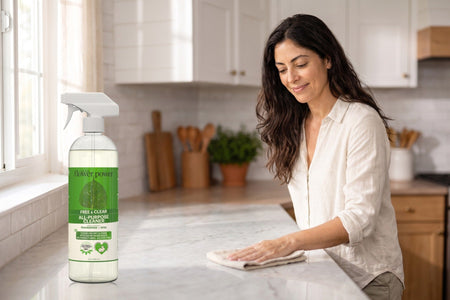
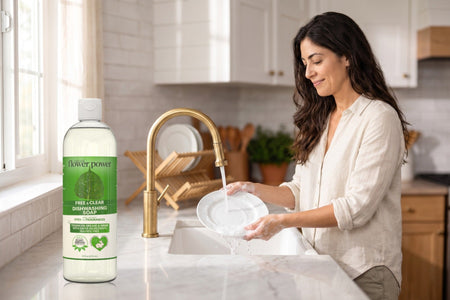
At Natural Flower Power, we don't claim our products are "safe for babies." What we do is eliminate the ingredients that create real exposure concerns: no synthetic fragrances hiding phthalates, no ammonia, no 2-BE, no formaldehyde releasers, no parabens. We use plant-derived cleaning agents because they work and they're easier to account for ingredient by ingredient. We offer a Free & Clear line that's completely unscented for families who want the absolute minimum. We publish full ingredient lists because transparency is the only real safety guarantee.
But even with all that, your own practices matter enormously. A product that's formulaically sensible becomes less safe if you mix it with something else (never do this), spray it while your toddler is in the room, or leave residual wetness on surfaces where crawling hands will pick it up. Product choice is part of the equation, but not the whole equation.
The Practical Approach: Choosing and Using Products Safely
In a household with young children, your evaluation process should look something like this.
First, check the ingredient list. If you see "fragrance" or "parfum" without clarification, it's hiding something. If you see ammonia or 2-butoxyethanol listed, you've got a reason to choose differently. If the list is vague or incomplete, that's a red flag. Companies that are confident about their formulations publish full ingredient lists. Look for that transparency.
Second, think about how you actually use the product. A degraser for the kitchen stovetop is more risky than a bathroom cleaner because kitchen surfaces are where food preparation happens and hands touch. Bathroom surfaces where kids don't spend much time are lower-risk. Floors where toddlers crawl directly are highest-risk. Your product choice can reflect this hierarchy. For high-risk surfaces (kitchen counters, baby play mats, the floor), use something formulated with transparent ingredients and known-safe compounds. For lower-risk surfaces, your choices are wider.
Third, manage the exposure itself. Let surfaces dry completely before children use them. Open a window while you're cleaning. Use the least amount of product you need to actually clean something—more isn't safer, it's just more exposure. Keep cleaning supplies stored securely so children can't access them. These practices matter more than product choice alone.
Finally, notice how your child reacts. If you switch to a new product and your child starts coughing, sneezing, or getting a rash, that's data. It doesn't mean the product failed or you're doing something wrong—it means that particular product isn't right for your kid. You have permission to switch. Many parents tell us they tried conventional cleaners and their child had respiratory irritation, then switched to plant-derived products and the issue cleared. That's a signal worth listening to.
What Parents Tell Us They're Actually Looking For
When Concerned Parents reach out to ask about product safety, they're not asking for absolute guarantees—they know those don't exist. They're asking for three things: transparency about what's in the product, honesty about what each ingredient does, and confirmation that someone has thought carefully about how their product sits in a home with children. When families have found products that meet those criteria, they tend to stay.
Parents tell us they switched because the ingredient list made sense. Because the company answered their specific questions. Because their child didn't get a rash or wheeze after using it. Because the product actually cleaned their floors instead of just coating them with fragrance. These are concrete, observable reasons to choose one product over another. Not fear-based, not marketing-driven, just: does this work for my actual life and can I understand what I'm buying?
The Storage and Usage Piece You Can't Skip
Product choice is important, but it's only part of the picture. The other part is keeping cleaning products securely stored and using them correctly. Children poison themselves accidentally from cleaning products more than from any other household substance, which means that what you do with the product after you buy it matters as much as which product you buy.
Store everything in a cabinet or drawer with a child lock—not because all products are equally dangerous, but because children are unpredictable and curious. Never transfer products to unmarked containers; keep them in their original bottles where the label is visible. Never mix cleaning products; combining even "safe" ones can create hazardous chemistry. Use the minimum amount needed to actually clean. Let surfaces dry completely before children use them. These practices work with almost any product, but they're especially important when you have young kids in the house.
Moving Forward Without Fear
You don't need to be afraid of cleaning your own home once you have children. You do need to be thoughtful. The ingredients we discussed—phthalates, ammonia, 2-butoxyethanol—are genuinely worth avoiding because they have documented concerns and you have easy alternatives. The rest of product evaluation is about transparency and sensible practices, not about achieving some impossible standard of purity.
A parent who understands which ingredients warrant attention, who reads ingredient lists, who stores products securely, and who uses products thoughtfully is doing a better job protecting their child than a parent buying the most expensive "natural" brand without looking at the actual ingredients. Information and attention beat marketing claims every time.
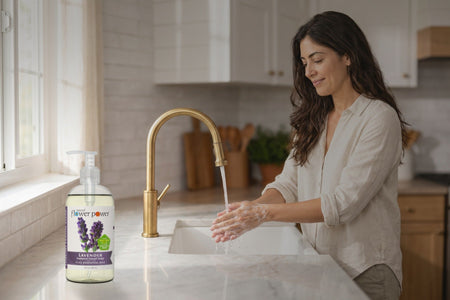
If you're looking for concrete alternatives, our all-purpose cleaners and dish soaps are formulated specifically with this in mind: transparent ingredients, no synthetic fragrances or ammonia, and plant-derived cleaning compounds. But more importantly, take the framework we've outlined here and apply it to any product you're considering. Read the label. Understand what you're buying. Use it thoughtfully. That's the real safety practice.
