What It Is
Quaternary ammonium compounds — commonly called quats or QACs — are a family of synthetic cationic surfactants built around a positively charged nitrogen atom bonded to four organic groups. The most common in cleaning products are benzalkonium chloride (BAC, CAS 8001-54-5), didecyldimethylammonium chloride (DDAC, CAS 7173-51-5), and alkyl dimethyl benzyl ammonium chloride. They function as antimicrobial actives, antistatic agents, and surfactants.
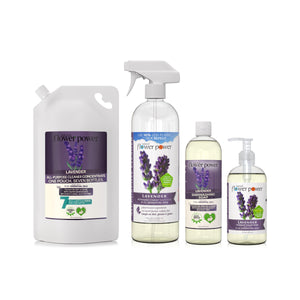
What we make for this
Common Uses
Quats appear in disinfectant sprays, wipes, hospital-grade cleaners, fabric softeners, dryer sheets, hair conditioners, and some hand sanitizers (especially alcohol-free formulations). On EPA-registered disinfectant labels, quats often appear with concentration callouts like "benzalkonium chloride 0.13%." Their use surged dramatically during the 2020–2022 pandemic period and remains elevated in many cleaning categories.
How It Works
Quats kill microorganisms by disrupting cell membrane integrity. The positively charged nitrogen head binds electrostatically to negatively charged sites on bacterial and viral membranes, while the lipophilic alkyl tail penetrates and destabilizes the membrane bilayer. The result is cell lysis. Quats are effective against many gram-positive and gram-negative bacteria, enveloped viruses, and some fungi, though they are less effective against bacterial spores and non-enveloped viruses than oxidizing disinfectants.
Safety and Regulation
Quats are EPA-registered antimicrobial pesticides and remain permitted in cleaning and personal care products. However, an American Chemical Society review published in Environmental Science & Technology in 2023 (Hartmann et al.) classified quats as a "chemical class of emerging concern," citing growing evidence of respiratory sensitization, reproductive toxicity in animal studies, and antimicrobial resistance development. Occupational exposure data from healthcare and janitorial workers shows increased rates of asthma diagnosis (Mount Sinai Selikoff Centers for Occupational Health, 2018). The EPA evaluated a class-based assessment of quats beginning in 2022. California regulators added quats to the Proposition 65 watchlist for further evaluation.
Why Natural Flower Power Does Not Use It
Natural Flower Power does not use quaternary ammonium compounds in any product.
Quats are antimicrobial actives, not surfactants in the cleaning sense — they are designed to kill microorganisms on contact, which means they bring respiratory sensitization and antimicrobial resistance concerns that our plant-derived surfactant system does not. We make cleaning products, not disinfectants. Mechanical removal of soil, grease, and microorganisms by surfactant action plus rinsing handles everyday household cleaning without exposing your family or your indoor air to quat residues. If true disinfection is needed for a specific surface, EPA-registered disinfectants exist for that purpose and should be selected deliberately, not built into every daily-use cleaner.
Related Ingredients
Benzisothiazolinone (BIT) is the preservative Natural Flower Power uses — preservatives protect product shelf life, they are not antimicrobial actives applied to surfaces. Triclosan is another synthetic antimicrobial banned by the FDA in over-the-counter antiseptic wash products. Sodium hypochlorite (chlorine bleach) is a non-quat disinfectant with a different safety profile. Decyl glucoside is a plant-derived non-antimicrobial surfactant.
Sources
- Hartmann, E.M., et al. "Quaternary Ammonium Compounds: A Chemical Class of Emerging Concern." Environmental Science & Technology, vol. 57, no. 19, 2023, pp. 7645–7665.
- Mount Sinai Selikoff Centers for Occupational Health. "Quaternary Ammonium Compounds in Cleaning Products: Information for Workers and Physicians." 2018.
- U.S. Environmental Protection Agency. "Antimicrobial Pesticide Registration." EPA Pesticide Registration Manual, Chapter 4.
- California Department of Toxic Substances Control. "Background Document on Quaternary Ammonium Compounds in Cleaning Products." 2024.
