
This ingredient is used in our products.
What It Is
Benzisothiazolinone (BIT) is a synthetic preservative in the isothiazolinone family (CAS 2634-33-5). Its chemical name is 1,2-benzisothiazol-3(2H)-one. BIT's primary function is antimicrobial preservation — it prevents the growth of bacteria, fungi, and yeast in water-based products that would otherwise support microbial contamination over their shelf life.
What we make for this


Common Uses
BIT is used as a preservative in household cleaning products (all-purpose cleaners, dish soaps, laundry detergents), some personal care products, paints, adhesives, and industrial fluids. In consumer cleaning products, it is typically used at very low concentrations — often between 0.005% and 0.05% of the total formula. It is less commonly found in leave-on personal care products, where other preservation systems are more typical.
How It Works
BIT works by interfering with the metabolic processes of microorganisms. Specifically, it disrupts enzyme systems that bacteria and fungi need to produce energy and maintain their cell structures. At the concentrations used in consumer products, BIT is effective against a broad spectrum of microorganisms while remaining at levels far below those that would affect human cells.
One of BIT's advantages over many other preservatives is that it works across a wide pH range. Some preservatives — like potassium sorbate or sodium benzoate — are only effective at low pH (acidic conditions). BIT functions from roughly pH 4 to pH 12, which makes it versatile for cleaning products that may range from mildly acidic to alkaline.
Safety and Regulation
BIT is approved for use in cosmetics in the EU at a maximum concentration of 0.01% (100 ppm) in rinse-off products (EU Cosmetics Regulation EC 1223/2009, Annex V). In the United States, BIT is permitted in cosmetics and cleaning products with no specific federal concentration limit, though industry practice follows CIR and EPA guidance.
BIT is a known contact allergen. Among the isothiazolinone preservatives, it is less sensitizing than methylisothiazolinone (MIT) and considerably less sensitizing than methylchloroisothiazolinone/methylisothiazolinone (MCI/MI). A European multi-center study found BIT sensitization rates among patch-tested dermatology patients in the range of 1–4%, depending on the population studied. The sensitization risk is concentration-dependent — lower concentrations carry lower risk.
BIT is biodegradable under aerobic conditions and does not bioaccumulate. It breaks down relatively quickly in the environment compared to some other preservative systems.
Why Natural Flower Power Uses It
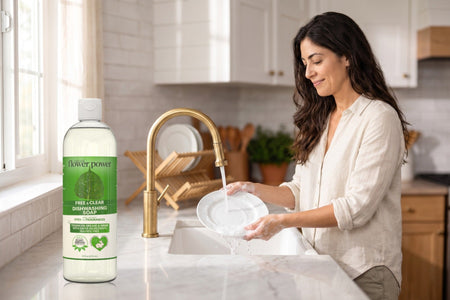
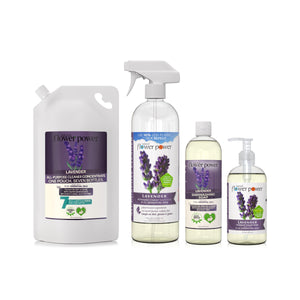
Natural Flower Power uses benzisothiazolinone in its all-purpose cleaners, hand soaps, and dish soaps.
Any water-based product needs a preservative. Without one, bacteria and mold will grow in the bottle — sometimes within days, depending on conditions. That is not a marketing decision; it is a microbiology reality. The question is which preservative to use and at what concentration.
We use BIT at approximately 0.005% — that is roughly 22 drops in a 55-gallon drum. At that concentration, it keeps our products stable and free of microbial contamination throughout their shelf life. We chose BIT over other options for specific reasons: it works across the pH range of all our formulas, it is effective at extremely low concentrations (which means less preservative in the bottle), and it allows us to maintain high plant-derived content in the overall formula. Parabens would also work, but we exclude those for other reasons. Phenoxyethanol requires higher concentrations and only works well at lower pH. Potassium sorbate and sodium benzoate are pH-limited and less reliable as standalone preservation in our formula chemistry.
The tradeoff is that BIT is a known sensitizer for a small percentage of people. At 0.005%, that risk is very low — but it exists, and we acknowledge it rather than pretend it does not.
Related Ingredients
Methylisothiazolinone (MIT) is a related isothiazolinone preservative with stronger sensitization potential — Natural Flower Power does not use it. Phenoxyethanol is an alternative preservative that works at different pH ranges and concentrations. Methylparaben and propylparaben are paraben-class preservatives that Natural Flower Power excludes from all products.
Sources
- EU Cosmetics Regulation EC 1223/2009, Annex V (list of permitted preservatives).
- Scientific Committee on Consumer Safety (SCCS). Opinion on Benzisothiazolinone, 2012.
