What It Is
1,4-Dioxane is a colorless, volatile synthetic chemical compound with the formula C4H8O2 (CAS 123-91-1). It is classified as "likely to be carcinogenic to humans" by the EPA (IRIS, 2013) and as "reasonably anticipated to be a human carcinogen" by the National Toxicology Program. 1,4-Dioxane is not an ingredient that manufacturers deliberately add to consumer products. Instead, it is created as a byproduct during the ethoxylation reaction used to manufacture many surfactants, polyethylene glycols, and ethoxylated emulsifiers.
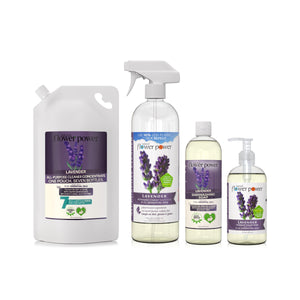
What we make for this
Common Uses
1,4-Dioxane itself is used industrially as a solvent in pharmaceuticals, paints, and laboratory reagents. In consumer products it appears not as an added ingredient but as a residual contaminant in products containing ethoxylated ingredients — typically anything with "-eth" in the name (sodium laureth sulfate, sodium myreth sulfate, ceteareth), PEG-prefixed ingredients (PEG-40, PEG-150), polysorbates, and some ethoxylated alcohols. Common product categories with documented 1,4-dioxane contamination include laundry detergents, dish soaps, shampoos, and bubble baths.
How It Works
The contamination pathway is a chemical reaction byproduct, not a functional ingredient. Ethoxylation involves reacting a starting material — typically a fatty alcohol — with ethylene oxide. A small fraction of ethylene oxide molecules cyclize during the reaction to form 1,4-dioxane, which then remains as a trace contaminant in the finished ingredient unless the manufacturer performs a removal step called vacuum stripping. Because vacuum stripping adds cost, many bulk ingredient suppliers do not include it, and the 1,4-dioxane carries through into finished consumer products at parts-per-million levels.
Safety and Regulation
The EPA Integrated Risk Information System classifies 1,4-dioxane as "likely to be carcinogenic to humans" via the oral route (EPA IRIS, 2013). The National Toxicology Program 14th Report on Carcinogens (2016) lists 1,4-dioxane as "reasonably anticipated to be a human carcinogen" based on liver tumor data in laboratory animals. New York State passed legislation in 2019 (S4389B) capping 1,4-dioxane at 1.0 ppm in personal care and cleaning products by the end of 2023 — the first state to set such a limit. California followed with similar testing requirements under the Safer Consumer Products program. Federal regulation in the United States remains limited to drinking water reference levels.
Why Natural Flower Power Does Not Use It
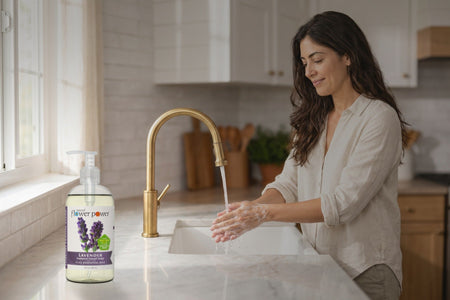
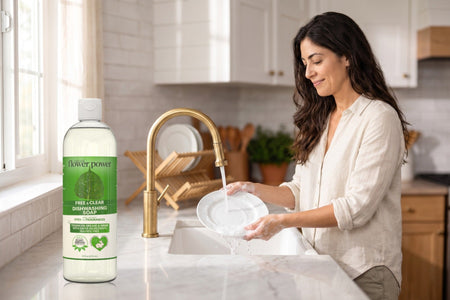
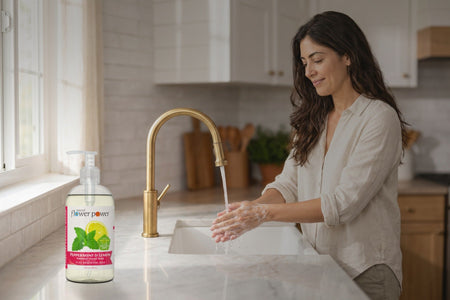
Natural Flower Power does not use ethoxylated surfactants in any product, which means our formulations carry no 1,4-dioxane contamination pathway.
Our plant-derived surfactant choices — decyl glucoside, coco-glucoside, and cocamidopropyl betaine — are manufactured through glycosylation and amidation reactions, not ethoxylation, so there is no opportunity for 1,4-dioxane to form as a byproduct. This was a sourcing decision made deliberately, not a happy accident. The presence of 1,4-dioxane in conventional sulfate-based dish soaps is one of the practical reasons our customers with chemical sensitivities report fewer reactions to our formulations.
Related Ingredients
Sodium laureth sulfate (SLES) is the most-discussed ethoxylated surfactant associated with 1,4-dioxane contamination. C6–C12 / C10–C16 alcohol ethoxylates are NFP-used ethoxylated ingredients — these are produced with vacuum stripping to remove residual 1,4-dioxane below detection limits. Decyl glucoside and coco-glucoside are non-ethoxylated alternatives we use in our hand soaps and dish soaps.
Sources
- U.S. Environmental Protection Agency, Integrated Risk Information System (IRIS). "Toxicological Review of 1,4-Dioxane." EPA/635/R-11/003F, 2013.
- National Toxicology Program. "14th Report on Carcinogens: 1,4-Dioxane." U.S. Department of Health and Human Services, 2016.
- New York State. Senate Bill S4389B (2019), restricting 1,4-dioxane in household cleaning, personal care, and cosmetic products.
- California Department of Toxic Substances Control. "Personal Care and Cleaning Products Containing 1,4-Dioxane." Safer Consumer Products Program, 2022.
