


TL;DR: "Sulfate-free" on a dish soap label tells you what was left out, not what went in — and what went in is the whole story. A good sulfate-free dish soap replaces SLS and SLES with a blend of milder surfactants like decyl glucoside and coco-glucoside, names every ingredient on the label, and is honest about its preservative and its fragrance. This guide walks through the chemistry, the label checks that work on any brand, and what to realistically expect at the sink. Then, with our cards on the table, we explain how our own dish soap is built and where its tradeoffs are.
Search "best sulfate-free dish soap" and you'll mostly find ranked lists. Number one is usually whoever pays the site's affiliate commission, the "testing methodology" is a paragraph of vibes, and the runner-ups exist to make the winner look deliberate. We're not going to pretend to be neutral judges in that contest, because we make a sulfate-free dish soap ourselves and we'd obviously rank it first.
So this is a different kind of guide. Instead of a rigged leaderboard, we'll teach you what actually makes a dish soap sulfate-free and good: which surfactants do the cleaning once sulfates are gone, what to check on any brand's label — including ours — and what performance you should honestly expect. At the end we'll present our own dish soap the way we think every brand should: here's exactly what's in it, here's why, and here's what you give up.
If you can evaluate a label yourself, you don't need anyone's listicle. That's the goal.
What "sulfate-free" actually means
Sodium lauryl sulfate (SLS) and sodium laureth sulfate (SLES) are the workhorse surfactants of conventional dish soap. They're inexpensive to produce, they foam enthusiastically, and they cut grease fast. Brands don't use them out of laziness or malice; they use them because they perform. Any honest conversation about sulfate-free products has to start there.
The case for skipping them comes down to two things. The first is how they treat skin. Sulfates are strong enough that they don't just strip bacon fat from a pan — they strip the oils your skin uses to protect itself, and hand-washing dishes is one of the most repetitive chemical exposures in a home. We walk through the mechanism in detail in how sulfates work and why we skip them.
The second is a manufacturing issue specific to SLES. SLES is made by ethoxylating SLS to make it milder, and that process can leave behind traces of 1,4-dioxane — a contaminant the National Toxicology Program lists as "reasonably anticipated to be a human carcinogen." The FDA describes 1,4-dioxane as a manufacturing byproduct rather than an ingredient, which means it never appears on a label, though the agency's monitoring has found that levels in consumer products have declined significantly over time as manufacturers improved their processes. The realistic takeaway isn't that a bottle of conventional dish soap is dangerous; it's that "what's on the label" and "what's in the bottle" aren't guaranteed to be the same thing, and choosing non-ethoxylated surfactants removes that question entirely.
One more definitional note, because it trips people up: "sulfate-free" refers to a specific family of ingredients — SLS, SLES, ammonium lauryl sulfate, and their relatives, which we've mapped out in our sulfates family guide. It does not mean "contains nothing with 'sulf' in the name." Some genuinely mild surfactants are sulfonates, which sound similar but are built on different chemistry. More on that below, because it matters for reading labels — including ours.

What we make for this
The surfactants that do the work instead
Take the sulfates out and something still has to grab grease and let water rinse it away. In most well-built sulfate-free dish soaps, that job falls to a blend, and the backbone of the blend is usually a glucoside.
Alkyl polyglucosides — decyl glucoside and coco-glucoside are the two you'll see most often — are made by joining plant sugars, typically from corn, with fatty alcohols from coconut or palm kernel oil. They're nonionic, meaning they carry no charge, which is a big part of why they're gentler on skin than charged surfactants like sulfates. They also biodegrade readily. The Cosmetic Ingredient Review Expert Panel assessed nineteen alkyl glucosides in 2013 and concluded they're safe as used in cosmetics when products are formulated to be non-irritating — a meaningful benchmark, since the panel was evaluating leave-on and rinse-off skin contact, which is exactly what hand dishwashing involves. Surfactants in this family also appear on the EPA's Safer Chemical Ingredients List, the roster of ingredients the agency's Safer Choice program draws from when certifying products.
Glucosides alone, though, rarely make a great dish soap. They're mild, but their grease-cutting bite and foam structure benefit from support. So formulators pair them with co-surfactants: amphoteric surfactants like cocamidopropyl betaine and lauramine oxide, which boost foam and actually reduce the irritation potential of the overall blend, and sometimes a mild anionic surfactant for degreasing power. This is where sulfonates come in. Sodium alpha-olefin sulfonate, for example, is coconut-derived, is not a sulfate, and is made without ethoxylation — so the 1,4-dioxane pathway that shadows SLES doesn't apply to it. A brand using a sulfonate in a "sulfate-free" product isn't cheating; it's using a different, defensible chemistry. A brand using a sulfonate and hoping you won't ask about it is another matter, which brings us to labels.
What to check on any brand's label
These five checks work on every dish soap, whoever makes it. They're the difference between buying a claim and buying a formula.
1. A full ingredient list, with real names. Every ingredient, disclosed by its standard name — not "cleaning agents" or "naturally derived surfactant blend." This is more reasonable to demand than it used to be: California's Cleaning Product Right to Know Act has required manufacturers selling in the state to disclose ingredients online since 2020 and on labels since 2021. Any national brand telling you its formula is a trade secret is choosing not to tell you, not unable to. Our broader primer on sulfate-free cleaning products covers what full disclosure looks like across categories.
2. Named surfactants. Once you can see the list, find the surfactants specifically. You now know what to look for: glucosides as a mild backbone, betaines or amine oxides as support, possibly a sulfonate for grease bite. If a product is "sulfate-free" but won't say what it uses instead, you can't evaluate the swap — and the swap is the entire product.
3. Preservative honesty. Any water-based dish soap needs a preservative system; water plus organic material is a growth medium. A brand that names its preservative is being straight with you. A water-based product claiming to be "preservative-free" deserves more skepticism, not less, because either something in the formula is doing preservative work unlabeled, or the product has a problem.
4. Fragrance disclosure. The single word "fragrance" on a label can legally stand in for a long list of undisclosed aroma chemicals. Look for brands that either name their scent sources — specific essential oils, ideally — or offer a genuinely fragrance-free option with no masking scents. California's disclosure law also forces fragrance allergens above 0.01 percent into the open, which is slowly making the single-word "fragrance" line rarer among honest brands.
5. Skepticism toward vague virtue words. "Non-toxic" has no legal definition on a cleaning product. Neither does "natural," "gentle," or "chemical-free" (everything is chemicals, including water). These words aren't proof a product is bad — plenty of decent products wear them — but they carry no information. The ingredient list carries information. When a label leans hard on adjectives and light on disclosure, the ratio itself is the signal.
What to expect at the sink
Here's the part rigged listicles skip: honest performance expectations. Sulfate-free dish soaps clean well, but they behave differently from the mass-market bottle you grew up with, and knowing the differences up front prevents disappointment that has nothing to do with actual cleaning power.
Foam is different, and foam isn't cleaning. Sulfates produce dramatic, persistent suds; that's a large part of why they dominate. Glucoside blends foam respectably but usually less extravagantly, and the suds may fade sooner in a sink full of greasy water. The foam is mostly theater — grease removal happens whether or not the bubbles persist. If you judge a dish soap by suds longevity, sulfate formulas will always win; if you judge it by the state of the plate after rinsing, the gap closes to nearly nothing.
Grease comes off; technique matters slightly more. For everyday dishes — plates, glasses, cookware with normal cooking residue — a well-built sulfate-free soap handles the job without drama. For heavy jobs like a roasting pan or a deep fryer's aftermath, you'll want hot water, an adequate squirt, and a few minutes of soaking rather than brute chemical force. We've written practical walkthroughs in getting grease off dishes without sulfates, and if you're wondering whether the plant-derived chemistry genuinely holds up, do plant-derived cleaners work on grease goes through the mechanism honestly.
Your hands should notice. This is the payoff for the whole exercise. Milder surfactants take less of your skin's protective oil with them, and for people who wash dishes daily — or whose hands crack every winter — the difference compounds. If that's the problem that brought you here, why dish soap dries out your hands covers what's happening and what actually helps.
You'll likely pay more per ounce. Glucosides and coconut-derived co-surfactants cost more to make than commodity sulfates. A brand charging more for a sulfate-free formula isn't necessarily gouging; the inputs are genuinely more expensive. Whether that premium is worth it is your call to make — which is exactly why you should be able to see what you're paying for on the label.
Our pick, with our cards on the table
We told you at the top: we make one, so we're not neutral. Here's our dish soap presented under the same five checks we just handed you, tradeoffs included.
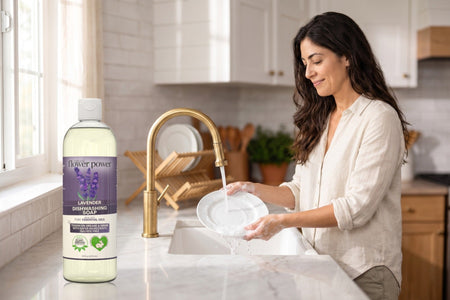
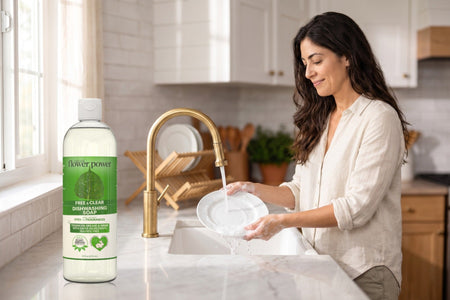
Our Free & Clear Liquid Dish Soap is built on four named surfactants, all coconut- or plant-derived: sodium alpha-olefin sulfonate, cocamidopropyl betaine, cocamide DIPA, and decyl glucoside. Yes — the first one is a sulfonate, the "sounds like sulfate but isn't" chemistry we flagged earlier. We use it because it brings real degreasing bite that a purely nonionic blend lacks, it's made without ethoxylation, and we'd rather name it and explain it than bury it. Every ingredient we use, in every product, has its own page in our ingredients library, because we think "what's in this" should never require a customer service email.
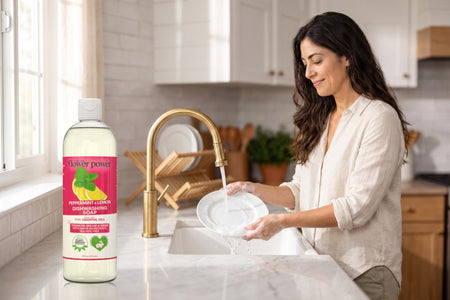
The Free & Clear version has no added fragrance, no masking scents, and no dyes. Our scented dish soaps use only essential oils — never synthetic fragrance — so the scent sources are named, specific, and checkable. Everything is made with plant-derived ingredients, formulated and bottled in-house in Cameron Park, California, where we've been making products since 2012. We're independently owned, which means nobody upstream of us gets a vote on what goes in the bottle.
The tradeoffs, stated plainly: it costs more per ounce than a warehouse-brand sulfate formula, because the surfactants cost more — we accept that cost because the mildness is the point of the product. The foam is real but not theatrical, for the reasons above. And a 16 fl oz bottle is smaller than the big-box jug; our answer to that is the 66 fl oz refill pouch, which refills the bottle four-plus times and uses 78 percent less plastic than buying the equivalent bottles. If none of that fits how your kitchen works, another well-labeled sulfate-free brand may suit you better — the label checks in this guide will tell you which ones are being straight with you.
Where to start
If fragrance-free is your baseline — sensitive skin in the house, or you just don't want your soap competing with dinner — start with the Free & Clear dish soap. If you'd rather have a named essential-oil scent over your sink, the full lineup is in our dish soaps collection, and every scent lists its exact oils.
Before you buy anything — ours or anyone's — spend two minutes with the ingredient list and run the five checks. If you hit an ingredient you don't recognize, our ingredients library exists for exactly that moment, and it covers the ingredients we avoid as thoroughly as the ones we use.
Every NFP product is backed by our 90-Day Love-It Guarantee: if it doesn't work for your household — the grease, the foam, your hands, any of it — we make it right. That's the honest way to test a buyer's guide: against your own sink.
