


TL;DR: Citrus oils are squeezed out of the peel rather than distilled out of it, and that changes what ends up in the bottle. Their dominant compound, d-limonene, is a genuine grease solvent — by the standard solvency test it outranks mineral spirits. We use whole cold-pressed orange and lemon oils instead of isolated limonene, and that choice carries real tradeoffs: citrus oil oxidizes into documented skin sensitizers, and both the ASPCA and Pet Poison Helpline flag citrus for pets, cats especially.
Most essential oils in cleaning products are there for the smell. The honest position on what essential oils do in a cleaner beyond scent is that the functional claims range from well-documented to wishful. Citrus is the exception: orange and lemon peel oil is one of the few botanicals where you can point to an industrial datasheet and say this is a solvent, here is its rating, here is what it dissolves.
That makes citrus worth a closer look than most oils get, and worth being careful about, because the same chemistry that lifts grease off a stovetop sits behind the two most common complaints about citrus cleaners: skin reactions once a bottle has been open a while, and worry about pets. Both are legitimate; neither is a reason to avoid citrus outright.
Cold-pressed means pressed, not distilled
Nearly every essential oil you've heard of is steam distilled. Plant material meets pressurized steam at close to boiling, the aromatic compounds evaporate, the vapor condenses, and the oil separates out. That's how peppermint, lavender, and lemongrass oils are made.
Citrus doesn't need the heat. The oil sits in glands just under the surface of the peel, and mechanical pressure is enough to rupture them. Modern equipment scores or abrades the rind while water carries the released oil away to a centrifuge — the old hand method of pressing zest against a sponge, industrialized. No steam, no solvent, no heat stage. Most of the world's supply is a co-product of the orange juice industry, which makes orange oil one of the least wasteful botanicals in a cleaning formula: the peel already exists.
Method shows up in the finished oil. Pressed oils yield more per pound of peel and smell closer to the fruit, because nothing was cooked. They also carry heavier, less volatile compounds steam can't lift over — waxes, pigments, and in lemon a small fraction of furocoumarins. Steam-distilled citrus oil is cleaner, more stable, and longer-lived precisely because it leaves those behind; it also smells flatter. Pressed oil is the more delicate, perishable, expensive option, and the one that smells like peel.

What we make for this

Why "contains limonene" isn't the same as cold-pressed citrus oil
Cold-pressed orange oil is dominated by a single terpene: d-limonene, often 90 percent or more of the oil by volume. That invites an obvious shortcut. If limonene does most of the work, why not skip the fruit and buy the molecule?
Plenty of formulators do. Limonene can be recovered and purified from citrus processing streams, or synthesized industrially by isomerizing alpha-pinene from turpentine. Isolated limonene is consistent, cheap at scale, and specifiable to a defined purity — real advantages if what you want is one predictable molecule.
It isn't what we want. We use whole cold-pressed citrus oils rather than isolated synthetic limonene, because the remaining few percent of a pressed oil is where its character lives. The minor aldehydes and terpenes that survive pressing are why cold-pressed lemon oil smells like a lemon while a purified terpene smells like a solvent with a citrus note. We'd also rather name a fruit on a label than a manufactured isolate — the same reasoning we apply when choosing essential oil suppliers.
Plainly: that's a sourcing and transparency preference, not a claim that pressed oil out-cleans purified limonene molecule for molecule. On raw solvency they're close cousins. We accept the higher cost and shorter shelf life anyway.
The degreasing is real, and it's measurable
Solvent strength has a standard test. The Kauri-butanol value, defined by ASTM method D1133, measures how much solvent it takes to cloud a standard resin solution; higher numbers mean stronger solvency for oily, non-polar soils. D-limonene comes in around 67. Mineral spirits — the petroleum solvent in a lot of conventional degreasers — sits near 37.
That gap is why d-limonene isn't a health-food-store curiosity but a working industrial solvent, sold by the drum for parts washing, automotive degreasing, adhesive removal, and graffiti cleanup. Its terpene structure slips into the non-polar chains of motor oils and heavy lubricants and undercuts them so they rinse away. Nobody buys 55 gallons of orange terpene for the aroma.
In a household cleaner the effect is proportionally smaller but the same in kind: citrus oil helps with the greasy, sticky, waxy soils that water and surfactant struggle with — cooking film on a range hood, adhesive residue from a price sticker, the tacky layer on cabinet fronts near a stove. It works alongside our plant-derived surfactants on grease rather than replacing them.
One boundary we won't blur: solvency is not sanitizing. Our cleaners are not disinfectants and we don't market them as such, however much of the internet insists otherwise about citrus oil.
The scent story, and why we name the fruit
Our Citrus & Spice line is where cold-pressed citrus does double duty. The scent is pressed-peel brightness warmed slightly so it reads as spiced rather than sharp — and the citrus oil creating that scent is the same citrus oil helping with the grease. Function and fragrance are one line item.
Lemon oil does scent work in our Peppermint & Lemon products too, sitting against menthol instead of spice. In both cases the label names the oil. We don't use "fragrance" as an umbrella term, so anyone with a known citrus sensitivity can read the ingredient list and make their own call — far more useful than a "natural fragrance" claim. We formulate and make everything ourselves in Cameron Park, California, as we have since 2012, so we know which lot of oil went into which batch.
Tradeoff one: citrus oil oxidizes, and oxidized limonene sensitizes
This is the most important caveat in the article, and the one citrus-cleaner marketing usually leaves out. Limonene itself has low sensitizing potential. But on exposure to air it autoxidizes, and among the oxidation products are limonene hydroperoxides, which are potent skin sensitizers. This isn't a fringe finding: hydroperoxides of limonene and linalool show up frequently as positive reactions in patch-test studies across European and US dermatitis populations, and research on oxidized d-limonene has found positive rates comparable to allergens in the standard testing series. It's why the European Union's Scientific Committee on Consumer Safety has assessed limonene specifically for its oxidation behavior, and why limonene is one of the individual fragrance allergens EU rules require to be declared above set thresholds — whether it arrived inside a natural citrus oil or as an isolate. Your skin doesn't distinguish.
Practically, age and storage matter more for a citrus product than a fragrance-free one. Keep the bottle closed and out of heat and direct sun, buy sizes you'll get through, and treat a long-forgotten citrus cleaner from the back of a cupboard with more suspicion than a fresh one. If you already know you react to fragrance, this is a reasonable place to choose the unscented option instead; our fuller take is in scented versus fragrance-free cleaning products. There's no version of citrus chemistry where this risk is zero, so we won't tell you it is.
Tradeoff two: pets, and cats in particular
Citrus and pets deserve a straight answer, so here's what the animal-health authorities actually say. The ASPCA's toxic-plant database lists both lemon and orange as toxic to dogs, cats, and horses, identifying the toxic principles as essential oils and psoralens, with vomiting, diarrhea, depression, and potential dermatitis as clinical signs. It notes the fruit is edible while the skins cause the problems — a useful reminder that peel is where cleaning-grade citrus oil comes from. The ASPCA's professional guidance on essential oils adds that oral and dermal exposure concern them more than inhalation, and that cats, rabbits, guinea pigs, and hamsters can be more sensitive to skin exposure because grooming turns it into an oral one.
Pet Poison Helpline is more specific: it lists citrus oil (limonene) among the essential oils known to cause poisoning in cats, and explains why cats stand out — they lack a liver enzyme other species use to metabolize and clear these compounds. Dogs don't share that deficiency, though the helpline is clear dogs can still be affected.
None of that describes a diluted cleaner wiped onto a counter and dried, but it explains why we don't hand-wave the question. In a cat household the sensible habits are the boring ones: let treated surfaces dry before the cat is back up on them, keep concentrate out of reach, ventilate while you work, and use the fragrance-free option around litter areas and food bowls. The full routine is in our guide to safer cleaning around cats and dogs. If a pet does get into something, ASPCA Animal Poison Control is at (888) 426-4435.
Tradeoff three: photosensitivity, which mostly isn't a cleaning issue
You'll see warnings that citrus oils make skin sun-sensitive. That's true, and specific. Cold-pressed lemon oil carries furocoumarins — bergapten and relatives — that distillation leaves behind, which is why expressed lemon oil is considered phototoxic and distilled lemon oil isn't. A phototoxic reaction needs the compound sitting on skin when UVA hits it.
That's a leave-on concern: massage oil, lotion, perfume applied before a day outdoors. For wash-off products the risk is considered negligible, because the compound doesn't stay on skin — and a diluted cleaner you wipe away is further still from the scenario. We mention it only because you'll meet the claim and deserve to know where it applies.
Where to start
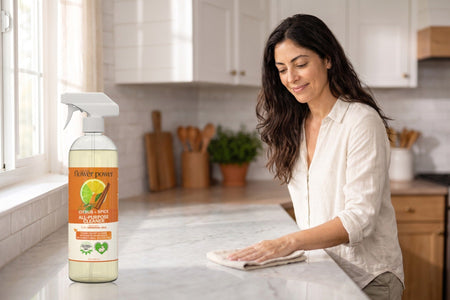
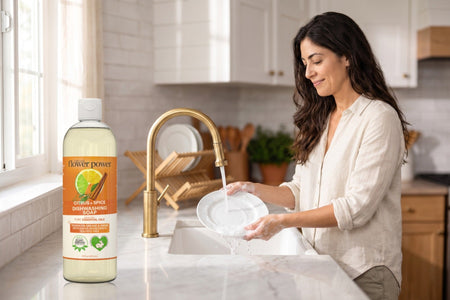
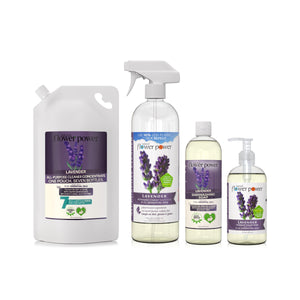
If you want to see what pressed citrus does on grease, start where grease lives. The Citrus & Spice all-purpose cleaner is 99% plant-derived and bio-based and earns its keep on stovetop film, range hoods, and cabinet fronts; the Citrus & Spice dish soap is the one for baked-on pans. If you go through cleaner quickly, the Citrus & Spice all-purpose refill uses 78% less plastic than buying bottles and is ready to use after adding water. To compare oils across our scented range, the essential oils collection names exactly what's in each one.
Every NFP product is backed by our 90-Day Love-It Guarantee: if it doesn't work for your household, for any reason, we make it right. With citrus that matters more than usual, because the honest answer to whether this scent and this chemistry suit your home, your skin, and your animals is that you have to try it and see.
