


TL;DR: Bulk concentrate is the cheapest way to buy cleaning products per diluted ounce, and it dramatically cuts the plastic and shipping weight that come with ready-to-use bottles. But it only pays off if you'll actually use it before it ages out: a big container that outlasts its shelf life is no bargain. Large households, home daycares, short-term rental hosts, and cleaning-heavy small businesses genuinely benefit; occasional cleaners are usually better off with a standard bottle and refill. Whoever you are, the rules are the same: measure instead of guessing, mind your water, and store big containers labeled and low.
There's a version of this article that just says "bigger is cheaper, buy the big one." We're not going to write that version, because it isn't true for everyone, and we'd rather you buy the size you'll actually finish.
Here's the context: we're in the process of adding larger bulk sizes to our lineup, the kind of multi-quart and multi-gallon formats we used to supply when Natural Flower Power was a commercial cleaning operation. Concentrates are where we started, and bringing back bigger containers is a return to our roots rather than a new experiment. But a decade of making household-sized products has taught us that bulk concentrate is a tool with a specific job. For the right kitchen, it's the best value we offer. For the wrong one, it's a jug that sits in a garage slowly going past its prime.
So this is the honest guide: who bulk concentrate is genuinely for, who it isn't, how to dilute it properly, and how to store a container that's heavier than anything else under your sink.
What a concentrate actually is
Every liquid cleaner is mostly water. That's not a criticism; water is the carrier that lets surfactants spread, dissolve grime, and rinse away. It's the first ingredient on nearly every label, including ours — we've written a whole ingredient page on water and why its quality matters in a formula. The difference between a ready-to-use product and a concentrate is simply where that water gets added: at our facility, or at your sink.
A ready-to-use spray arrives with all its water already in the bottle. A concentrate arrives with most of the water left out, and it becomes ready to use only after you add water at home. That qualifier matters. Concentrate straight from the container is stronger than the formula was designed to be used at: it can be wasteful on surfaces, harder to rinse, and harsher on skin than the diluted product. Dilution isn't a suggestion on the label; it's the final manufacturing step, and you're the one performing it.
This is exactly how our refill system already works, just at household scale. If you've used our refills to top up a 32 fl oz bottle, you already understand the mechanics — we walk through them step by step in how to refill your cleaning products. Bulk formats are the same idea with a bigger container and more diluted product per purchase.

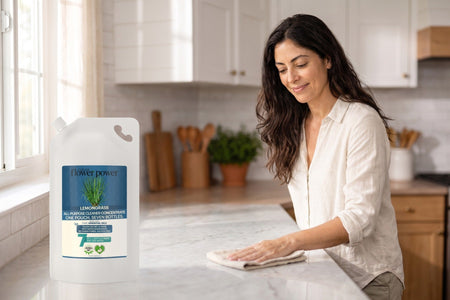
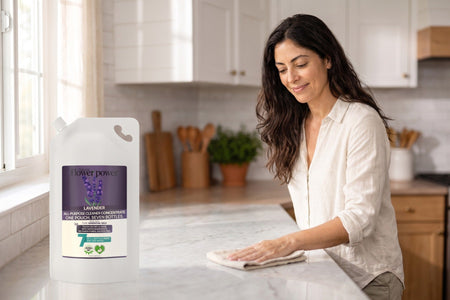
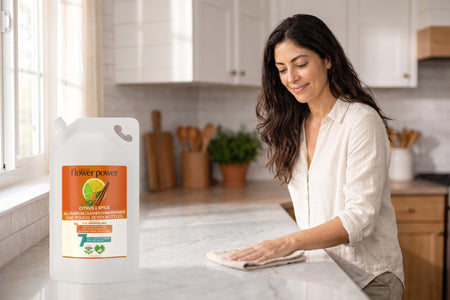
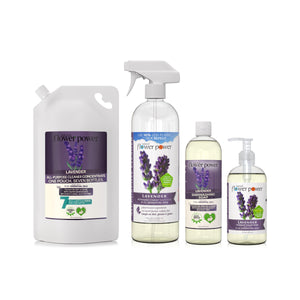
What we make for this
Who genuinely benefits from buying bulk
The single question that decides whether bulk concentrate makes sense: how fast do you go through diluted product? Everything else — price per ounce, plastic savings, convenience — flows from that. Here's who tends to answer "fast."
Large households. If you're running a dishwasher-optional kitchen for five or six people, washing hands a few dozen times a day, and wiping counters after every meal, you're refilling bottles constantly. A household like this can empty a standard refill in weeks, which means a bulk container gets used well within its lifespan and the per-ounce savings are real.
Home daycares. Surfaces get cleaned many times a day when small children are involved, and many providers prefer products with fewer harsh ingredients for everyday wiping around kids. One honest caveat: our products are cleaners, not disinfectants or sanitizers. If your licensing requires a sanitizing step for certain surfaces, that's a separate product doing a separate job — a plant-derived cleaner handles the everyday cleaning around it.
Short-term rental hosts. Airbnb and vacation-rental turnovers are cleaning-intensive by design: every checkout means a full reset of kitchen, bathrooms, and touchpoints. Hosts managing even one busy property go through diluted cleaner at a pace that makes single retail bottles feel silly. Bulk concentrate plus a set of labeled spray bottles is the standard setup in that world for a reason.
Small offices and studios. A break-room sink, a shared bathroom, desks and door handles — none of it is dramatic, but it's daily, and somebody is buying the soap. One bulk container replaces months of small-bottle purchasing decisions.
Cleaning-heavy small businesses. Salons, cafés, gyms, workshops — anywhere the cleaning happens hourly rather than weekly. This is the customer we originally built our formulas for, and it's the customer bulk formats serve best. The same caveat applies as with daycares: where health codes require sanitizing or disinfecting, that's a regulated category our products don't claim; for general-purpose cleaning, concentrate is the economical workhorse.
Who probably shouldn't buy bulk (yes, really)
If you live alone, cook a few nights a week, and clean on weekends, a bulk container is likely the wrong buy — and we'd rather tell you that than sell you one.
The reason is shelf life. Cleaning products don't last forever: surfactants stay stable for a long time, but essential oil scents fade and shift, and preservative systems are designed to protect a formula for a finite window, not indefinitely. We covered the details in do cleaning products expire? — the short version is that a well-stored product is typically at its best for a couple of years, and a bulk container an occasional cleaner buys today may still be half full when that window closes. At that point the "savings" have evaporated: you paid less per ounce for ounces you never used.
There's a comfortable middle ground, and it's the one most households actually belong in: a standard bottle plus our refill sizes. You still skip most of the single-use plastic, you still get better per-ounce pricing than buying a new bottle every time, and the quantity matches a normal household's pace. The refill system exists precisely for this — bulk is simply the next rung up for people who outgrow it.
A quick self-test: look at how long your current bottle of dish soap or all-purpose cleaner lasts. If a standard refill lasts you six months, bulk isn't for you yet. If you're refilling every few weeks and it's starting to feel like a chore, keep reading.
The math: cost per diluted ounce
Bulk pricing only makes sense when you compare the right numbers. The number on the shelf tag — price per ounce of what's in the container — is misleading for concentrates, because an ounce of concentrate isn't an ounce of usable product. The number that matters is cost per diluted ounce: what you pay for each ounce of ready-to-use cleaner after you've added the water.
The calculation is simple. Take the price of the concentrate, figure out how many diluted ounces it makes (the dilution ratio on the label tells you), and divide. A hypothetical example with round numbers: a concentrate that costs $40 and makes sixteen 32 fl oz bottles yields 512 diluted ounces, or about 8 cents per diluted ounce. A $6 ready-to-use bottle of the same size works out to almost 19 cents. Run that math on any concentrate you're considering — ours or anyone's — and the shelf-tag illusion disappears.
The second half of the math isn't on your receipt. Because ready-to-use cleaners are mostly water, shipping them means paying — in freight cost and in fuel — to move water around the country, and packaging them means a new plastic bottle for every gallon of what is largely tap water. Concentrates flip that: the water gets added at your sink from your own tap, so a single container replaces a long line of bottles. Our refills already cut plastic by 78 percent compared to buying new bottles, and larger bulk formats push the same logic further. We've unpacked the freight-and-plastic side of this in the environmental case for concentrated cleaners, but the summary is: the cheapest ounce to ship is the one that's water you added yourself.
Dilution done right
Concentrate rewards a little precision. Here's what a decade of making these formulas has taught us about doing the water-adding step well.
Measure — don't glug. Free-pouring concentrate into a bottle "until it looks right" almost always over-doses. Over-diluted product cleans poorly and makes you distrust the formula; over-concentrated product wastes money, leaves residue that attracts new dirt, and is harder on skin. Use a measuring cup, a marked dosing cap, or a pump with a known output, and follow the ratio on the label. Thirty seconds of measuring is the entire skill.
Water first is a good habit for sudsy formulas. Adding concentrate to water, rather than water to concentrate, keeps foaming formulas like dish and hand soap from turning your bottle into a foam column before it's full.
Mind your water quality. The water you add becomes an ingredient, so it's worth knowing what's coming out of your tap. Hard water carries dissolved calcium and magnesium that can blunt a surfactant's performance — the U.S. Geological Survey classifies water above roughly 180 milligrams of dissolved minerals per liter as "very hard," and a lot of American tap water qualifies. If your glassware comes out of the sink spotty and your kettle scales up, you have hard water; you may find you get better results diluting spray-bottle batches with filtered or distilled water, or using the slightly stronger end of the label's dilution range.
Mix what you'll use within a reasonable time. A sealed concentrate is protected by its preservative system at full strength; once you dilute it, that protection is spread across a lot more water. This is normal and by design — preservative systems are built to protect the product through its intended use — but it's the reason we suggest mixing bottles you'll use within a few months rather than diluting an entire container the day it arrives. If you're curious how preservation actually works in water-based products, our preservative systems guide covers it without the scare tactics.
Label every bottle you fill. What's in it, what the dilution was, and the date you mixed it. Future-you, three bottles deep, will not remember.
Back to where we started
Bulk concentrate isn't a pivot for us. Before Natural Flower Power made a single retail bottle, we were a commercial cleaning company, and concentrates in big containers were the daily reality: they're how professional cleaning has always worked, because nobody who cleans for a living pays to ship water. The formulas we sell today grew directly out of that work — we tell the full story in why we started with commercial cleaning.
We've made our products in-house since 2012, and everything still comes out of our own facility in Cameron Park, California. That matters for bulk formats specifically: a concentrate is only as good as the consistency of the formula and the honesty of the dilution ratio on the label, and because we manufacture ourselves, both of those are ours to control. Larger sizes are us handing our original format back to the people it was designed for — this time with the ingredient standards we've spent a decade refining, plant-derived surfactants and sulfate-free formulas included.
Storing and handling larger containers
A bulk container is heavier and lasts longer than anything else in your cleaning cupboard, so it deserves slightly more thought than a spray bottle.
Keep it in its original container. Poison control centers are emphatic on this point: household chemicals should stay in their original, labeled packaging, and should never be transferred into food or drink containers — juice bottles, jars, cups — where someone could mistake them for something drinkable. The original label also carries the ingredient and first-aid information anyone would need in an emergency. When you do decant into working spray bottles, label them clearly with the contents.
Store it low. A full multi-gallon container is a two-hands object. Keep it on the floor or the lowest shelf — never overhead, where lifting it down is an accident waiting to happen — and somewhere cool, dry, and out of direct sunlight, which is the same storage that protects shelf life. A garage that stays temperate works; a spot next to a water heater or in an attic doesn't.
Make dispensing easy. Wrestling a heavy jug over a funnel every week gets old fast, and spills waste more product than bad measuring ever will. A simple spigot or pump turns refill day into a one-handed job. Dispense at counter height or in a sink so drips land somewhere forgiving.
Keep it away from kids and pets, and don't mix products. Concentrates are stronger than diluted product, so the everyday rules apply with more force: cabinet locks or high-traffic-proof placement if small children are around, and never combine different cleaning products in one container — even gentle formulas are designed to work alone.
Where to start
If you've read this far and recognized yourself in the "who benefits" list, here's the practical path. Our larger bulk formats are arriving soon; if you run a rental, a daycare, an office, or a business that goes through cleaner quickly and you want first word when they land, reach out and ask — we're happy to talk through sizes and dilution for your situation.
In the meantime, the concentrate logic is already available at household scale: our refill sizes cover dish soap, hand soap, and all-purpose cleaner in every scent we make, and All About Refills explains the system in five minutes. If you'd rather see products on a shelf before committing to volume, we're stocked in more than 700 stores — the store locator will find the nearest one.
And whichever size you choose, it's covered by our 90-Day Love-It Guarantee: if it doesn't work for your household — or your rental, or your shop — we make it right. That promise was easy to extend to bigger containers, because concentrates are where we learned to make cleaning products in the first place.
