


TL;DR: The CDC credits plain soap, friction, and at least 20 seconds of scrubbing with physically removing germs from your hands, and the FDA has said outright that consumer antibacterial soaps haven't been shown to work better than plain soap and water. So the germ question is settled by technique, not by a special soap. What isn't settled is your skin: once you're washing ten or more times a day in dry indoor air, the formula starts to matter, because stripped, cracked hands are both uncomfortable and a reason people quietly stop washing. Our hand soaps are not antibacterial and make no germ-kill claims. They're built to be gentle enough that you'll keep washing all season.
Flu activity in the US usually starts climbing in October, most often peaks somewhere between December and February, and can stay elevated into May, according to the CDC. Which means early September is the last quiet stretch before the season, and a good moment to think about the one habit that carries the most weight through it.
Most cold-and-flu-season advice about hand-washing stops at "wash your hands more." That's fine advice, and it's incomplete, because it ignores what happens to your hands in month three. If you're a teacher, a nurse, a parent of a kid in daycare, or just someone who touches doorknobs for a living, "wash more" adds up to something like ten to fifteen washes a day for eight straight months, in a house or building with the heat running and the humidity on the floor. That combination is what produces the split knuckles and the stinging-under-cold-water feeling that show up around January.
So this is a piece about two things that get tangled together on soap labels. First: what actually removes germs, which is a settled question with a boring answer. Second: what's in the soap, which has nothing to do with germs and everything to do with whether your hands can tolerate the habit long enough for it to help.
What actually removes the germs
The CDC's explanation of hand-washing is mechanical, not chemical. The surfactants in soap lift soil and microbes off skin; lathering and scrubbing create friction that helps pry dirt, grease, and microbes loose; and rinsing under running water carries them away. The CDC also notes that people simply scrub more thoroughly when they're using soap, which removes more germs on its own.
That's the whole mechanism. Germs get physically removed and go down the drain. No step in there requires the soap to kill anything.
The CDC's five steps are: wet your hands with clean running water, warm or cold, then turn off the tap and apply soap; lather, including the backs of your hands, between your fingers, and under your nails; scrub for at least 20 seconds; rinse well under clean running water; and dry with a clean towel or air dryer. On the 20 seconds, the CDC's position is specific: studies show you need roughly that long to remove harmful germs, and if you wash for less time you won't remove as many.
The payoff is real and worth stating plainly. The CDC cites studies showing hand-washing can prevent about 1 in 3 diarrhea-related illnesses and about 1 in 5 respiratory infections, including colds and flu. For something that costs a few cents a wash, that's an unusually good return.
When soap and water aren't available, the CDC says to use an alcohol-based hand sanitizer with at least 60% alcohol, checking the label to confirm the concentration. But its stated preference is unambiguous: washing with soap and water is the best way to get rid of germs in most situations.

What we make for this
Why we don't sell an antibacterial hand soap
This is the part of the article where a lot of brands would introduce a germ-fighting hero ingredient. We don't have one, and we want to be direct about why.
In 2016 the FDA issued a final rule barring 19 active ingredients, including triclosan and triclocarban, from over-the-counter consumer antiseptic wash products — liquid, foam, and gel hand soaps, bar soaps, and body washes. The agency's reasoning was that manufacturers hadn't provided the data needed to show those ingredients were both safe for daily long-term use and any more effective than plain soap and water. In its consumer guidance on the subject, the FDA's summary of the evidence is that there isn't sufficient evidence that over-the-counter antibacterial soaps are better at preventing illness than washing with plain soap and water. The rule covers consumer washes used with water; it doesn't apply to hand sanitizers, hand wipes, or the antibacterial soaps used in hospitals and other healthcare settings, which are a different category with different evidence behind them.
So the regulator that would have to approve a germ-kill claim on a consumer hand soap looked at the data and concluded the claim hadn't been earned. Natural Flower Power hand soaps are not antibacterial, are not disinfectants, and we make no germ-kill claims about them. They are soap. Soap plus friction plus 20 seconds is what the CDC credits, and that's the mechanism our products participate in.
Being clear about this also makes the rest of the conversation honest. If no consumer soap gets to claim it removes more germs than another, the only variables left worth comparing are the ones nobody markets: how the formula treats your skin, and whether you'll keep using it.
Ten washes a day changes the math
A single wash with a harsh soap is a non-event; your skin barrier recovers before you notice. The problem is cumulative, and cold season is when the arithmetic turns against you.
The WHO's hand hygiene guidelines describe the mechanism in careful detail: repeated exposure to soaps and detergents can cause chronic cumulative irritant contact dermatitis, because detergents remove skin-surface lipids, damage skin proteins, and denature the keratin in the outer layer. Frequent washing disrupts the epidermal barrier, and once that barrier is compromised the inflammatory response follows. This is well-documented in the population that washes most — healthcare workers — and it's the same physics in a kitchen or a classroom.
Winter stacks two more variables on top. Heated indoor air is dry air, so water leaves your skin faster between washes. And cold-weather habits push people toward hotter water, which strips lipids more aggressively. Note that the CDC's own instruction says warm or cold water: temperature isn't part of the germ-removal mechanism, so the very hot wash buys you nothing and costs your hands something.
What's in the soap matters here because surfactants are not interchangeable. Dermatology research on frequent hand-washers has repeatedly used sodium lauryl sulfate as the reference irritant precisely because it's so reliable at disrupting the barrier, and studies of hand dermatitis risk have found that how a person reacts to it is among the better predictors of who develops the condition. That's the same family of ingredients we've written about in how sulfates work and why we skip them, and the reason our formulas are sulfate-free — no SLS, SLES, or ALS in any of them.
If you want the fastest demonstration of all this, it's the one most people already have: the reason dish soap dries out your hands is that dish detergents are formulated to demolish grease, and the lipids in your skin barrier are also grease. Cold-season hand-washing frequency turns hand soap into the same kind of repeated exposure, which is the case we made at length in why hand soap quality matters.
Cracked skin is its own problem
Dry hands are uncomfortable. Cracked hands are a different category, for two reasons that both matter more in cold season.
The first is that broken skin is harder to clean well. Fissures, inflamed patches, and raw knuckles don't tolerate 20 seconds of scrubbing, and they compromise the barrier that's supposed to be keeping things out.
The second is behavioral, and it's the one that actually derails a season. When washing hurts, people wash less. They cut it to five seconds, they skip the backs of their hands, they rinse without soap, they reach for sanitizer on visibly dirty hands because it stings less than the sink. Nobody decides to stop washing their hands during flu season. They just start washing badly. And since the CDC's benefit depends on scrubbing long enough to remove germs, a shortened wash is a smaller benefit.
This is the honest version of why soap choice matters at all: not because one soap removes more germs, but because the one that doesn't hurt is the one you'll still be using properly in February.
The technique, and when to use it
Worth running through once at the start of the season, because most of us drift. Follow the CDC's five steps, and give the 20 seconds its due — it's longer than it feels, which is why the humming trick exists. Cover the spots that get skipped: backs of hands, between fingers, thumbs, under the nails. Use warm or cold water rather than hot. Dry with a clean towel rather than leaving hands damp, and be gentle about it; briskly scrubbing already-irritated skin with a rough paper towel adds mechanical insult to chemical.
On timing, the CDC's key moments are the ones to build around: before, during, and after preparing food; before eating; after using the toilet; after changing a diaper or cleaning up a child who used the toilet; after blowing your nose, coughing, or sneezing; before and after caring for someone who's sick, especially with vomiting or diarrhea; and before and after treating a cut or wound.
Two cold-season additions worth making into habits: wash when you come home, before you touch your face or the fridge handle, and wash after handling anything a sick household member has been handling.
Hand care that lasts eight months
The most useful thing we can tell you is that the soap is only half of it. The WHO's hand hygiene guidance is specific here: several controlled trials have found that regular use of products containing humectants, fats, and oils helps prevent and treat the irritant contact dermatitis that hand hygiene products cause, and the timing matters — apply a cream or ointment-based emollient right after water exposure, before the skin has fully dried, to head off rapid drying and cracking.
That guidance also comes with a caveat we'd rather you hear from us than discover in January. A humectant works by attracting and holding water, and a water-based humectant used alone can end up increasing water loss as its water content evaporates. In other words, humectants are genuinely useful, and they aren't a complete answer by themselves. Barrier repair also wants lipids.
Which is exactly how we'd frame the humectants in our own hand soaps. Every one of them includes glycerine and aloe barbadensis leaf juice. Glycerine is the best-studied humectant there is, and controlled work has found that glycerol-treated skin recovers barrier function faster than untreated skin. Aloe's measured contribution to skin hydration is real but modest, and it doesn't supply the structural lipids the barrier is built from. So: both earn their place in a soap you use fifteen times a day, and neither replaces a proper moisturizer. Keep one at the kitchen sink and one in your bag, and use it while your hands are still slightly damp.
A few other things that help through a long season. Wear gloves for dishes and cleaning, since that exposure is longer and harsher than hand-washing. Rings trap soap and water against skin, so rinse under them or take them off. And if your hands are reactive to begin with, cold season is the wrong time to introduce a new scent — the approach in cleaning products for sensitive skin is to strip the variables down first and add back only what you've tested.
Getting kids to wash their hands
Kids are the reason cold season is cold season, and they're also where technique falls apart fastest. A few things that make the difference.
Twenty seconds is an abstraction to a six-year-old, so make it a song, a count, or a specific tune they choose. Kids also wash the palms and nothing else, so name the parts out loud — backs, between fingers, thumbs, nails — until it's automatic. Water temperature should be comfortable rather than hot, both because hot water isn't doing anything for germ removal and because it makes the whole thing something they'll resist.
Sting is a bigger deal for children than adults, and it's a real compliance problem: a soap that makes small, already-chapped hands hurt is a soap that produces a five-second rinse and an argument. A gentler, unscented formula removes both the sting and the fragrance question at once, which is the same reasoning we walk through in choosing safer cleaning products with young children in the house. And moisturizer applies to kids too — after the bath, on damp skin, is the easiest slot to make it stick.
One more, for the adults: kids copy what they see. Washing properly at the sink they use does more than any reminder taped to the mirror.
Where to start
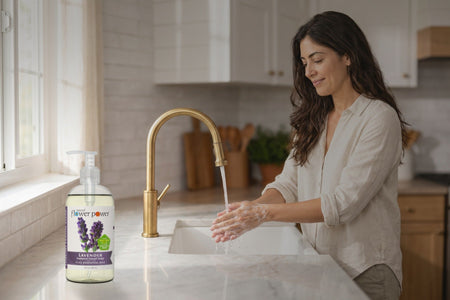
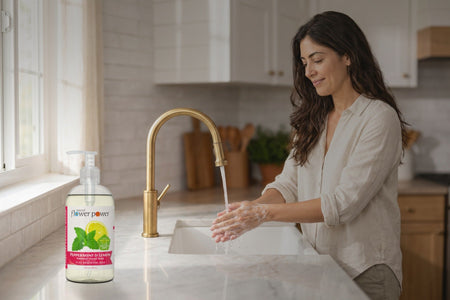
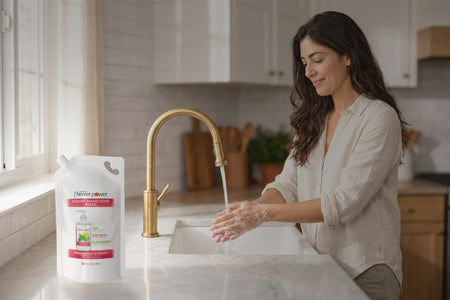
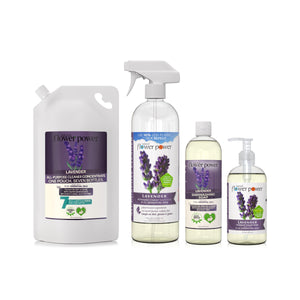
Every soap in our hand soap collection is sulfate-free and made with plant-derived ingredients, with glycerine and aloe in every formula and the complete ingredient list published on every page. They aren't antibacterial, they don't claim to kill anything, and their job is to be gentle enough that you keep washing the way the CDC describes for the whole season. If it's early September and you're stocking up, the fragrance-free Free & Clear hand soap is the simplest formula we make and the one we'd point to for chapped hands, reactive skin, or a sink the kids share. Everything is made in-house at our facility in Cameron Park, California, where we've controlled every formulation decision since 2012, and you can read what each ingredient is and why it's there on our Ingredients & Transparency hub before you buy.
Every NFP product is backed by our 90-Day Love-It Guarantee: if it doesn't work for your household, for any reason, we make it right. Which is the right way to test a hand soap you're about to use several thousand times before spring — on your own hands, in your own dry winter air, with nothing riding on it if the answer is no.
