


TL;DR: Cats aren't small dogs: they lack the liver enzyme that breaks down phenols, which turns a short list of cleaning ingredients — phenols, quats, bleach, ammonia, and certain concentrated essential oils — into genuine feline hazards. Here's the mechanism, the exposure math, and our honest recommendations for cat households, including about our own scented products.
Most pet-safety advice treats "pets" as one category. For cleaning products, that's a mistake, because cats are the special case the whole topic bends around. We covered the full multi-species picture in our pet-safe cleaning guide; this article is the feline deep dive — why cats specifically, which ingredients specifically, and what to do about it in a real household.
The enzyme cats don't have
Cats are deficient in glucuronyl transferase, the liver enzyme most mammals — dogs and humans included — use to neutralize phenolic compounds. It isn't a sensitivity or an allergy. It's a missing metabolic pathway: what your liver clears in hours can accumulate in a cat's system, damaging the liver and nervous system. This single fact explains most of what's different about cleaning around cats.
Phenols show up in some traditional disinfectants (especially products marketed for heavy-duty antimicrobial action) and, in smaller amounts, in certain essential oils. For a dog, trace exposure is usually a non-event. For a cat, the math is different because the compound doesn't leave.

What we make for this
The exposure route is grooming, not drinking
Almost no cat drinks cleaner from a bucket. The real route is quieter: she walks across a damp floor or counter, the residue coats her paws, and then she does what cats do — grooms, thoroughly, ingesting whatever she picked up. Add that cats live low (floors, baseboards, the area around the litter box, which gets cleaned more often and more aggressively than most surfaces) and breathe close to where vapors settle, and a cat's real chemical exposure can exceed yours in the home you both share.
That's why the single most protective habit costs nothing: keep cats off cleaned surfaces until they're completely dry. Dried residue on a sealed surface is a far smaller ingestion risk than wet film on the floor she's about to cross.
The four ingredient groups that matter most for cats
Phenols and phenolic disinfectants. The enzyme gap above makes these the top exclusion. Check labels for "phenol" or "phenolic"; symptoms of exposure include drooling, vomiting, tremors, and lethargy.
Quaternary ammonium compounds (quats). The active ingredient in many disinfecting wipes and "hospital-grade" cleaners — and cats are notably sensitive to them. Veterinary toxicologists have documented corrosive mouth and tongue injuries in cats from grooming residue off treated surfaces. Look for "benzalkonium chloride" or anything containing "ammonium" in a long chemical name.
Bleach and ammonia. Airway irritants for every species, worse for animals breathing at floor level — and cats are oddly attracted to bleach's smell, which makes wet bleached surfaces a real hazard rather than a theoretical one. Never mix the two anywhere, but especially not in a home with animals; the chloramine gas they produce settles exactly where pets breathe.
Certain essential oils, at concentration. The same enzyme gap that makes phenol dangerous makes some essential oils risky for cats — tea tree, pine, wintergreen, citrus (d-limonene), eucalyptus, peppermint, and ylang ylang are the documented ones. Concentration and route matter enormously: a puddle of undiluted oil is a different universe from trace amounts in a finished, dried product. But the risk is real, and any brand that scents with essential oils owes cat owners a straight answer about it.
Our straight answer, since we scent with essential oils
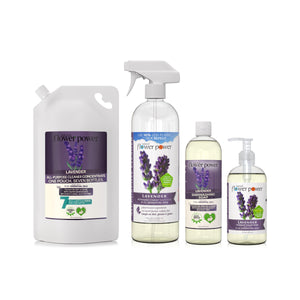
Natural Flower Power's scented products use named essential oils — including peppermint and citrus oils, which appear on the caution list above. We're not going to pretend that away.
Here's our honest guidance for cat households. If you want zero essential-oil exposure, use our Free & Clear all-purpose cleaner, dish soap, and hand soap — the line exists precisely for households where fragrance of any origin is a concern, feline or human. If you use our scented products, apply the dry-surface rule without exceptions, and skip scented sprays around your cat's core territory — bedding, feeding area, litter zone. Our air fresheners don't come in a Free & Clear version, so for a cat-sensitive household the honest recommendation is to keep air-freshener spray out of the cat's spaces entirely, or skip that category around the cat altogether.
Every scent component in every product is named on its page — no "fragrance" catch-alls — so you or your vet can check any specific oil against your specific cat. That's the transparency that makes an informed decision possible, and it's the standard you should hold any brand to, ours included. Our ingredient library covers all of it in plain English.
The 60-second label check for cat households
Before a cleaning product comes home to a cat, scan the label for four things: any form of phenol; any quat (benzalkonium chloride is the common one); bleach or ammonia; and the bare word "fragrance" — because an undisclosed blend can't be checked against the feline caution list, which makes it unevaluable rather than automatically dangerous. A product that fails the fourth test isn't necessarily toxic; it's unknowable. With a cat's enzyme gap, unknowable is the thing to avoid.
If exposure happens
Rinse or wipe her paws and coat with plain water promptly — before grooming does the ingesting — and watch for drooling, vomiting, wobbliness, tremors, or unusual lethargy over the next several hours. If symptoms appear, or if the product contained phenols, quats, bleach, or ammonia, call your veterinarian, the ASPCA Animal Poison Control Center at (888) 426-4435, or the Pet Poison Helpline at (855) 764-7661. Both hotlines are staffed by veterinary toxicologists around the clock (a consultation fee applies), and the first thing they'll ask for is the ingredient list — keep the bottle.
Common questions from cat owners
Is vinegar safe to clean with around cats? Diluted white vinegar is one of the lower-risk options for cat households — it's an irritant at full strength and cats hate the smell, but it isn't a phenol-pathway problem. Its limitation is performance: it's a weak cleaner for grease and it isn't a disinfectant, whatever the internet says.
What about essential-oil diffusers? Higher risk than cleaning products, honestly — active diffusers aerosolize concentrated oil continuously into air a cat can't opt out of, and droplets settle on fur that gets groomed. If your cat has airway issues or you run oils from the caution list, the safest answer is not to diffuse in the cat's living space. We say that as a company that sells essential oils.
My cat licked a freshly cleaned floor. Panic? Usually no — check the label first. If the cleaner was free of phenols, quats, bleach, and ammonia, a lick of dilute residue is very unlikely to cause harm; rinse her paws, offer water, and watch her. If it contained any of the four, or you can't tell because the label hides behind "fragrance," call one of the hotlines above with the bottle in hand.
Cats concentrate everything this blog cares about: ingredient transparency stops being a philosophy and becomes a practical necessity, because the animal grooming your kitchen floor off her paws can't read the label and can't metabolize your mistake. Know the four groups, hold every brand to full disclosure, keep her off wet floors — and the rest of it gets much less scary than the internet makes it.
