


TL;DR: Most cleaning products don't have a hard expiry date; they have a slow decline. Surfactants keep working for a long time, but scents oxidize, formulas separate, and anything containing water is a potential home for bacteria and mold. A few products do have documented shelf lives — Clorox states its concentrated bleach holds label strength for six months from manufacture, and hydrogen peroxide fades once opened. For liquid cleaners, the number that matters isn't printed on the bottle: it's whether the formula is preserved at all. "Preservative-free" on a water-based cleaner is a claim we'd question, and we'd rather tell you which preservative we chose and why.
This is one of the questions we get most often, usually with a slight apology attached: "I found a bottle of your dish soap at the back of the cupboard from, um, a while ago. Is it still good?" The honest answer has more parts than you'd expect.
Cleaning products are not food. They don't rot, and almost none become dangerous with age. But they do change. The surfactants that actually do the cleaning are usually the most stable thing in the bottle, while the parts you notice first — scent, clarity, thickness — are the parts that drift. And there's a category of change that nobody markets and everybody should understand: microbial growth in a water-based formula that wasn't properly preserved.
So rather than invent a date, here's what actually ages in a bottle, which products have real published shelf lives, and the uncomfortable middle of this topic — the preservative.
Four different things people mean by "expired"
Performance fade. The product still works, just less. A dish soap that used to cut a greasy pan in one pass now takes two. Surfactants are fairly robust, but pH drifts, thickeners relax, and the balance shifts.
Physical separation. An emulsion is a truce between ingredients that would rather not be mixed, and temperature swings break that truce: cloudiness, a layer at the top, thin patches. Often cosmetic and reversible with a shake — sometimes a symptom of a formula that has destabilized.
Scent oxidation. The fastest clock in most naturally scented products, and the subject of its own section below.
Microbial growth. The only one that's a hygiene issue rather than a performance issue, and the reason preservatives exist. Water plus organic material is a growth medium. A cleaner that develops a bacterial or mold population isn't a weaker cleaner; it's a contaminated one, and shaking doesn't fix it. Only this last one resembles "expired" as most people use the word — the first three are a gradient, not a cliff.

What we make for this

Which products have real, documented shelf lives
Here's where we disappoint anyone hoping for a tidy chart. Most household cleaners carry no expiration date because none is required, and where brands print one it reflects their own stability testing rather than a common standard. Many bottles carry only a batch or lot code, which the manufacturer can decode for you. Two chemistries are the well-documented exceptions, and both are oxidizers.
Chlorine bleach is the clearest case. Clorox's published guidance is that its concentrated bleach is formulated to hold its label sodium hypochlorite concentration for six months from the date of manufacture, and the company publishes a way to decode the date stamp on the bottle. After that the hypochlorite keeps breaking down into salt and other byproducts, and heat accelerates it — a bottle in a hot garage fades considerably faster than one in a cool cupboard. Dilution speeds the decline further, which is why institutional protocols call for mixing bleach solutions fresh. If you keep bleach for disinfecting, an old bottle is a real problem: you may believe a surface has been disinfected when the active ingredient is largely gone.
Hydrogen peroxide is the other. It decomposes into water and oxygen, a reaction driven by light — which is why it ships in brown or opaque bottles — and by heat. Commonly reported figures put a sealed household bottle at roughly one to three years of useful strength, dropping to months once opened and repeatedly exposed to air. Fresh 3% peroxide fizzes immediately on contact; a bottle that barely reacts has lost most of its punch.
For everything else — dish soaps, hand soaps, all-purpose cleaners, laundry liquids — you'll find confident numbers online, usually between one and two years. We won't repeat them as fact, because they aren't traceable to a standard or a testing protocol. What a surfactant cleaner actually depends on is an intact preservative system and reasonable storage. Get those right and its practical life is measured in years, with the scent degrading long before the cleaning does.
Why a water-based cleaner needs a preservative
This is the part the natural cleaning category tends to skip, so we'll be direct.
Water is the first ingredient in nearly every liquid cleaner on the market, including ours. Water plus the organic material in a plant-derived formula — sugar-based surfactants, glycerine, plant oils — is, from a microbe's point of view, dinner. Formulation science is unambiguous: high-water products are the category where microbial growth is most likely, and they are preserved for exactly that reason. Every time you open a cap, touch a pump, or top off a bottle, you hand bacteria, yeast, and mold a fresh chance.
Which is why "preservative-free" on a water-based liquid cleaner should make you curious rather than reassured. There are only two possibilities behind it. The product may be preserved by something the brand doesn't count as a preservative — a high or low pH, a high concentration of alcohol or salt, an organic acid doing double duty. That's legitimate chemistry, but it's still preservation, and the label is a wording choice rather than a formulation achievement. Or the product is genuinely unpreserved, in which case its real risk profile is worse than a preserved product's, not better. This is the same species of vague label language we pick apart in why "chemical-free" doesn't make sense.
Preservatives are also not one thing. Parabens, formaldehyde-releasers, isothiazolinones, phenoxyethanol, and organic acids are distinct classes with different mechanisms and very different regulatory records, and our preservative systems guide compares them class by class. The useful shift: the question isn't whether your liquid cleaner is preserved. It's which preservative was chosen, at what level, and whether the brand will say so.
What we use, and the tradeoff we accepted
We preserve our water-based products with benzisothiazolinone, usually written as BIT. It's on every label, by name. We chose it because it's effective against bacteria and mold at very low use levels in our formulas, and because it let us decline the alternatives we didn't want. We use no parabens. We use no formaldehyde-releasers such as DMDM hydantoin or quaternium-15 — formaldehyde itself is classified by the International Agency for Research on Cancer as carcinogenic to humans, and we'd rather not build a formula that slowly releases it. And within BIT's own chemical family we don't use methylisothiazolinone or the MCI/MIT mixture, the members regulators have restricted most tightly; the American Contact Dermatitis Society named methylisothiazolinone its Contact Allergen of the Year in 2013.
Now the honest part. BIT is a recognized skin sensitizer. The EU's Scientific Committee on Consumer Safety has explicitly declined to establish a safe exposure threshold for BIT with respect to sensitization — the regulatory position is that it may provoke an allergic reaction in susceptible people. What the research offers instead is exposure modelling: a peer-reviewed analysis estimated that BIT below roughly 0.035% in dish soap and 0.021% in spray cleaner is unlikely to induce skin sensitization, and the Cosmetic Ingredient Review has recommended 15 ppm for rinse-off products. Low levels in rinse-off products are the well-characterized end of that range, and that's where our use sits.
We accept that tradeoff deliberately, and we'd rather explain it than hide it. An unpreserved water-based cleaner isn't a safer product — it's a product with a microbial risk nobody wrote on the label. One well-characterized preservative, used at low concentration and named on the label, is the version we can defend. The detail sits on its own benzisothiazolinone page; the broader logic is in how we formulate our products.
Scent goes first
If you open an older bottle of a naturally scented cleaner and think "that smells different," you're smelling chemistry rather than imagining it.
Essential oils don't spoil microbially; they oxidize. Aromatic molecules react with oxygen and convert into chemically different compounds, a process that starts the moment a bottle meets air and accelerates with heat and light. Citrus oils move fastest because they're dominated by limonene, a monoterpene highly reactive with oxygen; typical shelf life figures for cold-pressed citrus oils land around nine to twelve months, shorter if stored warm. Lavender's linalool and peppermint's menthol change too, just more slowly.
The part that matters beyond aesthetics: oxidized fragrance compounds are generally more allergenic than their fresh forms, not less. Research comparing oxidized and non-oxidized geraniol found reaction rates several times higher in the oxidized form. So for fragrance-sensitive skin, an old scented product carries a slightly different risk than a fresh one — one reason we suggest starting fragrance-free while you're still identifying triggers, as we lay out in scented versus fragrance-free cleaning products. How oils behave inside a cleaning formula is covered in our essential oils in cleaning guide.
Practically: scent fade is the earliest honest signal that a bottle is getting old. It doesn't mean the cleaner stopped cleaning.
Storage, in four unglamorous rules
Cool. Reaction rates rise steeply with temperature — roughly doubling for every 10 °C (18 °F) increase. A cupboard beats a garage, and a garage in a Sacramento-area summer, which we know intimately from making products in Cameron Park, is the worst storage in the house.
Dark. Light drives oxidation, of essential oils and oxidizers like peroxide alike. Under the sink beats a sunny windowsill, even for a good-looking bottle.
Capped. Every hour a bottle spends open is oxygen exposure and a contamination opportunity. Don't decant into an open jug.
Clean and dry, if you're reusing a bottle. The rule people skip. Wash, rinse, and let it dry before refilling — residual old product plus a wet interior is exactly the environment a preservative then has to fight. Professional cleaning guidance discourages topping off spray bottles for this reason: bottles and spray mechanisms accumulate contamination over repeated refills.
Concentrates, refills, and diluted product all age differently
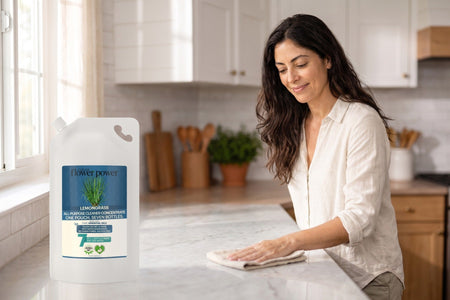
A concentrate is the most stable format you can buy, because there's proportionally less water in it: a less hospitable environment, and a preservative system that isn't stretched thin. Concentrates are also, by definition, ready to use only after adding water — and that step resets the clock. Diluting one into a spray bottle makes a new, more dilute product: more water, less preservative per unit volume, a fresh set of microbial opportunities. Treat diluted working solutions as short-lived and mix what you'll actually use.
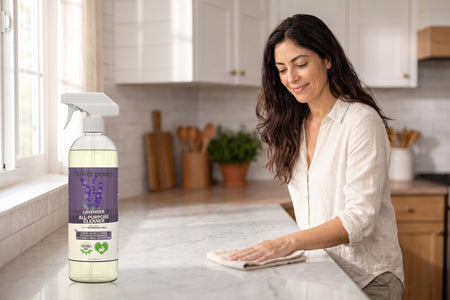
Our refills don't all behave the same way, and the difference matters here. Hand soap and dish soap refills are full-strength liquid — you pour one into the bottle you already own and use it straight away, so it ages exactly the way the original bottle did. All-purpose cleaner and air freshener refills are concentrates, ready to use only after adding water, which puts them under the paragraph above: very stable sitting in the sealed pouch, and the clock restarts on whatever you mix in the bottle. So don't read "refill" as one shelf-life category — check which of the two you're holding. Either way, wash and dry the receiving bottle before you fill it. The reasoning behind running both formats, including the friction we don't pretend away, is in why we offer refills and how the refill system works.
Which makes the sensible buying pattern unromantic: a deeply discounted case that sits for three years isn't a saving if the scent has turned and the bottles have been through two garage summers.
How to tell if a bottle has actually turned
Look. Persistent separation that won't recombine after a good shake, a colour shift, cloudiness in something that was clear, or anything filmy, stringy, or floating. Visible growth of any kind ends the conversation: dispose of it. A soap that's merely gone watery or gluey has had its thickener system change — a performance issue, not a hygiene one.
Smell. Faded is normal and fine. Sour, musty, yeasty, or off in a way that isn't merely weaker is the signal that something is living in there — a different smell from a lemon scent gone flat, and you won't mistake it twice.
Use it and watch. If it still cuts grease and rinses clean, it's working. If a dish soap suddenly needs three times as much for the same pan, that's a signal. And if a product that never bothered your hands starts to, stop using it and check the label against what you know about your own skin — we list everything in what we put in our products. And when you do pour an old cleaner away, dilute it with running water rather than emptying a full bottle down the drain, particularly on a septic system.
Where to start
If a cupboard audit is what brought you here: pull everything out, check dates on any bleach or peroxide, smell the rest. The one or two bottles that have turned will be obvious. If you're buying rather than auditing, match your quantities to how fast your household actually goes through cleaner. Our refills are built for that rhythm — you keep the bottle and we ship the product without the extra packaging layer, whether that's a pour-and-go soap refill or a concentrate you top up with water. If you're new to us and want to test before committing to volume, the start here collection is the smallest sensible first order.
And if the preservative question is what brought you here, read the ingredient pages rather than taking our word for it. Every ingredient we use — including the ones with genuine tradeoffs, like our preservative — has its own page in our ingredient library, written to include the parts that aren't flattering. We've made these products in our own facility in Cameron Park, California since 2012, which is why we can tell you exactly what's in a bottle.
Every NFP product is backed by our 90-Day Love-It Guarantee: if it doesn't work for your household, for any reason, we make it right. We'd rather sort out a bottle that isn't right than have it sit at the back of your cupboard for two years, slowly proving the point of this article.
