


TL;DR: Eucalyptus oil is unusual among essential oils because its dominant compound does a job you can measure. Roughly half to four-fifths of the oil is 1,8-cineole, or eucalyptol, and published solvent research has tested cineole as a grease solvent serious enough to propose as a replacement for petroleum-derived industrial degreasers. What it is not is a disinfectant, and we don't claim it kills anything. The tradeoffs are real too: the secondary compounds oxidize fast in storage, and the ASPCA lists eucalyptus as toxic to dogs, cats, and horses.
Most people know what eucalyptus smells like even if they've never bought a bottle. It's the smell of a steam room, a freshly mopped locker room, a sprig hung over a shower head. It reads as "clean" so reliably that it has become a kind of shorthand — and scent shorthand is usually a substitute for function, not evidence of it.
Eucalyptus is one of the few cases where the shorthand has chemistry underneath it: the compound responsible for the smell is also the compound solvent chemists have studied as a degreaser. That doesn't make it a miracle ingredient, and it definitely doesn't make it a sanitizer. But it does mean the oil is doing something besides smelling nice, which is the standard we hold every botanical to when we ask whether essential oils earn their place beyond scent.
What eucalyptus oil actually is
Eucalyptus oil is steam distilled from the leaves and twigs of eucalyptus trees. The species that dominates the household market is Eucalyptus globulus, sometimes called blue gum — the sharp, medicinal, unmistakably eucalyptus version of the smell rather than the softer lemon-scented varieties.
Its main compound is 1,8-cineole, known by the common name eucalyptol. Authentic, non-rectified E. globulus oil typically runs from around 50 percent up into the low 70s for cineole content, while rectified oil, redistilled to concentrate the cineole, can exceed 80 percent. Published compositional analyses of globulus oil have reported cineole at roughly 77 to 80 percent. Commercial grading is organized around that number — eucalyptus oil is bought and sold on its cineole percentage.
The remaining fraction matters more than its size suggests. One published analysis put the rest at limonene near 6.5 percent, alpha-pinene near 5 percent, and gamma-terpinene near 3 percent, plus a tail of minor constituents. Those secondary compounds shape the smell — and, as we'll get to, they're the part of the bottle that goes off first.

What we make for this
Where it comes from
There are close to 800 eucalyptus species, and essentially all of them are native to Australia. Australia is still the reference point for premium high-cineole oil, but it is no longer where most of the world's supply is distilled — cultivated plantations elsewhere account for the large majority of global production, with China dominant and India significant. Our own eucalyptus globulus is steam distilled from leaves and wood sourced out of India.
That geography matters because eucalyptus oil is a commodity with a wide quality spread. Two bottles can both say "eucalyptus oil" and differ in cineole percentage, in distillation care, and in how long the oil sat before reaching you — which is why how we choose essential oil suppliers is a longer conversation than the label shows.
Cineole is a documented grease solvent
Here's the part that separates eucalyptus from decorative botanicals. Cineole has been studied specifically as an industrial degreasing solvent. Work published in the Flavour and Fragrance Journal tested cineole and cineole blends against conventional degreasers and concluded that while no single solvent was likely to replace 1,1,1-trichloroethane across every application, cineole had strong potential to replace it as a degreaser specifically — one blend exceeded trichloroethane's degreasing ability once the solvent itself had become grease-contaminated. Cineole is also readily biodegradable and recoverable from spent solvent by steam distillation.
Now the caveat, and it's a big one. An industrial degreasing bath is not a diluted household cleaner. In a consumer formula, eucalyptus oil is present at a fraction of a percent, and the surfactants do the overwhelming majority of the work. Eucalyptus contributes at the margin, not the reason a cleaner cuts grease. What the research establishes is narrower and still worth something: the compound has a mechanism, rather than being inert perfume riding along in the bottle. That's the whole difference between an essential oil and a fragrance, which we unpack in our comparison of essential oils versus fragrance oils.
One thing we won't stretch: there is a substantial laboratory literature on eucalyptus oil's activity against bacteria and fungi in petri dishes, and none of it makes a cleaner a disinfectant. In-vitro activity at concentrations far above anything in a consumer product tells you nothing reliable about your counter after twenty seconds of wiping. Our products are not registered disinfectants and we don't claim they kill germs. If you need disinfection, you need a registered disinfectant used at its labeled contact time.
Why eucalyptus reads as "clean"
The scent profile is cool, sharp, and camphoraceous over a woody-sweet base. Globulus is the most medicinal-smelling of the common eucalyptus varieties, which is precisely why it signals cleanliness so strongly. It doesn't smell like a flower or a fruit. It smells like a decision was made about a room.
That's a legitimate function as long as it's named as one. What we won't do is let the smell stand in for cleaning performance, or hide it behind the word "fragrance" so nobody can check what's in there — the same reasoning behind our take on scented versus fragrance-free cleaning products. One expectation to set: essential-oil scent mixes with the air, handles the odor, and fades rather than hanging around for hours the way synthetic fragrance does. We accept that tradeoff because the alternative is fixative chemistry we don't want in the bottle.
Oxidation is the tradeoff nobody markets
Cineole itself is reasonably stable. The problem is the minor fraction. Limonene and alpha-pinene oxidize readily on exposure to air, heat, and light, and studies tracking peroxide values in stored eucalyptus oil found the sharpest increase during the first month. Oxidized limonene is a documented skin and respiratory irritant, and it sits on the European Union's list of individually declarable fragrance allergens for exactly that reason. An oxidized bottle also smells worse: the sharp top note goes flat.
On sensitization, eucalyptus does better than most essential oils, and it's worth being precise rather than reassuring. In the German IVDK patch-test network's analysis of essential oil sensitization from 2010 to 2019, ylang ylang produced the most positive reactions at 3.9 percent of patients tested and lemongrass came second at 2.6 percent. Every other oil in the series, eucalyptus included, came in at 1.1 percent or below, with eucalyptus among the lowest. Earlier European surveillance data put positives to eucalyptus oil at roughly 0.25 percent when patch tested at 2 percent.
Low is not zero. Allergic contact dermatitis from eucalyptus is documented, including occupational and airborne cases in people who handle the foliage. If you have a known fragrance allergy, patch test first, and treat an old bottle as riskier than a fresh one. Practically: amber glass, cap tight, cool cupboard, a size you'll finish — the same storage logic in our guide to essential oils in cleaning.
Pets and kids: the part we won't soften
Eucalyptus is on the ASPCA's toxic plant list, and the listing is explicit: toxic to dogs, toxic to cats, toxic to horses, toxic principle "essential oils: eucalyptol," clinical signs salivation, vomiting, diarrhea, depression, and weakness. Pet Poison Helpline adds proportion: small ingestions of a few leaves or of low-concentration oil tend to cause minor nausea, while exposure to high-concentration essential oil can produce neurologic abnormalities and, rarely, kidney impairment. Skin absorption counts, not just ingestion.
The human numbers deserve the same respect. The National Capital Poison Center states that a teaspoonful or less of undiluted eucalyptus oil can be fatal, that symptoms usually appear within thirty minutes but can be delayed hours, and that children under two should not be given eucalyptus oil at all. Their storage advice is ours: keep eucalyptus-containing products up, away, and out of sight.
The distinction that matters in practice is concentration. The risk lives in the neat oil on a shelf, not in a diluted cleaner used and wiped away — which is a reason to be deliberate rather than relaxed. Don't leave the undiluted bottle where a dog or a toddler can reach it, don't run a diffuser hard in a closed room shared with a cat or a bird, and rinse surfaces a pet routinely licks. The full household version of this is in our guide to safer cleaning around cats, dogs, and other pets — read it before buying eucalyptus, not after.
Where eucalyptus sits in our line
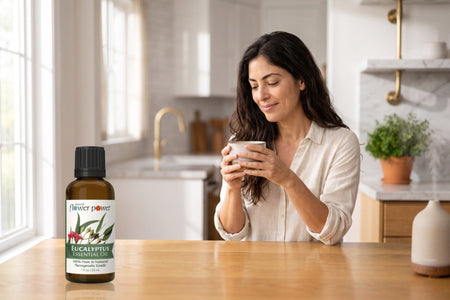
We sell eucalyptus globulus as a pure, undiluted single oil in a 1 fl oz amber glass bottle, steam distilled, one ingredient on the label, no carrier oil or additives. It is not currently blended into any of our air freshener scents — those are lemon with cinnamon and cassia in Citrus & Spice, plus lavender, lemongrass, and Peppermint & Lemon. If eucalyptus ever goes into a formula of ours, it will be named on the label. An oil hidden behind the word "fragrance" can be diluted or swapped without telling anyone; an oil printed by name can't.
We've been formulating and making everything ourselves since 2012, in our own facility in Cameron Park, California. Independently owned, in-house manufacturing, which here mostly means we know which drum of eucalyptus went into which batch and when it arrived — less romantic than a sourcing story, more useful when someone with a fragrance allergy calls to ask.
Where to start
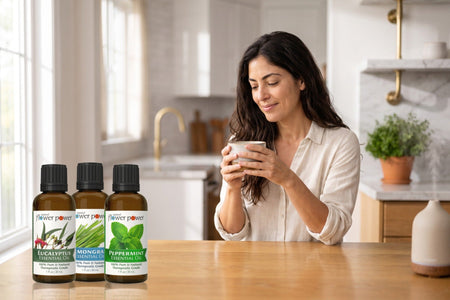
To work with eucalyptus directly, the essential oils collection is where to go. Eucalyptus globulus is there as a single oil, which is the most flexible way to use it: a few drops in your own countertop spray or floor bucket, at a concentration you control. If you'd rather have scent handled for you in a formula that's already balanced and diluted, our air fresheners use only named essential oils and plant-derived isolates — no synthetic fragrance, no phthalates, no dyes. Every oil we work with has a page in our ingredient library if you want to check a compound against your own sensitivities first.
Every NFP product is backed by our 90-Day Love-It Guarantee: if it doesn't work for your household, for any reason, we make it right. Eucalyptus is a strong, opinionated smell in a home that may include animals, and the only real way to learn whether it belongs in yours is to try it and pay attention.
