

TL;DR: The major pregnancy health organizations treat routine household cleaning as low-risk, with sensible precautions: ventilate, wear gloves, go easy on aerosol sprays, and never mix bleach with ammonia. The alarming findings you've seen in headlines mostly come from occupational research on people who clean for a living — hours of daily exposure that doesn't describe wiping down your own kitchen. Heightened smell sensitivity in pregnancy is common and real, which makes fragrance-free a comfort choice worth knowing about — not a safety promise. And any specific concern belongs in a conversation with your healthcare provider, not on a product label.
Somewhere in the first trimester, a lot of people have the same small crisis in the cleaning aisle. A product you've used for years suddenly smells unbearable, a well-meaning relative forwards an article about "toxins," and a quick search returns two kinds of answers: breezy reassurance that everything is fine, and fear-based marketing suggesting you throw out everything under your sink and buy whatever the article happens to sell.
Neither is the truth, and we should be upfront about our own position here: we make cleaning products, which means you should read us with the same skepticism you'd apply to anyone else in that second category. So let's set the ground rules now. Nothing in this article is medical advice. We will not be calling any product "pregnancy-safe" — including our own — because that's a claim no honest company should make about a body and a pregnancy it knows nothing about. What we can do is walk through what the actual guidance from health organizations says, separate the occupational research from the household reality, and explain why we think a complete ingredient list is the single most useful thing a cleaning product can offer you right now.
What the guidance actually says
Start with the sources whose job is answering exactly this question. MotherToBaby, the pregnancy exposure information service run by the Organization of Teratology Information Specialists, puts it plainly: common household cleaning products, used as directed on the label, are not expected to increase risks to a pregnancy. Their reasoning is about routes of exposure — you aren't drinking the stuff, so what reaches a developing baby from normal use is very little. Tommy's, the UK pregnancy charity whose information is written with midwives, lands in the same place: most modern cleaning products are very low risk, especially if you use the stronger ones sparingly and follow the label.
The American College of Obstetricians and Gynecologists approaches it from the clinical side. Its guidance on toxic environmental agents (Committee Opinion 832) recommends that obstetric clinicians ask patients about environmental exposures as part of prenatal care. That tells you two useful things at once: exposures during pregnancy are worth taking seriously as a topic, and the right venue for your specific situation is your provider's office — not a comments section, and not a brand's marketing copy. If you work with chemicals, if you're doing a renovation, if something about your home or job worries you, bring it up at your next appointment. That conversation is precisely what it's for.
So the honest summary of the mainstream position is neither "everything is fine" nor "everything is dangerous." It's this: routine household cleaning is considered low-risk, a handful of precautions are consistently recommended, and a smaller set of products and situations deserves more attention. Let's take those in order.

What we make for this
The precautions everyone agrees on
The recurring advice across MotherToBaby, Tommy's, and medically reviewed parenting resources like Nemours KidsHealth is refreshingly boring, and that's a good sign — boring advice is usually the well-established kind.
Ventilate. Open a window, run the exhaust fan, and keep the air moving during and after cleaning. Whatever is evaporating out of a product, ventilation lowers how much of it you breathe. This is the same logic behind everything we've written about cleaning products and indoor air quality, and it applies to everyone in the house, pregnant or not.
Wear gloves. Skin is a real route of exposure for some chemicals, and gloves plus washing your hands afterward is the cheap, simple fix the guidance recommends. If a label suggests gloves, take it at its word.
Never mix products — especially bleach and ammonia. Household bleach is sodium hypochlorite, and combining it with ammonia produces chloramine gases. State health departments, including Washington State's, warn about this combination because breathing chloramines causes coughing, shortness of breath, and eye and airway irritation — and in serious cases, worse. This has nothing to do with pregnancy specifically; it's dangerous for every human with lungs. It earns its place on every pregnancy checklist anyway, because "I'll just add a little bleach to make it stronger" is exactly the kind of improvisation that causes it.
Go easy on aerosols and sprays. UK pregnancy guidance suggests cutting down on spray and aerosol formats, for a mechanical reason rather than a chemical one: spraying puts the product into the air as fine droplets, and airborne product is product you inhale. A liquid poured onto a cloth delivers the same chemistry with far less of it in your breathing zone. If you have a choice between spray and liquid versions of the same cleaner, the liquid is the lower-exposure option.
Delegate the harshest jobs. Medically reviewed guidance from Nemours lists oven cleaners, paint thinners and varnish removers, and some carpet-cleaning products among those that deserve extra caution during pregnancy — and suggests, sensibly, letting someone else handle them. The classic example is painting the nursery: have someone else do it, particularly in older homes where pre-1978 paint may contain lead. If there was ever a season of life to cash in accumulated household goodwill, this is it.
Solvents, VOCs, and the occupational research — read honestly
If you've seen genuinely alarming statistics about cleaning chemicals and pregnancy, they almost certainly came from occupational health research, and that context matters enormously.
The CDC's National Institute for Occupational Safety and Health lists organic solvents among workplace reproductive hazards, and notes that some — formaldehyde, for example — could increase the chances of fertility problems or miscarriage with workplace-level exposure. Cohort studies back this up in occupational settings: in the French PELAGIE birth cohort, the women most regularly exposed to solvents during pregnancy were nurses and midwives, teachers, and professional cleaners. Other cohort research has associated maternal occupational exposure to cleaning chemicals with higher rates of wheeze and asthma in children.
Here is the honest framing, which fear-marketing reliably skips: those studies describe people exposed to concentrated products for hours a day, most days, often in enclosed spaces, over months or years. That's a fundamentally different exposure than one person wiping down a kitchen a few times a week with household products at household dilutions. The researchers themselves don't claim the findings transfer to routine home cleaning, and neither should anyone selling you a soap. If your actual job involves daily cleaning or solvent work, that's a real occupational question — and exactly the thing ACOG wants your provider to know about, because workplace accommodations during pregnancy are a medical conversation, not a shopping decision.
What the occupational research does legitimately support for the rest of us is a direction of travel: fewer volatile organic compounds in your indoor air is a reasonable preference. Solvent-heavy products — oven cleaners, degreasers, and other members of the petroleum-based solvent family — are where the caution genuinely concentrates. Everyday surfactant-based cleaners like dish soap and hand soap sit at the other end of that spectrum, which is why the guidance treats them so differently.
Why everything suddenly smells so strong
Now for the part almost everyone experiences and almost no product label acknowledges. In surveys reviewed in the research literature — including a 2014 review in Frontiers in Psychology — roughly two-thirds of pregnant women describe their sense of smell as heightened, most often in the first trimester. Interestingly, objective testing hasn't consistently confirmed that detection thresholds actually drop; the measurable change may be less about acuity and more about how intensely and unpleasantly odors register. Researchers have long hypothesized a connection with the nausea and food aversions of early pregnancy, though the mechanism isn't settled.
For practical purposes, the unsettled science doesn't matter much. If the lemongrass cleaner you've loved for years makes you gag at week eight, that experience is real, common, and reason enough to switch — no toxicology required. Scent aversion in pregnancy is a comfort problem, and comfort problems deserve solutions too.
One caution from MotherToBaby is worth engraving somewhere, though: your nose is not a dosimeter. A strong smell does not mean high chemical exposure, and a faint smell does not mean low exposure. Some of the most respiratory-relevant compounds have little odor, and some intensely scented ingredients are present in tiny amounts. Smell tells you about your comfort; the ingredient list tells you about the product. Both matter, and they're not the same thing.
Because fragrance is the most common trigger of pregnancy scent aversion, it's also worth knowing that "fragrance" on a label is an umbrella term that can legally cover a long list of undisclosed compounds — we've written about the whole synthetic fragrance family and about choosing between scented and fragrance-free products in detail. If scent is your problem right now, fragrance-free is the clean experiment: it removes the variable entirely.
What ingredient transparency changes
Here's where we'll state our actual position, and it's narrower than a safety claim: you cannot evaluate what a company won't disclose, and neither can your healthcare provider.
ACOG's recommendation — talk to your clinician about your exposures — quietly assumes you can tell your clinician what you're exposed to. With most cleaning products, you can't. A one-word "fragrance" line item, undisclosed processing agents, and marketing terms with no legal definition (we've covered why "non-toxic" doesn't actually mean anything) leave you and your provider evaluating a mystery. The most useful thing a cleaning product can hand a pregnant customer isn't a reassuring badge; it's a complete list of what's in the bottle, so the person who actually knows your medical history can weigh in on the specifics.
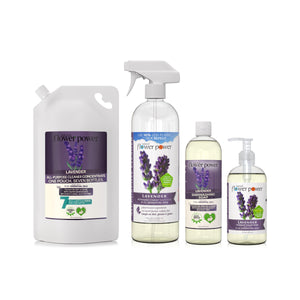
That's the standard we hold ourselves to. We formulate and make every Natural Flower Power product in our own facility in Cameron Park, California — we've been making them since 2012 — and because nothing is outsourced to a contract manufacturer or hidden inside a supplier's proprietary blend, we can publish the full ingredient list for every product and answer questions about any line on it. Our scented products list their essential oils by name; our Free & Clear line has no added fragrance and no masking agents at all. None of that makes anything "pregnancy-safe," and we won't pretend it does. It makes our products evaluable — by you, and by your provider — which is the thing that actually helps.
It also happens to be useful practice for the next stage: the same transparency habit that serves you now is the one you'll want when you're choosing cleaning products with a young child in the house, or if anyone in your home deals with asthma and cleaning-product triggers. Reading ingredient lists is a skill, and pregnancy is when a lot of people learn it.
Where to start
First, genuinely: if you have any specific concern — a product, a job, a renovation, a symptom — take it to your healthcare provider. That's not a legal disclaimer; it's the actual best move, and it's what the clinical guidance is built around.
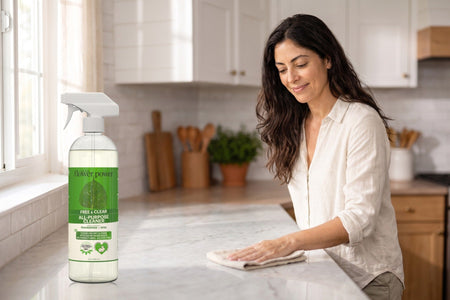
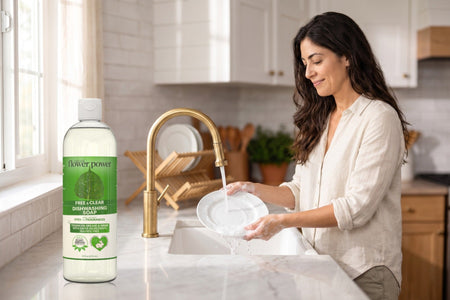
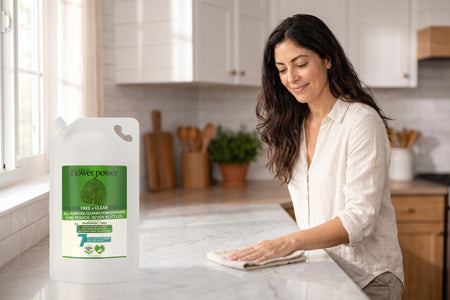
If scent aversion is making your usual products unbearable, our Free & Clear line is the low-scent option: no added fragrance, no essential oils, no dyes, plant-derived surfactants, and a complete ingredient list on every product page. Most people start with the Free & Clear hand soap and Free & Clear dish soap — the two products your hands and nose meet most often — and add the liquid Free & Clear all-purpose cleaner for counters. We recommend them here for comfort, not as a safety claim: they remove fragrance from your day while everything else about your senses is running at eleven. If you want to check any ingredient against your own situation, our Ingredients & Transparency hub covers every one we use, and plenty we don't.
Every NFP product is backed by our 90-Day Love-It Guarantee: if it doesn't work for your household, for any reason — including "this smell that never bothered me before is suddenly impossible" — we make it right. Pregnancy changes fast; your cleaning products should be the easy part.
