


TL;DR: "Chemical-free" is impossible — water is a chemical, salt is a chemical, every plant extract is made of chemicals. What people mean is "free from a specific list of synthetic ingredients they want to avoid." This explains why the term is meaningless on labels, what it usually substitutes for, and the more useful language to ask of brands.
You're standing at the store shelf reading labels. One bottle says "chemical-free." Another says "all-natural." A third promises "no harsh chemicals." You feel the relief of these labels in your chest—finally, something safe to bring home.
But here's the problem: that relief is built on a claim that isn't scientifically possible. Water is a chemical. Salt is a chemical. Vinegar is a chemical. Every single cleaning product ever made—including the ones proudly branded as "chemical-free"—is entirely composed of chemicals. The term doesn't mean what you think it means, which makes it functionally meaningless as information.
And yet companies keep using it, because it works. It triggers something in people who worry about safety, even though it tells them almost nothing about whether the product is actually safe. Understanding why this claim exists and what it's really trying to say is the first step toward making choices based on actual information instead of marketing language.
Everything Is Made of Chemicals—Yes, Really
Chemistry is the study of matter and how it behaves. Every substance you can touch, taste, smell, or see is made of chemicals. Your skin is made of chemicals. Your kitchen sponge is made of chemicals. A bowl of strawberries is made of chemicals. This isn't a claim or an opinion—it's the definition of matter itself.
Water (H₂O) is a chemical. Baking soda (sodium bicarbonate) is a chemical. Vinegar (acetic acid) is a chemical. Soap—the stuff people have been using to clean since ancient Rome—is a chemical compound created when you combine fats and lye. None of these are dangerous because they're chemicals. They're chemicals because they're made of atoms bonded in specific ways. Safety has nothing to do with chemical versus non-chemical. Safety has to do with whether a specific substance, at a specific dose, in a specific context, causes harm.
When a cleaning product label says "chemical-free," what it's actually claiming is impossible. The product would have to be made of absolutely nothing—not hydrogen, not carbon, not oxygen, not anything that exists in physical form. A completely honest "chemical-free" cleaner would be empty space.

What we make for this

So What Does "Chemical-Free" Actually Mean?
The term has slipped into common use as a substitute for several different claims that sound scarier when explained precisely. When someone says "chemical-free," they usually mean one of these things:
"It doesn't contain synthetic chemicals made in a lab." This is what most consumers think they're buying when they pick up a chemical-free product. They're imagining molecules synthesized in industrial facilities, not found in nature. But this definition falls apart immediately—labs can synthesize exact copies of naturally occurring chemicals, and natural chemicals can be just as potent as synthetic ones. Ricin is all-natural. Arsenic is all-natural. Opium poppies are all-natural. "Not made in a lab" tells you how it was produced, not whether it's safe.
"It's without harsh surfactants or aggressive cleaning agents." This is closer to something real. Some cleaning products contain sulfates or other strong detergents that can irritate skin or damage delicate materials. If someone's looking for "chemical-free," they might actually be trying to avoid these specific ingredients. But saying "harsh chemicals" is imprecise. A mild soap can be incredibly effective for dishes. A strong detergent might be exactly what you need for laundry. Calling them all "chemicals"—and then claiming your product has none—obscures what's actually different.
"It's made from plants instead of petroleum." Plant-derived ingredients feel safer, more aligned with nature. But a chemical is a chemical regardless of its origin. A plant-derived surfactant is still a surfactant. It still interacts with your skin and your plumbing the same way. What matters is not whether it came from a plant, but whether it's the right ingredient for the job you're asking it to do.
The real problem is that "chemical-free" bundles all these different ideas under one phrase, then uses that phrase to stand in for actual information. You're supposed to hear "no synthetic chemicals" and feel safe, even though you have no idea which specific ingredients are in the bottle or what they actually do.
Why Companies Use a Claim That Doesn't Make Sense
If "chemical-free" is scientifically inaccurate, why do so many brands use it? Because it works.
The claim triggers an emotional response faster than a detailed explanation ever could. You see "chemical-free" and your brain associates it with safety without requiring evidence. You don't have to understand what a surfactant is or whether sulfates are actually harmful in the concentrations present in your dish soap. You just feel better. That feeling becomes the product's primary value proposition.
Companies use vague claims like "chemical-free" because they're unregulated. The FDA doesn't define "chemical-free." There's no standard. There's no testing. A product with any ingredients at all can slap this label on because no one enforces it. The government allows it because prosecuting unclear marketing language takes resources, and enforcement agencies are already stretched thin regulating actual safety claims.
There's also the commercial incentive: vague claims work regardless of what's actually in the bottle. A brand can sell an expensive "chemical-free" cleaner that contains exactly the same ingredients as a cheaper competitor—just in different concentrations or with essential oils swapped in for one synthetic fragrance—and consumers will perceive it as completely different. The label creates the perceived difference, even when the chemistry is nearly identical.
This is why you see "chemical-free" on products that contain potassium sorbate, citric acid, sodium lauryl sulfate, and mineral oil. Every single one of those is a chemical. Every single one is listed on the ingredient label. But the brand still gets to claim "chemical-free" because the term has no legal definition.
What "Chemical-Free" Masking Actually Prevents You From Understanding
When you accept "chemical-free" at face value, you stop asking real questions. You don't ask which specific ingredients are in the product. You don't ask what each ingredient actually does. You don't investigate whether the product will work for your particular use case or your particular skin. You just buy based on the marketing claim.
Real safety decisions require specificity. If you have eczema and react to sulfates, you need to know that the product contains a mild sulfate-free cleanser, not just that it's "chemical-free." If you're concerned about synthetic fragrances triggering migraines, you need to see whether the scent comes from essential oils or fragrance compounds, not rely on a vague promise. If you have pets and want to avoid certain surfactants because they're toxic to cats, you need to read the actual ingredient list.
The "chemical-free" label lets brands avoid providing this information. It lets them sell comfort instead of clarification. And it leaves consumers—especially those with real sensitivities or safety concerns—unable to make informed decisions because the information that would actually help them is buried under marketing language.
How Natural Flower Power Approaches This
We don't use the term "chemical-free" because it's inaccurate. We don't hide behind vague claims. Instead, we describe exactly what our products are made from and why we chose those ingredients.
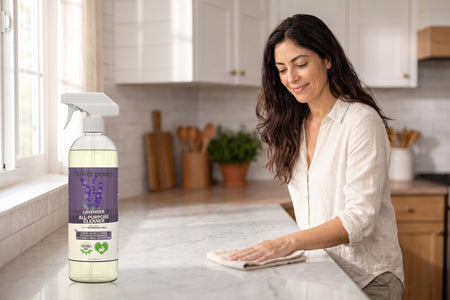
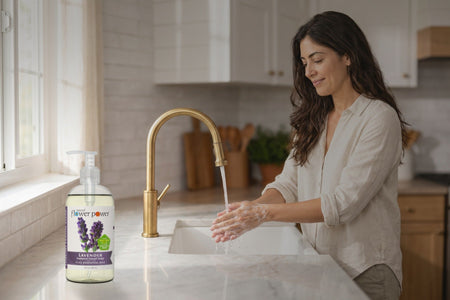
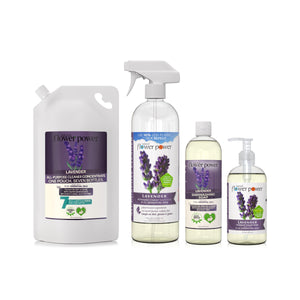
All of our cleaning products are formulated with plant-derived ingredients. That's a specific, defensible claim: it tells you the source of our materials. We make our own formulas in our facility in Cameron Park, California, which means we control every ingredient that goes into every bottle. Our liquid dish soaps use plant-derived surfactants instead of petroleum-derived ones. Our all-purpose cleaners are built on essential oils for scent, not synthetic fragrances. Our hand soaps include a Free & Clear variant that's completely unscented for people with fragrance sensitivities. Every NFP product is backed by our 90-Day Love-It Guarantee — if it doesn't work for your household, we make it right.
But we're honest about what we're doing and why. Using plant-derived ingredients doesn't mean the product is magically safer—it means we chose specific plants based on their cleaning properties and their safety profile. Our products still contain chemicals, because everything does. Those chemicals have to work to clean your dishes or your hands. The fact that they're plant-derived doesn't make them inert or risk-free. It means we've made deliberate choices about which chemicals we use and which ones we exclude.
This approach requires saying more, not less. It requires actual transparency instead of reassuring language. But it also means you can make real decisions based on real information instead of guessing what a marketing claim actually means.
What You Should Actually Look For Instead
If "chemical-free" is meaningless, what information actually matters? Here's what separates products designed for clarity from products designed for comfort.
Full ingredient lists, with names you can verify. If the label lists every ingredient and you can look up what each one does, the company is being transparent. If the ingredient list is short or vague, or if major components are hidden under umbrella terms like "fragrance," that's a red flag. You should be able to research every ingredient if you want to.
A clear story about where ingredients come from. Does the brand use plant-derived surfactants? Petroleum-based detergents? Essential oils or synthetic fragrances? This is specific information that changes the product—and that should be stated clearly, not hidden behind "all-natural" or "chemical-free."
Honest acknowledgment of tradeoffs. Plant-derived doesn't mean cheaper. Unscented doesn't mean it cleans better. A company that explains why they made their choices and what you're gaining or losing by choosing that product over a competitor is being more honest than one that just claims superiority.
Real safety information for your situation. If you have sensitivities, the brand should either test with sensitive skin or acknowledge that they don't. If you have pets, they should explain their ingredient choices in the context of pet safety. If you're concerned about the environment, they should explain what they're actually doing differently—not just claim "eco-friendly" without specifics.
For more about how we think through these decisions, see our Story & Standards page.
The Bigger Picture: "Chemical-Free" and Greenwashing
"Chemical-free" is one version of a larger problem: vague claims that sound meaningful but don't actually tell you anything. "Natural," "green," "eco-friendly," "non-toxic"—these terms are all in the same category. They feel informative, but they're unregulated and almost impossible to verify. If you're interested in the broader pattern, we've written more about what "non-toxic" actually means and how to spot greenwashing in general.
The companies using these terms are betting that you'll feel safe without asking for evidence. Some are genuinely trying to communicate something real but doing it poorly. Others are deliberately exploiting the gap between what people think these words mean and what they actually mean.
Either way, your defense is the same: demand specificity. Ask what the product contains. Read the ingredient list. Research individual ingredients if you need to. Find a company that's transparent enough that you don't have to guess whether their claims are real.
Water is a chemical. Your skin is a chemical. The dirt on your floor is a chemical. Safety isn't about eliminating chemicals from your home—that's impossible. Safety is about choosing products made with ingredients you understand and companies that respect your intelligence enough to be clear about what's actually in the bottle. That's not a claim that fits on a label. But it's the one that actually matters.
