

TL;DR: Natural Flower Power began in 2012 by formulating and manufacturing cleaning products for professional use—commercial kitchens, facilities, janitorial crews—not for consumers. Commercial work demands documented efficacy and batch-to-batch consistency, because other businesses are liable when a product fails. Building our standards in that environment first, rather than the softer consumer market, is the reason our household products are formulated, tested, and validated the way they are. The tradeoff is speed: we keep formulation in-house in Cameron Park, California, which limits how fast we can grow.
In 2012, Natural Flower Power wasn't a household brand. We started by formulating and manufacturing cleaning products for professional use: commercial kitchens, facilities management, janitorial services. The market made sense. Commercial cleaning was demand-driven and growing faster than residential consumer products. It was also brutally honest feedback—when a formula doesn't work for a professional cleaning crew that depends on it for their livelihood, you hear about it immediately. The work forced us to know what we were making and why.
We've spent the last fourteen years applying that foundation to household products. The decision to start commercial before household wasn't a path to consumer market expansion. It was a choice about where to build our standards first.
What commercial formulation demands
Professional cleaners operate in a completely different constraint system than households. A commercial disinfectant must work in thirty seconds on a heavily soiled surface in a high-pathogen environment. The cleaning crew cannot wait. Downtime costs money, and batch-to-batch variation destroys workflow predictability. Every container must perform identically to the one before it. If it doesn't, the business operates in chaos.
That reliability requirement drove us deep into formulation science. Commercial cleaning products demand documented efficacy. We needed third-party testing to prove that our plant-derived formulations actually killed the microorganisms our customers needed dead. Not implied. Not claimed. Tested and verified. A commercial buyer requires that documentation because they're liable if the product fails.
The chemistry itself is more complex. Commercial formulations blend multiple surfactant types: anionic surfactants pull particulate soil away from surfaces; nonionic surfactants emulsify oils and grease. Household products can often get by with a simpler approach because the soil loads are lighter and the frequency of use is lower. Commercial products work harder, in worse conditions, with less margin for error.

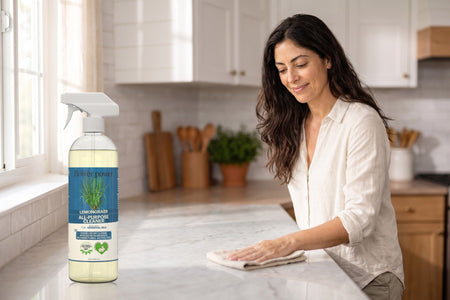
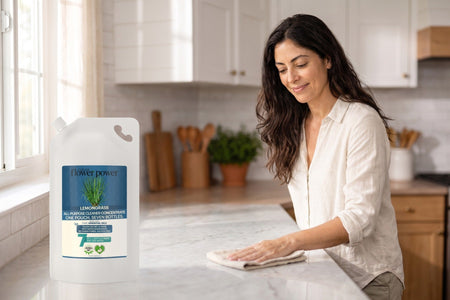
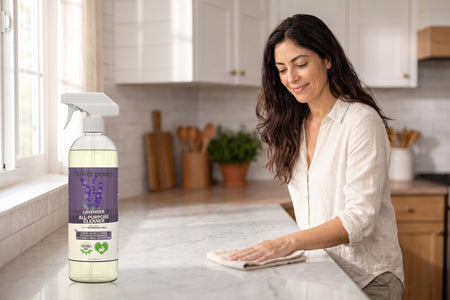
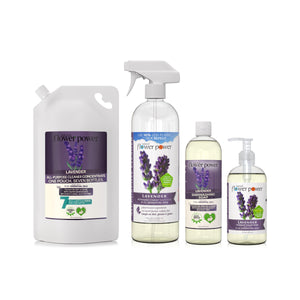
What we make for this
The knowledge transfers
We never treated commercial experience as something separate from household product development. Everything we learned moved into our household line directly.
Understanding how to formulate plant-derived surfactants with real efficacy was the core skill. Plant-derived chemistry is harder to execute than synthetic surfactants because the active compounds are less stable and require different stabilization strategies. But we had to solve it for commercial disinfection. If we could make a plant-derived product that meets EPA efficacy standards for killing pathogens in a commercial setting, a household all-purpose cleaner or hand soap is technically simpler. It's the same discipline we still bring to how we formulate our products today.
We also inherited the accountability mindset. In commercial work, you track batches, understand shelf stability, and know which formulations phase-separate under stress or lose effectiveness over time. You test it. You document it. That rigor doesn't disappear when you move to household products. We applied the same batch validation processes, the same stability testing, the same quality control discipline.
Customer feedback loops accelerated our learning. Commercial clients told us directly what worked and what didn't. When a formula underperformed, we knew within days, not months. That rapid iteration shaped our decision-making in ways that generic market research never could. We had one batch of commercial disinfectant fail EPA testing in 2014; that single failure taught us more about formulation resilience than months of successful iterations could have.
Why we didn't start consumer-first
Plenty of cleaning product companies start in the household market. The barrier to entry is low. You can launch a brand with minimal capital and local marketing. Thousands of small cleaning supply companies do this successfully.
But that path builds different habits. Consumer market expectations are softer than commercial expectations. Customers care about scent, sensory experience, and price. They tolerate variation that professionals wouldn't accept. They infer efficacy from brand reputation rather than documented testing. None of that is wrong for consumer marketing, but it doesn't force the founder toward rigor.
We chose rigor first. That meant starting where rigor was mandatory. Commercial work demands performance documentation and batch consistency because other businesses depend on it. Once we had built our standards there, moving to household products didn't mean lowering them. It meant applying them to a different market.
The tradeoff
Starting commercial and then moving household has a real cost: speed. We don't outsource formulation. We don't private-label products. Every formula we make is developed and manufactured in-house at our facility in Cameron Park, California. That choice limits how fast we can grow. We could move faster if we used contract manufacturers or bought existing formulations.
We don't, because we learned in commercial work that you can't separate quality control from formulation control. The moment you outsource one, you lose visibility into the other. In commercial cleaning, that wasn't acceptable. We decided it wouldn't be acceptable for household products either—it's the core reason we manufacture in-house rather than hand a recipe to someone else.
The result is that we grow carefully instead of fast. We're in 700+ retail stores, we sell direct-to-consumer online, and we're available on Amazon. That's meaningful distribution. But we could be significantly larger if we were willing to compromise on manufacturing control. We're not. That's a constraint we accept deliberately, and it's the same logic behind what we mean by "standards first" and why it limits our growth.
What this means for product quality
When you formulate household products to commercial standards and validate them through commercial-level testing, you get different results than when you formulate household products for the household market alone.
Our all-purpose cleaners work because we tested them the way commercial products get tested. Our hand soaps don't irritate because we understood surfactant chemistry in depth. Our plant-derived formulations work because we had to solve that problem commercially first. The rigor carries forward.
This isn't invisible. A Quality-First customer who tests our dish soap against a competitor's notices the difference. The people who actually stick with the switch tend to notice the consistency of the product, the performance without buildup, the sensory quality. They're noticing the output of having built our standards first through commercial work.
Why it still matters
The commercial cleaning market is still substantial. We still formulate for professional use. But the household side has become our primary business. We brought the commercial mindset with us. We brought the testing discipline. We brought the accountability.
For customers trying to choose between household cleaning product brands, "started in commercial cleaning" is worth noticing. It means a founder who built standards first in a market that forces honesty about whether things work. It means a company that thinks about efficacy documentation and batch consistency as non-negotiable, not as marketing advantages.
It doesn't mean we're better than every other brand. It means we decided where to build our credibility and we applied it consistently. That choice is visible in every product we make.
Where to start
The clearest place to see how all of this fits together is our Our Story & Standards page, which lays out where we draw our lines and why. If you'd rather just try the output, the Home Cleaning System Starter Kit is the simplest way in—the everyday products your hands and counters meet most, formulated to the standards we built in commercial work. You can also browse our best sellers to start with the products people stick with most often.
Every NFP product is backed by our 90-Day Love-It Guarantee—if it doesn't work for your household, for any reason, we make it right. That's the honest way to test whether "built our standards first" actually shows up in the bottle: try it against your own home, with no risk if it isn't the right fit.
