


TL;DR: "Hypoallergenic" has no legal definition and requires no testing. A manufacturer can print it on any bottle without proving anything to anyone. One UK analysis of 206 products marketed as hypoallergenic found that 74% contained a known allergen or a likely cross-reactor once you counted related ingredients. The word isn't a safety standard — a complete ingredient list you can check against your own triggers is. This guide explains where the term came from, why it's hollow, and what to look for instead.
You've probably grabbed a bottle of cleaner because it said "hypoallergenic" on the label, thinking it meant the product had been tested, evaluated, and proven safe for people with sensitivities. You're not alone in making that assumption. The problem is that the word means almost nothing, legally speaking. A manufacturer can print "hypoallergenic" on a bottle without conducting any testing at all, without submitting proof to anyone, and without worrying about regulatory consequences. That gap between what the word sounds like and what it actually means causes real problems for people dealing with contact dermatitis, eczema, respiratory sensitivity, or chemical sensitivities.
The regulation that never happened
In 1975, the FDA tried to fix this. They published a rule that would have required the word "hypoallergenic" to be paired with a disclaimer: "Less likely to cause adverse reactions than some competing products." It was an attempt to make the claim more honest. Cosmetic companies sued immediately. The U.S. Court of Appeals sided with the manufacturers, ruling that the FDA hadn't proven how consumers actually interpret the word. The regulation was struck down. No federal definition has existed since.
That was fifty years ago. Today, cleaning product manufacturers can still use the term without submitting substantiation to anyone. There's no testing requirement. There's no regulatory review. The FDA has authority over cosmetics but no pre-market approval power over them, and it doesn't demand proof of hypoallergenicity claims. The agency's own guidance on the topic essentially amounts to this: the term is unregulated, and there are no federal standards governing its use.

What we make for this
Why so many "hypoallergenic" products contain allergens
Research tells a sobering story here. Researchers in the UK analyzed 206 personal care products marketed as hypoallergenic and checked them against a standardized list of known contact allergens. What they found: 38 percent of these products contained at least one documented allergen. When they broadened the scope to include ingredients that might cross-react with allergens, the number jumped to 74 percent. Three of the most common allergens they found were cetearyl alcohol, paraben mix, and fragrance or parfum, with fragrance appearing in 41 percent of the products studied.
That fragrance figure is particularly striking. Products labeled hypoallergenic should theoretically be free of common irritants, and fragrance is the number one trigger for contact dermatitis. Yet fragrance appeared in 41 percent of the hypoallergenic products studied. This isn't a small oversight. It's a fundamental mismatch between the claim and the contents — and it's the same loophole we unpack in the most common trigger ingredients in cleaning products.
The patterns extend beyond fragrances. Preservatives like methylisothiazolinone and methylchloroisothiazolinone show up regularly in products claiming hypoallergenicity, even though both are recognized contact allergens and respiratory sensitizers. The same goes for certain surfactants, optical brighteners, and other formulation staples that manufacturers use because they work or because they're inexpensive.
What dermatologists actually tell patients
If you've ever been to a dermatologist with contact dermatitis or eczema triggered by cleaning products, you probably heard something consistent: stop relying on marketing labels and start reading ingredient lists. Dermatologists are skeptical of "hypoallergenic" because they see the consequences when patients trust the claim. They see reactions to products bearing that label.
What dermatologists actually recommend is fragrance-free and dye-free formulations with minimal ingredient lists — the same approach we describe in our guides to cleaning products and eczema and cleaning with sensitive skin. They advise patients to avoid synthetic fragrances entirely and to be cautious even with essential oils, since some of the oils themselves (linalool from lavender, limonene from citrus) can trigger sensitization in reactive individuals. They recommend liquid detergents over powders, because powders leave residue on fabrics longer. They tell patients to patch test new products before regular use, to keep ingredient lists for reference if reactions occur, and most importantly, to demand complete transparency from manufacturers instead of trusting marketing language.
None of this requires a product to be labeled hypoallergenic. In fact, dermatologists tend to see the label as a red flag for marketing overreach rather than evidence of safety.
Term distinctions that actually matter
Not all label claims are equally meaningless. Here's what you're actually seeing when you encounter these terms on a shelf:
Hypoallergenic: No legal definition. No mandatory testing. No regulatory oversight. Essentially unsubstantiated.
Fragrance-free: More useful. Means no fragrance has been intentionally added. There's an important caveat: some plant-derived products can still carry scent from essential oils or plant extracts without being labeled as fragrances. But "fragrance-free" on a label indicates at minimum that no fragrance or parfum appears in the ingredient list.
Dermatologist-tested: Implies some level of professional evaluation, which is more credible than nothing, but no standardized testing protocol is mandated. One company might conduct a full patch-test panel; another might do a minimal skin irritation screening. The rigor varies widely.
Allergy-tested: Suggests the manufacturer has screened for or eliminated known allergens, but again, no standardized requirement exists. It's more specific than hypoallergenic but still lacks enforcement.
The claims with actual backing are third-party certifications. The Asthma & Allergy Friendly certification program, run by the Asthma and Allergy Foundation of America in partnership with Allergy Standards Limited, requires independent laboratory testing. Products have to demonstrate they remove allergens from surfaces or fabrics according to rigorous science-based standards. That certification means something. The label alone does not.
Plant-derived doesn't mean allergen-free
One more complication worth addressing: plant-derived ingredients are often marketed as inherently safer or gentler. They're not inherently hypoallergenic. Essential oils and plant extracts contain compounds that can trigger sensitivities just as readily as synthetic preservatives or fragrances. The fact that linalool comes from lavender doesn't make it less of an allergen for someone sensitive to it. Limonene from citrus peels oxidizes into strong contact sensitizers. "Natural" is marketing language, not a safety guarantee — the same way "non-toxic" tells you almost nothing on its own.
That said, when a company uses plant-derived ingredients and combines them with fragrance-free options and complete ingredient transparency, you can actually make an informed choice about what's right for your specific sensitivities. The plant-derived part matters less than the transparency part.
What actually helps
Stop trusting the word hypoallergenic. Start doing this instead: request a complete ingredient list before you buy. Look for products that skip synthetic fragrances and dyes. Check whether the brand offers fragrance-free options. See if they list every single ingredient or if they're using vague terms like "fragrance blend" or "proprietary formula" to hide what's actually inside. If a manufacturer won't tell you what's in the bottle, there's a reason — and knowing which words are regulated and which aren't is half the battle.
Patch test before regular use. Apply a small amount to your inner arm and wait. Most contact reactions appear within 24 to 48 hours. If you react to a product marked hypoallergenic, you have every right to conclude the label was misleading.
Keep a list of ingredients that trigger your reactions. Over time, you'll develop pattern recognition. Maybe you react to methylisothiazolinone but tolerate other preservatives. Maybe essential oils are fine for you but synthetic fragrance isn't. Maybe you're fine with coconut-derived surfactants but sensitive to sulfates. The specific ingredient matters more than the category. Generic "hypoallergenic" tells you none of this.
Look for third-party certifications. The Asthma & Allergy Friendly mark, the National Eczema Association seal, and similar certifications represent actual testing, not marketing copy.
We don't use the word hypoallergenic on our labels, even though many of our products would qualify under any reasonable interpretation. We make that choice deliberately. We've formulated and manufactured everything in-house in Cameron Park, California since 2012, which means we can list every ingredient and stand behind it. Our Free & Clear line is fragrance-free and minimal-ingredient specifically for people dealing with sensitivities. If you read our ingredient list and decide it's not right for your specific sensitivities, that's the correct response. If you buy it and react, we want to hear about it.
The confusion doesn't have to be yours
The confusion around hypoallergenic exists because the word fills a gap. People with sensitivities need a way to quickly identify products formulated for them. In an ideal world, there would be a legally defined, well-tested standard. Instead, there's a regulatory vacuum that marketing has filled. You're not wrong to be confused. You're just better off ignoring the label and reading the list.
Where to start
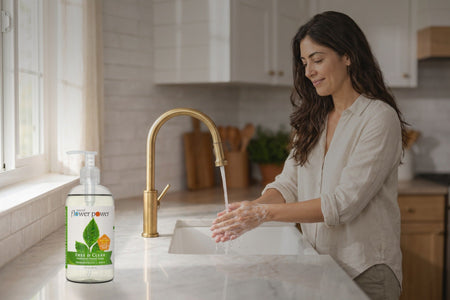
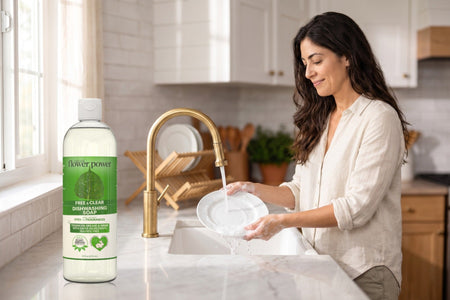
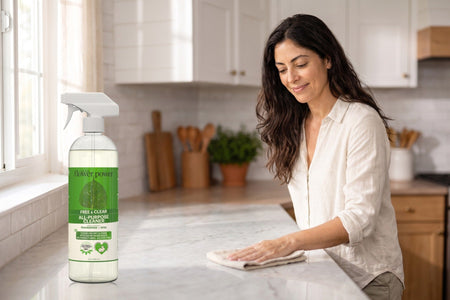
If you want a short ingredient list with no fragrance to react to, our Free & Clear line is the place to begin: no added fragrance, no essential oils, no dyes, plant-derived surfactants, and a complete ingredient list on every page. Most people managing sensitivities start with the Free & Clear hand soap and Free & Clear dish soap—the products your skin meets most often—then add the Free & Clear all-purpose cleaner for counters and surfaces. Whatever you're checking against, our Ingredients & Transparency hub lists exactly what's in every product, so you can confirm it against your own triggers before you ever buy.
Every NFP product is backed by our 90-Day Love-It Guarantee—if it doesn't work for your household, for any reason, we make it right. For sensitive homes that's the honest way to try something new: patch-test it against your own skin, with no risk if it isn't the right fit.
