


TL;DR: Eczema-prone skin reacts to a short list of cleaning ingredients: sulfates like SLS and SLES, synthetic fragrance blends, and certain preservatives such as methylisothiazolinone. The fix is reading labels and avoiding the actual triggers, not chasing vague marketing claims. This guide names the ingredients to skip, the ones safe to keep, and how to build a low-irritation cleaning routine at home.
Updated September 2026 with ingredient-library links, a corrected preservative rundown, and answers to common questions.
Your skin flares up after you've finished cleaning the bathroom. You wash your hands with your regular dish soap, and by evening the skin between your fingers is raw and cracked. You've already eliminated the obvious culprits—harsh bleach, aerosol sprays, heavy fragrances—but you're still reacting to something.
The problem is that "harsh" and "gentle" aren't regulated categories. A product marketed as hypoallergenic or dermatologist-tested can still contain ingredients that will absolutely trigger an eczema flare in your skin. And if you're trying to figure out exactly which ingredient is responsible, manufacturers have built-in escape routes. Fragrance can hide dozens of chemicals. Preservatives carry names that don't appear on most product labels. Sulfates appear under multiple different chemical names depending on how they're derived.
After years of working directly with customers who have eczema, we've learned that what actually matters is knowing the specific chemicals to avoid, understanding how to read a label for truth rather than marketing, and accepting an honest limitation: even plant-derived products can trigger reactions in some people. This guide will walk you through all three.
The Core Problem: Eczema and Your Skin Barrier
Before talking about which products to avoid, it helps to understand what's actually happening in eczematous skin. Eczema isn't a single condition—it's a group of inflammatory skin conditions with shared characteristics. Atopic dermatitis, the most common type, involves a compromised skin barrier. The lipid layer that normally keeps moisture in and irritants out isn't working properly. Your skin loses water faster, becomes drier, and becomes more reactive to irritants that a healthy skin barrier would shrug off.
This is why a cleaning product can be safe for most people and cause an immediate reaction in someone with eczema. You're not necessarily dealing with a true allergy—you're dealing with a weakened barrier that overreacts to chemical exposure. Surfactants (the cleaning agents), preservatives, fragrances, and dyes are all potential triggers because they penetrate or interact with a barrier that isn't functioning as a shield. Even some plant-derived ingredients can cause this reaction if the skin is sensitized enough.
The consequence is that people with eczema have learned to approach cleaning products with legitimate caution. You've probably had the experience of a product working fine for a while, then suddenly triggering a reaction—possibly because your skin barrier temporarily worsened, or because you developed a new sensitivity. This is normal. What's not normal is expecting you to guess which ingredient is responsible based on marketing claims.
The National Eczema Association's guidance on household products points at the same short list this article covers — fragrances, certain preservatives, and harsh surfactants — which is a useful sanity check: the triggers are known and finite, not a mystery.

What we make for this

Sulfates: The Stripping Problem
Sulfates are surfactants—they break surface tension and allow oil and water to mix, which is how anything gets clean. Sodium lauryl sulfate (SLS) and sodium laureth sulfate (SLES) are the most common types in commercial products. They're effective, cheap, and they create a satisfying lather that makes people feel like the product is working.
The problem is that sulfates strip your skin. At a microscopic level, they don't distinguish between the oils on your hands and the lipids in your skin barrier. High-concentration exposure or repeated use can compromise the barrier further, leading to dryness, cracking, and inflammation. For someone whose barrier is already damaged from eczema, sulfates are particularly problematic.
Plant-derived alternatives exist. Surfactants derived from coconut oil, decyl glucoside, and saponified plant oils all clean effectively without the same stripping action. These are what we use in all our formulas. The tradeoff is that they cost more, they don't create the same foamy lather that people mentally associate with "clean," and they require more careful formulation to achieve the same performance. But the point is: alternatives exist, and they work better for sensitive skin.
If a dish soap or hand soap doesn't explicitly list its surfactants and instead uses the generic terms "cleaning agent" or relies on the word "gentle" without explaining why, assume it contains sulfates. Read the full ingredient list. If you see sodium lauryl sulfate, sodium laureth sulfate, or ammonium lauryl sulfate, that product isn't safe for eczema-prone hands.
Fragrance: The Invisible Irritant
Fragrance appears on cleaning product labels as a single word, but it can represent anywhere from five to fifty different chemical compounds. We covered this in detail in our previous post on what fragrance actually means on cleaning labels, so we'll summarize here: the fragrance loophole allows companies to hide the individual components they use to make a product smell like something.
For people with eczema, fragrance is one of the most common triggers. That's partly because some synthetic fragrances (limonene, for example) are known allergens. It's partly because essential oils, while plant-derived, are highly concentrated and can irritate compromised skin. And it's partly because if you react to a product with hidden fragrance, you can't figure out which specific component caused the problem, so you end up avoiding the whole category.
Products labeled "unscented" are not necessarily fragrance-free. Companies sometimes add a masking fragrance to cover the smell of other ingredients, then claim the product is unscented. Truly fragrance-free products have no fragrance entry on the ingredient list at all. Look for that absence. Better still, look for products that are explicitly labeled as Free & Clear or Fragrance-Free and actually list every ingredient—not by marketing claim, but by chemical honesty.
Preservatives: The Hidden Sensitizers
Preservatives keep a product from spoiling. Without them, bacteria and mold would grow in your dish soap bottle or hand soap pump. But certain preservatives are common triggers for people with eczema or contact dermatitis.
Methylisothiazolinone (MI) is a case study. It became so associated with contact dermatitis outbreaks that the European Union banned it from leave-on cosmetics and sharply restricted it in rinse-off products. Yet it's still common in American cleaning products, particularly in liquids that sit in dispensers for weeks. Other problematic preservatives include imidazolidinyl urea, diazolidinyl urea, and quaternium-15—all of which can sensitize skin with repeated exposure.
The challenge is that preservatives don't always have consumer-friendly names. MI might be listed as "methylisothiazolinone," "MIT," or "2-methyl-4-isothiazolin-3-one." If you've reacted to multiple products and can't figure out why, look up the preservative systems they use. You might find a pattern. Many alternative preservatives exist—sodium benzoate, potassium sorbate, and plant-derived options are all used in safer formulations—so if a product uses a known irritant, you have alternatives to choose.
Dyes, Ammonia, Bleach, and Other Direct Irritants
Some ingredients are straightforward irritants. They don't require sensitivity; they simply damage the barrier directly.
Dyes are coloring agents with no functional purpose in a cleaning product. They're there to make the product look nice. If you have eczema, they serve no benefit and are a direct source of unnecessary irritation. Ammonia and chlorine bleach are strong chemical bases and oxidizers that will dry and irritate sensitive skin on contact. Aerosol spray propellants create airborne particles that can irritate respiratory passages, which then inflame surrounding skin. Phenols and strong acids are used in some disinfectant products but are harsh enough to damage barrier function directly.
These are easier to identify and avoid than fragrance or hidden preservatives, but they're worth listing because they often appear in products marketed as "all-purpose" or "disinfecting." If a product is in a spray can, contains visible color, or smells intensely chemical, it almost certainly contains one or more of these irritants. Skip it.
What We Do Differently: Direct Experience with Eczema Customers
When we started Natural Flower Power in 2012, we weren't trying to build a business around people with eczema. We were formulating plant-derived cleaners because that's what interested us. But very quickly, we started hearing from customers with sensitive skin and diagnosed eczema. They reported the same thing repeatedly: they'd struggled for years to find products that actually worked without triggering reactions. Most products marketed as "gentle" or "sensitive" still made their skin worse. They'd grown skeptical of marketing claims because they'd been let down too many times.
So we made specific choices in our formulations. We use plant-derived surfactants, not sulfates. We don't use synthetic fragrances—all our scented products use essential oils only, listed by name. Our Free & Clear line contains no fragrance at all, not even essential oils. We don't use dyes. We preserve with benzisothiazolinone (BIT) at 0.005% — a known sensitizer for a small percentage of people; at that concentration the risk is very low, but it exists, and we acknowledge it rather than pretend it doesn't. If isothiazolinones are one of your known triggers, that entry gives you what you need to decide. We list every single ingredient on every product page, with no vague categories or hiding.
This approach costs us more than competitors who use cheaper sulfates and hidden fragrance. Our shelf life is shorter because essential oils degrade. Our marketing is less flashy because we can't claim magical ingredients or invisible benefits. But the feedback we get from customers with eczema is consistent: these products don't trigger flares.
We can't promise they'll work for every person with eczema. Reactions are individual. Some people are sensitive to coconut-derived ingredients. Some are sensitive to specific essential oils. Some have such severe sensitivities that they can tolerate almost nothing. But we've built our line specifically to be safe for the majority of people with eczema, and we do that by being transparent and specific about what we use and why.
How to Actually Read a Label for Safety
Ingredient lists are required by law, but they can be misleading if you don't know what you're looking for. Here's how to read one if you have eczema.
Start with the surfactants. These are usually the second or third entry on the list (after water, which is typically listed first). Look for plant-derived options: coco-glucoside, decyl glucoside, saponified oils, or sodium lauroyl methyl isethionate are all plant-derived, gentler options. Avoid sodium lauryl sulfate, sodium laureth sulfate, or ammonium lauryl sulfate.
Check the fragrance and preservative system. If the word "fragrance" or "parfum" appears, you don't know what's in it. If "unscented" is a claim but fragrance appears on the list, it's a masking fragrance. For preservatives, look for methylisothiazolinone or the other problematic ones listed above. Gentler preservative systems include sodium benzoate and potassium sorbate. (Phenoxyethanol is often described as gentle, but it carries enough irritation reports that we don't use it — read up before trusting it on eczema-prone skin.)
Look for the absence of known irritants. Scan the full list for ammonia, bleach, dyes, strong acids, and phthalates. If you see any of these, the product is not eczema-safe regardless of other marketing claims.
If you don't recognize something, look it up. Ingredient names can be intimidating. Sodium chloride sounds scary but it's just salt. Citric acid sounds harsh but it's from citrus fruit and used as a gentle pH buffer. Tools like the Environmental Working Group's Skin Deep database can help you understand unfamiliar ingredients. Your allergist or dermatologist can also tell you if a specific ingredient is known to trigger your reactions.
Understand "plant-derived" doesn't mean "safe for you." Plant-derived ingredients are still chemicals. They can trigger reactions in people who are sensitive to that plant, or in people whose barrier is so compromised that almost any ingredient will irritate. "Plant-derived" is a formulation choice, not a guarantee of personal safety. This is why we recommend patch-testing any new product before regular use, especially if your skin has been reactive.
Patch Testing: The Honest Approach to New Products
Even after you've read the label and verified that a product doesn't contain known irritants, your individual skin might still react. This is the tradeoff with eczema: you can't always predict which ingredients will trigger your specific barrier dysfunction.
Before switching to a new cleaning product, patch test it. Use it on a small area—the inside of your wrist, or on one hand only—for two to three days. Watch for redness, itching, cracking, or inflammation. If you see a reaction, you know to avoid that product. If your skin stays calm, the product is likely safe for you.
This takes time, and we understand why it's frustrating. You want to be able to trust a label claim and move on. But honest brands understand that eczema reactions are individual, and we can't promise that our products will be safe for every person with eczema. What we can promise is that we've eliminated the known irritants and that our ingredients are specific and transparent, which gives you the information you need to test and decide for yourself.
What This Means for Your Cleaning Routine
If you have eczema, switching cleaning products is often the fastest way to reduce flares, because cleaning products contact your skin directly and frequently—unlike, say, laundry detergent residue that might be less concentrated. Start with your most-used product: usually your hand soap or dish soap. Look for one without sulfates, without hidden fragrance, and with a safe preservative system. If your hands improve, you've identified part of the problem. Then move to your next most-used product.
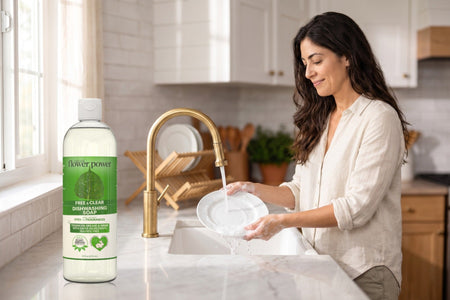
We designed our Free & Clear hand soap and Free & Clear dish soap specifically for this purpose. No fragrance, no dyes, no sulfates, plant-derived surfactants, safe preservatives. They're not our only options—we have scented hand soaps and dish soaps that people with eczema use successfully—but Free & Clear is where most people with eczema start. Every NFP product is backed by our 90-Day Love-It Guarantee — if it doesn't work for your household, we make it right.
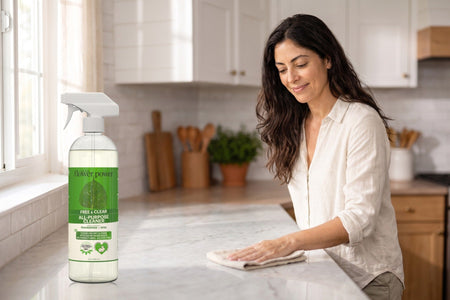
Your all-purpose cleaner matters too. Many people don't realize that the cleaner they use on kitchen counters and bathroom surfaces can trigger hand eczema if they're not wearing gloves. Our Free & Clear all-purpose cleaner uses the same standards: no fragrance, no dyes, plant-derived surfactants, safe preservatives. If you're currently using a conventional multi-purpose cleaner, switching to this will likely reduce the irritation your hands experience while cleaning.
You can learn more about our full approach to safety and standards at Our Story & Standards, and look up any ingredient — ours or a competitor's — in our plain-English ingredient library.
Common Questions
Do gloves solve the problem? They help a lot for cleaning tasks — but choose cotton-lined, latex-free gloves (latex is itself a common allergen), keep the insides dry, and take them off after 15–20 minutes; trapped sweat inside a glove is its own trigger. And gloves can't help with hand soap, which is exactly why that's the first product to switch.
Is "dermatologist-tested" meaningful? Not by itself. The phrase has no legal definition and doesn't tell you what was tested or what the result was. A complete ingredient list you can actually read beats any badge on the front of the bottle.
What should I switch first? Hand soap, then dish soap — the two products your skin meets most often. If your hands improve within a couple of weeks, you've identified part of your answer and can keep going product by product.
Choosing cleaning products when you have eczema comes down to being specific. Specific about which ingredients your skin reacts to, specific about reading labels rather than trusting marketing claims, and honest about the fact that no single product is safe for everyone with eczema. But if you know what to look for and test carefully before committing, you can find products that let you clean your home without triggering flares. That's what we've worked to make possible.
