What It Is
Nonylphenol ethoxylates (NPE) are a family of synthetic nonionic surfactants produced by ethoxylating nonylphenol (NP, CAS 25154-52-3) with varying numbers of ethylene oxide units. Common variants include nonoxynol-4, nonoxynol-9, and nonoxynol-12 — the number indicates the average ethylene oxide chain length. NPE functions as a wetting agent, detergent, emulsifier, and dispersant in a wide range of industrial and consumer formulations.
What we make for this


Common Uses
NPE appears in laundry detergents (especially industrial and institutional grades), heavy-duty degreasers, hard-surface cleaners, paints, pesticide formulations as a surfactant adjuvant, textile processing chemicals, and pulp and paper manufacturing. In the United States, NPE remains common in commercial cleaning supplies and is frequently found in residential laundry detergents under the ingredient names "nonoxynol" followed by a number, "nonyl phenoxy polyethoxy ethanol," or simply "nonionic surfactant."
How It Works
NPE functions through standard surfactant chemistry — the nonylphenol head group is lipophilic and the polyethoxy chain is hydrophilic, allowing the molecule to emulsify oils and lift soil. The compound is highly effective at wetting and penetrating fibers, which is why it is favored in textile processing and laundry applications. The biological problem emerges after the surfactant has done its work: NPE biodegrades partially in wastewater treatment to nonylphenol (NP), which is significantly more persistent and bioactive than the parent surfactant.
Safety and Regulation
Nonylphenol is an established endocrine disruptor with estrogen-receptor binding activity documented across multiple peer-reviewed studies (Soto et al., Environmental Health Perspectives, 1991). The European Union banned nonylphenol and NPE in consumer products under REACH Annex XVII Entry 46 in 2005, with restrictions on industrial uses following. The U.S. EPA has flagged nonylphenol as a "Chemical of Concern" since 2010 under the Safer Chemicals Action Plan and issued voluntary phase-out goals, but enforceable restrictions in U.S. consumer cleaning products do not exist. NP and NPE are widely detected in U.S. surface water, sediment, and wastewater treatment effluent at concentrations associated with measurable endocrine effects in fish (USGS National Water Quality Assessment).
Why Natural Flower Power Does Not Use It
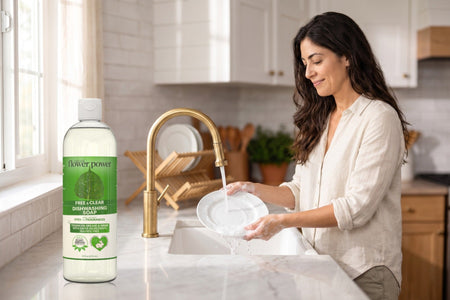
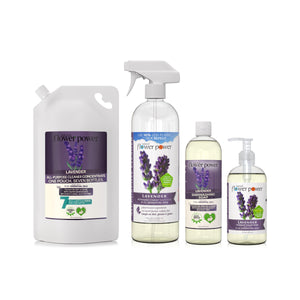
Natural Flower Power does not use nonylphenol ethoxylates or any nonoxynol-prefixed surfactants in any product.
The regulatory split between the EU (full ban) and the United States (voluntary phase-out) is a useful test case for how we make formulation decisions. When a major regulatory body classifies an ingredient as endocrine-disrupting and another permits it, we treat that as a signal to look at the underlying science rather than the local rulemaking. The peer-reviewed literature on nonylphenol's hormonal activity has been consistent for 30 years. We use decyl glucoside and coco-glucoside as our primary plant-derived nonionic surfactants. They deliver equivalent cleaning performance without the bioaccumulation profile.
Related Ingredients
Decyl glucoside and coco-glucoside are plant-derived alternatives Natural Flower Power uses. Sodium laureth sulfate (SLES) is another ethoxylated surfactant with separate concerns around 1,4-dioxane contamination. C6–C12 / C10–C16 alcohol ethoxylates are NFP-used ethoxylated alternatives without nonylphenol's endocrine-disruption profile.
Sources
- European Commission. REACH Regulation (EC) No 1907/2006, Annex XVII Entry 46 (Nonylphenol and Nonylphenol Ethoxylates), 2005.
- U.S. Environmental Protection Agency. "Nonylphenol (NP) and Nonylphenol Ethoxylates (NPEs) Action Plan." Toxic Substances Control Act, 2010.
- Soto, A.M., et al. "p-Nonyl-Phenol: An Estrogenic Xenobiotic Released from ‘Modified’ Polystyrene." Environmental Health Perspectives, vol. 92, 1991, pp. 167–173.
- U.S. Geological Survey. National Water Quality Assessment Program — alkylphenol surveys in U.S. surface waters.
