


TL;DR: Peppermint essential oil earns its place in a cleaner. Its main compound, menthol, disrupts the cell membranes of bacteria and fungi and helps inhibit biofilm — the protective layer mold and mildew build on surfaces. The familiar cooling tingle is a real signal: menthol activates a cold-sensing receptor on your nerves. The pest-deterrent claims are honest only for ants; for spiders and especially mice, the evidence thins out fast. Quality, concentration, and naming the ingredient by name are what separate function from decoration.
A few years ago, our Peppermint & Lemon dish soap became one of our most-asked-about products. Customers would pick it up, appreciate the scent, and then ask a straightforward question: is this just for the smell, or does the peppermint actually clean? That question is exactly right. Most people have learned to separate fragrance from function. They expect scent to be decorative and effectiveness to come from the active ingredients they can't see. When an essential oil shows up on a label, skepticism is warranted.
But peppermint doesn't fit that pattern. What we include in our formulations, and why, comes from knowing what the research actually shows about how menthol works against bacteria and fungi, how it creates a sensory experience, and why quality and concentration matter. It's one of the clearest examples of how essential oils can do real work beyond scent in a cleaner.
Menthol is a functional antimicrobial compound
Peppermint essential oil's primary active compound is menthol, which makes up roughly 30 to 55 percent of the oil by volume depending on the plant variety, growing conditions, and harvest timing. The rest is a mix of secondary compounds including menthone, eucalyptol, and others that work together to enhance the total effect.
What makes menthol functional is its ability to disrupt the cell membranes of bacteria and fungi. When menthol encounters bacterial cells, its molecular structure allows it to penetrate the lipid bilayer that holds the cell together. This isn't gentle. The compound compromises the cell's structural integrity, which kills or inhibits growth. Peer-reviewed studies have documented this activity against common pathogens including E. coli, Staphylococcus aureus, and Listeria monocytogenes. In controlled laboratory conditions, distilled peppermint oil has shown antimicrobial activity comparable to the antibiotic gentamicin.
What's less obvious from individual compound research is that the complete essential oil works better than menthol alone. When all the compounds in peppermint oil work together, they produce greater antimicrobial activity than you'd predict from studying menthol in isolation. This is a synergistic effect, and it's why we use the whole oil rather than trying to isolate and concentrate menthol.

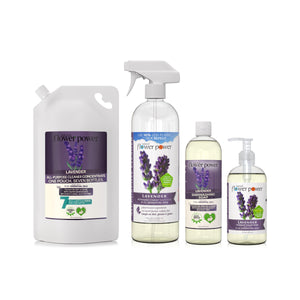
What we make for this

Antifungal function: biofilm disruption matters more than you'd think
Peppermint oil shows strong antifungal activity, which is where it becomes genuinely useful in a cleaner for bathrooms and kitchens. Laboratory research has documented efficacy against Candida species, molds like Aspergillus niger, and other fungi that commonly appear on household surfaces in moist environments.
The more important finding, though, is that peppermint oil disrupts biofilm formation. A biofilm is a protective film that fungi and bacteria produce to shield themselves from antimicrobial compounds and environmental stress. Once a biofilm forms, conventional antimicrobials struggle to penetrate it. Peppermint oil has demonstrated the ability to inhibit biofilm formation at concentrations that remain well below irritation thresholds, which makes it particularly valuable in a product you'll use regularly on surfaces where mold and mildew tend to establish themselves.
The cooling sensation: why menthol feels like it's working
When you use a peppermint-scented cleaner and feel that refreshing, cool tingle, that's not random or decorative. Menthol activates a specific receptor on your sensory nerves called TRPM8, which normally responds to actual cold. The compound binds to this receptor through precise molecular interactions and triggers the same signal your nervous system sends when you encounter cold temperatures, even though the actual temperature hasn't changed. Your brain perceives coolness without any thermal change occurring.
This sensation fades relatively quickly through a process called sensory adaptation. Your TRPM8 receptors stop firing after prolonged exposure, which is why the cooling feeling diminishes if you keep your hand under the stream of diluted cleaner. That adaptation is normal and doesn't mean the cooling effect will disappear the next time you use the product. What matters for cleaning is that you get an immediate signal that the cleaner is active and engaging with the surface. For many people, that sensory feedback contributes to their perception of effectiveness — a reminder that scent and function aren't always separate things. It's also part of why a single oil's character matters, which is something we cover in our look at essential oils versus fragrance oils.
Pest deterrence: where the evidence gets selective
Here's where we need to be direct. Peppermint oil has a reputation for repelling ants, spiders, and rodents, and that reputation isn't entirely unfounded. But the evidence for each pest type varies significantly — from research-backed to anecdotal.
For ants, the research is legitimate. Multiple peer-reviewed studies have documented that peppermint oil disrupts ant chemical communication and foraging behavior. Ants navigate and communicate through pheromone trails, and menthol interferes with their ability to read those trails. In controlled studies, peppermint oil reduced ant activity measurably. We've heard from customers who use our all-purpose cleaner in kitchens and food-prep areas and report noticing fewer ant problems. That tracks with what the science shows.
Spiders present a different case. The mechanism is plausible — peppermint oil interferes with sensory perception, which spiders depend on to detect prey and navigate. We have anecdotal customer reports, but we don't have the level of controlled-trial evidence that exists for ants, which means we're working from reasoned inference rather than lab confirmation.
Mice and rodents tell a different story. There's a persistent belief that mice hate peppermint's strong smell, but there aren't meaningful peer-reviewed studies demonstrating this. What we have is consumer testimonials and theoretical reasoning. If you're hoping peppermint oil is a rodent solution, we'd recommend managing expectations. Mice may be deterred by the smell in some circumstances, but that's not something you can reliably count on based on published research.
Quality and sourcing affect what you actually get
India produces the majority of the world's peppermint oil, roughly 600 to 700 metric tons annually. The growing regions are concentrated in Uttar Pradesh, Punjab, and Haryana. Other sources include the United States, China, and smaller volumes from Morocco. The choice of source affects price, but it also affects quality and consistency.
Peppermint oil is extracted through steam distillation, which is the standard method for leafy herb oils. The dried leaves are exposed to pressurized steam, which volatilizes the oil molecules. The vapor is then condensed back to liquid, and the oil separates. When this process is controlled carefully, you get a stable, concentrated product that preserves the active compounds. When it's done carelessly, you lose potency and consistency.
Good sources carry certifications: ISO standards for quality control, GMP (Good Manufacturing Practices) certification, and often organic certification as well. These aren't marketing. They represent third-party verification that the supplier actually tested what they produced and followed documented procedures. In our case, we formulate and manufacture in-house in Cameron Park, California, where we've made everything ourselves since 2012 — which means we know exactly which oil went into which batch and can trace it back to its source. The same logic applies to every botanical we use, including how we choose and test lavender essential oil on the scented side of our line.
Safety in diluted use is well-established
Menthol has a long history of use in over-the-counter medications, cosmetics, and food products. Most people tolerate it without adverse effects, and the established acceptable daily intake is about 0.2 mg per kilogram of body weight. In a diluted cleaning product, you're nowhere near those thresholds for incidental skin contact.
That said, concentration matters. High-percentage menthol applied directly to skin has caused irritation and even chemical burns. Some individuals are sensitized to menthol and react at low concentrations. Allergic contact dermatitis from menthol is rare in the general population but documented in the dermatological literature, particularly in people with prior fragrance sensitivities.
For our products, peppermint oil is one ingredient in a larger formulation designed for dilution and brief contact. The menthol concentration in our Peppermint & Lemon dish soap or all-purpose cleaner is far below concentrations that cause irritation. If you have a known sensitivity to peppermint or menthol, we recommend patch testing before regular use. Beyond that, the safety profile for typical cleaning-product use is straightforward.
Named ingredients build trust with the people who care most
When you see "fragrance" or "natural fragrance" on a product label, the manufacturer can hide hundreds of individual ingredients behind that single word. It's a regulatory loophole that benefits companies more than the people trying to make informed decisions. We don't use that approach.
Our peppermint products list "Peppermint Essential Oil" by name. That transparency matters to our customers, especially people with known fragrance sensitivities or allergies who need to know exactly what they're bringing into their home. It also forces us to stand behind what we're actually putting in the bottle. If we listed peppermint as hidden fragrance, we could dilute it or swap it out without disclosure. Named ingredients keep us honest.
For the customers who specifically ask whether peppermint contributes real function, that transparency is its own answer. If we included it just for the smell, we'd probably call it fragrance and move on. The fact that we name it, that we've spent years sourcing it consistently, and that we're willing to stand behind what we know about its properties tells you something about how we formulate. That's plant-derived cleaning doing real work — not exotic, not revolutionary, just a straightforward compound with documented properties, used at concentrations that are both effective and safe, and disclosed plainly enough that you can make your own judgment about whether it's right for your home.
Where to start
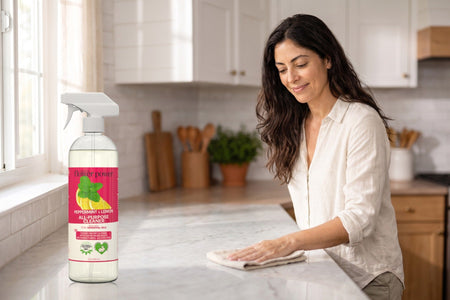
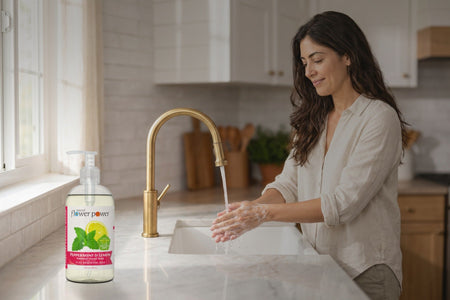
If you want to feel what functional peppermint actually does, our Peppermint & Lemon line is the place to begin. Most people start with the Peppermint & Lemon dish soap and Peppermint & Lemon hand soap — the products your hands meet most often — then add the liquid Peppermint & Lemon all-purpose cleaner for counters and food-prep surfaces, where the antimicrobial and ant-deterrent properties earn their keep. If you'd rather explore the full range of scents we work with, the essential oils collection lists exactly what's in each one, named ingredient by named ingredient.
Every NFP product is backed by our 90-Day Love-It Guarantee — if it doesn't work for your household, for any reason, we make it right. That's the honest way to try peppermint for yourself: put it to work on your own surfaces, with no risk if it isn't the right fit.
