


TL;DR: Lavender essential oil isn't in cleaning products just for the smell. It's mildly antimicrobial, calming on skin contact, and one of the more allergen-friendly essential oils when used at appropriate concentrations. This explains how lavender oil contributes to cleaning formulations beyond scent, the formulation tradeoffs, and why NFP uses it in specific products.
You spray your bathroom with a lavender all-purpose cleaner, and within minutes the mirror is clear, the sink gleams, and the room smells genuinely calming—not overpowering, not artificial, but genuinely pleasant. What most people notice first is the scent. What they don't always know is that the lavender essential oil in that bottle is doing actual work beyond making the space smell better.
Lavender has antimicrobial properties. The same compounds that give it its scent—linalool and linalyl acetate—also inhibit bacterial growth and combat certain molds. This isn't new science discovered last year. It's documented in research and observed in formulation practice. But there's a catch, the kind that separates real product development from marketing claims: you can only get those benefits if the lavender essential oil is actually there in meaningful concentration, and if you're using the right kind of lavender in the first place.
Over fourteen years of formulating plant-derived cleaning products, we've learned that this distinction matters. Many cleaning companies know about lavender's antimicrobial properties and talk about them vaguely in marketing copy. Fewer actually build formulations around that knowledge. We do, which is why our entire lavender line—from dish soap to all-purpose cleaner—is built on Lavandula angustifolia essential oil at a concentration that produces real benefit, not just a detectable scent. Every NFP product is backed by our 90-Day Love-It Guarantee — if it doesn't work for your household, we make it right.
What the Research Actually Shows
Lavender essential oil—specifically from the Lavandula angustifolia species (also called English lavender)—has been shown in multiple studies to inhibit the growth of bacteria and fungi. The primary active compounds, linalool and linalyl acetate, work by disrupting bacterial cell membranes and interfering with fungal cell wall formation. This isn't speculative. It's measurable in controlled settings.
The relevant bactericidal dose for lavender appears to be in the range of 4.0 to 9.0 mg/mL—a concentration meaningful enough to actually affect microbial growth. For context, that's not the same as the trace amount you get from "fragrance" listed on a label. It's enough to notice that the product has real cleaning action, not just aromatic appeal.
Where the marketing narrative gets murky is that most cleaning products don't disclose their essential oil concentration. You see "lavender essential oil" listed as an ingredient, and without knowing the percentage or the concentration relative to water or other carriers, you have no way to know whether it's present in the quantity that produces antimicrobial benefit or whether it's there primarily for scent. That opacity is partly because many companies treat essential oils as fragrance first and active ingredient second.

What we make for this



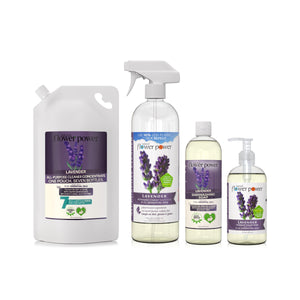
Why Lavandula angustifolia, Not Just Any Lavender
When we specify "lavender essential oil" in our formulations, we're not choosing from an infinite menu. We use Lavandula angustifolia—English lavender—specifically because of its documented chemical profile. Different lavender species have different ratios of linalool, linalyl acetate, and dozens of other compounds. Some lavenders have higher camphor content, which changes both the scent and the antimicrobial profile. Lavandula angustifolia tends to have the most consistent linalool concentration across different harvest years, which matters for formulation reliability.
This specificity matters because you can't just assume all lavender is the same. Lavandin (Lavandula × intermedia), a hybrid grown more widely for commercial use, has a different chemical profile and a harsher scent profile. Spike lavender (Lavandula latifolia) has higher camphor content and a sharper smell. For a cleaning product intended to be calming rather than punchy, and for consistent antimicrobial function across batches, we chose Lavandula angustifolia, which means we pay more for the raw material than a competitor might.
The Formulation Tradeoff: Effectiveness vs. Stability vs. Shelf Life
This is where the tension between pure formulation principles and market convenience becomes real. Essential oils are less stable than synthetic fragrances or synthetic preservatives. Linalool and linalyl acetate oxidize when exposed to light, heat, and air. Over months, the scent profile of a lavender-based cleaning product shifts. The initial sharp freshness evolves into something more muted and slightly woody as some compounds break down and others form. This is not a sign of spoilage—it's the natural chemistry of essential oil degradation.
Synthetic fragrances and fragrance stabilizers are engineered to remain constant. They don't oxidize as readily. They maintain their olfactory profile for years. They're also engineered to be much more potent, so you need less of them. This is why conventional cleaning products with synthetic fragrance can promise consistency and why they cost less to produce. The tradeoff is opacity—you don't know what you're getting because the label can hide everything under the word "fragrance."
We chose transparency over shelf-life consistency. Our lavender products work immediately when fresh, maintain their antimicrobial properties throughout their shelf life, but their scent does evolve. A bottle of our lavender hand soap will smell subtly different six months from now than it does today. For the customers we serve—people who value knowing what's in the bottle and why—that's preferable to the alternative.
Concentration, Sensitivity, and the Limits of Plant-Derived Lavender
One honest acknowledgment: even plant-derived lavender essential oil can trigger reactions in sensitive people. The compounds that give it antimicrobial power—particularly linalool and linalyl acetate—are terpenes, and some people with fragrance sensitivity or terpene sensitivity react to essential oils just as they might to synthetic fragrances. The difference is that you can identify what caused the reaction because the ingredient is named. If you react to our lavender products, you know it was the lavender. With conventional "fragrance," you'd never know which of the fifty hidden chemicals was responsible.
This is also why concentration matters for sensitivity. A product that contains lavender essential oil at 0.1% concentration behaves very differently in a sensitive person's hands than one containing 2% or 3%. The therapeutic range—where lavender provides real antimicrobial benefit and pleasant scent—sits in a zone that some sensitive people can tolerate and others cannot. There's no formulation that makes a terpene universally safe. Which is why we also offer our full hand soap line and dish soap line in a fragrance-free option, our Free & Clear products, for people who need to avoid all essential oils.
How Lavender Contributes to Cleaning, Beyond Smell
In a practical sense, lavender essential oil's antimicrobial properties mean your cleaning product is doing multiple jobs at once. You're using it for mechanical cleaning action—the surfactants lift dirt and oils off the surface. You're using soap or other detergents for their emulsifying power. And you're also getting suppression of odor-causing bacteria and some mold and mildew resistance from the lavender essential oil itself.
This is particularly useful in bathrooms, where mold and mildew are constant problems, and in kitchens, where bacteria from food residues can proliferate. An all-purpose cleaner with lavender essential oil at meaningful concentration isn't relying on the lavender to do the cleaning work alone—but it's not irrelevant either. The antimicrobial action of the essential oil compounds contributes to overall product effectiveness and helps suppress bacterial regrowth between cleanings.
The scent itself is also functional. A genuinely fresh, calming scent (not an artificial "synthetic fresh spring garden" smell) means you're less likely to mask odors with perfume masking. You're actually addressing the source—the microbes that produce the odor—while also providing a sensory signal that the space is clean. This is why you notice the difference immediately when using a product with real lavender versus one with synthetic fragrance.
What This Means for Your Choice
If you're choosing a cleaning product and you see "lavender essential oil" on the label, you have a few useful questions to ask. Is the concentration disclosed? If not, can you contact the company and get that information? Is it Lavandula angustifolia specifically, or just "lavender"? If a company knows this and is willing to say so, that's a signal they've thought carefully about the ingredient, not just grabbed whatever lavender oil was cheapest.
You might also ask whether the product has a noticeable scent evolution over months of storage. This isn't a flaw—it's a sign of a real essential oil formulation. Synthetic fragrances maintain an identical scent profile indefinitely, which is convenient for marketing consistency but doesn't signal that you're getting a genuine ingredient.
If you have sensitive skin or respiratory sensitivities, the fact that lavender essential oil is named on the label is your advantage. You can identify it as a potential trigger and test products without it. This is why we made the choice to build an entire product line that's completely transparent about what's in it. You can learn more about our ingredient standards and decision framework at Our Story & Standards. Our essential oils collection also lets you explore lavender directly and understand the range of concentrations and product formats we're working with.
Lavender essential oil works in cleaning products because of what it is chemically, not because we decided to put it there for marketing appeal. That distinction—between formulation driven by function and formulation driven by fragrance marketing—is the core of how we think about plant-derived cleaning products. Every ingredient we use is there because it does something. The lavender in our air fresheners is there for scent, yes. But the lavender in our dish soaps and all-purpose cleaners is there because it contributes to actual antimicrobial action while also providing a scent experience. You get both benefits simultaneously, which is the whole point of working with real plant-derived ingredients instead of synthetic chemicals engineered to hide their composition.
