
This ingredient is used in our products.
What It Is
Sodium chloride is the chemical name for common salt (CAS 7647-14-5). It is an inorganic compound composed of sodium and chlorine ions in a crystalline structure. In cleaning and personal care products, sodium chloride functions primarily as a viscosity modifier — it thickens liquid formulas rather than contributing to cleaning performance.
What we make for this


Common Uses
Sodium chloride is used as a thickener in liquid hand soaps, body washes, shampoos, and some dish soaps. It also appears in toothpastes, nasal sprays, contact lens solutions, and intravenous fluids. In surfactant-based cleaning products, its role is strictly structural: it increases the viscosity of the liquid so the product pours and dispenses the way consumers expect. It does not clean, preserve, or condition.
How It Works
In surfactant solutions, sodium chloride increases viscosity through an electrolyte effect. When salt dissolves, the sodium and chloride ions interact with the charged head groups of anionic and amphoteric surfactants, causing the surfactant micelles to change shape — they elongate from spheres into rod-like or worm-like structures. These elongated micelles entangle with one another, which makes the overall liquid thicker.
This effect has a limit. Adding salt beyond a certain concentration — often called the "salt curve peak" — causes the micelles to over-screen and the viscosity drops again. Formulators have to find the right salt concentration for each specific surfactant blend. In practice, this means small changes in salt level can produce noticeable differences in how a soap feels and pours.
Safety and Regulation
Sodium chloride is classified as Generally Recognized As Safe (GRAS) by the FDA for food use (21 CFR 182.1). The Cosmetic Ingredient Review (CIR) Expert Panel concluded that sodium chloride is safe as a cosmetic ingredient in current practices of use and concentration (CIR, 1987; reaffirmed 2005).
At concentrations used in cleaning and personal care products (typically 0.5%–3%), sodium chloride presents no known skin irritation or sensitization risk. It is one of the most well-characterized substances in chemistry and biology, with extensive safety data across food, pharmaceutical, and cosmetic applications.
Why Natural Flower Power Uses It
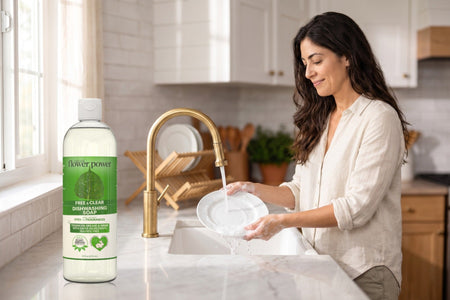
Natural Flower Power uses sodium chloride in its hand soaps and dish soaps as a viscosity modifier.
Getting the right thickness in a liquid soap matters more than most people realize. Too thin and it runs right through your fingers before you can lather. Too thick and it does not dispense properly from a pump bottle. Salt is the simplest, most predictable way to dial in viscosity once the surfactant blend is set. We adjust the salt concentration for each formula individually because every surfactant combination has its own salt curve peak. Our hand soap formulas and dish soap formulas use different surfactant ratios, so they each require a different amount of sodium chloride to hit the right consistency.
Related Ingredients
Cocamide DIPA is another viscosity-building ingredient in NFP's formulations, though it works through a different mechanism — it stabilizes foam and thickens through fatty acid chain interactions rather than electrolyte effects. Sodium gluconate is also a sodium salt used in cleaning products, but it functions as a chelating agent rather than a thickener. Decyl glucoside also contributes some viscosity in NFP formulas, though its primary role is as a surfactant.
Sources
- Cosmetic Ingredient Review (CIR). "Final Report on the Safety Assessment of Sodium Chloride." Journal of the American College of Toxicology, vol. 6, no. 4, 1987, pp. 441–467. Reaffirmed 2005.
- U.S. Food and Drug Administration. 21 CFR 182.1 — Substances Generally Recognized As Safe.
- Holmberg, K., et al. Surfactants and Polymers in Aqueous Solution. 2nd ed., John Wiley & Sons, 2003.
