

You're standing at the sink, looking at two bottles of dish soap. One says "plant-derived" on the label. The other is what you've been using for years. Both promise to clean effectively. Both say they're safe. So what's actually different? Is the plant-derived version actually better, or is it just marketing with a higher price tag?
The straightforward answer is that they do similar work in fundamentally different ways, and which one performs better—or matters more—depends on what you're cleaning, your household's specific needs, and what happens after the soap goes down the drain. Understanding those differences is more useful than assuming one category is automatically superior to the other.
How cleaning products actually work—the shared foundation
Before diving into differences, it helps to understand what both plant-derived and conventional cleaners have in common. Both are built on surfactants—the active ingredient that breaks the invisible bond between dirt and surfaces. A surfactant is a molecule with two distinct ends: one end loves water, the other loves oil. When you apply a cleaning product to a greasy plate, the surfactant molecules orient themselves at the boundary between oil and water, wedging between them and essentially breaking their grip. The dirt lifts away, stays suspended in the rinse water, and goes down the drain.
This mechanism is identical whether the surfactant came from a plant or was synthesized in a chemical facility. The molecular structure and behavior are what matter—not the origin.
Where plant-derived and conventional products diverge is in the selection of that surfactant, the supporting ingredients that are added to make the product stable and pleasant to use, and what happens to those ingredients after they enter the water system.
What we make for this



The core difference: where the surfactant comes from
A plant-derived surfactant typically starts with a natural oil or fat—coconut oil, palm oil, or other plant sources—and undergoes chemical processing to convert it into a surfactant. The most common plant-derived surfactants are sodium lauryl sulfate (SLS) and sodium laureth sulfate (SLES) derived from coconut oil, or decyl glucoside derived from corn glucose and coconut oil. These are not "natural" in the sense that you could extract them directly from the plant; they are synthesized through a controlled chemical process. But the starting material is plant-based, and the chemical transformation is relatively straightforward.
A conventional surfactant often begins with petroleum as its source material—crude oil derivatives like linear alkylbenzene sulfonate (LAS) or other synthetics. These are engineered molecules that don't exist in nature and require more extensive chemical synthesis to produce.
This distinction matters in two practical ways: how the surfactant performs in water, and how it behaves in the environment after use.
Performance differences in water
Plant-derived surfactants, particularly those derived from coconut oil, tend to have a narrower optimal working range. They perform best in specific water conditions—neutral to slightly acidic pH, moderate water hardness. Hard water (high in calcium and magnesium ions) can reduce their effectiveness because those minerals bind to the surfactant molecule and render it less active. Some plant-derived surfactants are also more sensitive to temperature; they work differently in cold water than in hot water.
Conventional petroleum-derived surfactants, by contrast, were often engineered specifically to tolerate a wider range of water conditions. They were designed to work reliably in the hard water and varied pH levels found in municipal water systems across different regions. In that sense, they are more universally functional.
This is why we specify cold-water performance on our all-purpose cleaners and include guidance on water hardness in our instructions. We chose plant-derived surfactants because of what they don't leave behind, not because they outperform conventional options across every scenario. In some cleaning tasks, in some water conditions, a conventional surfactant simply works better—and honesty about that matters more than pretending superiority.
What happens after the rinse
Once a cleaning product goes down the drain, it enters municipal water treatment systems. Plant-derived surfactants, particularly coconut-derived ones, are highly biodegradable—bacteria can break them down relatively quickly into harmless compounds. Most conventional surfactants are also biodegradable, but some were engineered to be persistently active in water, which means they take longer to break down in the environment and can accumulate in aquatic systems.
In wastewater treatment facilities, plant-derived surfactants are typically easier for the system to process and remove. This reduces the load on the treatment system and means fewer surfactants make it to receiving waters. Conventional surfactants require more advanced treatment stages to remove effectively, and in regions with less developed infrastructure, more of them can persist in waterways.
Supporting ingredients: where the real divergence gets complicated
The surfactant itself is only part of the formula. A complete cleaning product includes several supporting ingredients, and this is where plant-derived and conventional products look quite different in a bottle.
A conventional dish soap or all-purpose cleaner typically includes synthetic fragrances—complex blends of aroma compounds engineered to smell consistent and pleasant. It may include synthetic dyes to create an appealing color. It often includes conventional preservatives to prevent bacterial growth. It may include petroleum-derived emollients or conditioning agents. Conventional products also typically rely on synthetic chelating agents—compounds that bind to hard water minerals and prevent them from interfering with the surfactant's effectiveness.
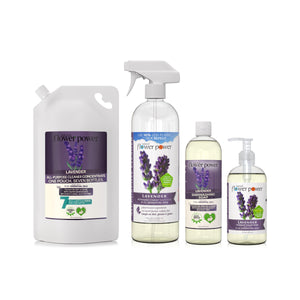
A plant-derived product (including ours) forgoes all of that. We use essential oils for scent—citrus oils, lavender, eucalyptus, whatever fits the product. We use no synthetic dyes; if the product has a color, it comes from the natural color of the plant-derived ingredients themselves. We use plant-derived preservatives and chelating agents. Some of our products, like our Free & Clear line, contain no added fragrance at all.
| Ingredient Category | Plant-Derived Products | Conventional Products |
|---|---|---|
| Primary Surfactant | Plant-derived (coconut, palm, corn-based) | Petroleum-derived or synthetic lab compounds |
| Fragrance | Essential oils or no fragrance | Synthetic fragrance compounds or natural-identical molecules |
| Color/Dyes | None, or from plant sources only | Synthetic dyes (FD&C-approved or otherwise) |
| Preservatives | Plant-derived (citric acid, sodium benzoate from plants) | Synthetic (parabens, phenoxyethanol, others) |
| Hard Water Treatment | Plant-derived chelators (citrates, etc.) or requires softer water | EDTA, DTPA, or other synthetic chelators; broader water-compatibility |
| Consistency/Texture | Plant-derived thickeners, guar gum, xanthan gum | Synthetic polymers or traditional thickeners |
| Sulfates | None (or plant-derived, depending on formulation choice) | Often present for cost and performance reasons |
The significance of these differences depends on the household. If you or someone in your home has sensitive skin, especially to fragrance or sulfates, a plant-derived product with no synthetic fragrances and no sulfates can be noticeably gentler. Many customers tell us they switched to Natural Flower Power after struggling to find products that cleaned effectively without causing irritation—typically itching, drying, or redness on their hands. Whether that's a direct reaction to specific ingredients or a cumulative sensitivity is hard to isolate, but switching to a plant-derived formula often resolves it.
If your household has no sensitivities and you're not concerned about what happens to surfactants in wastewater systems, a conventional product will work perfectly adequately and likely cost less. The argument for plant-derived products in that scenario is primarily environmental—which is valid, but it's not an argument based on superior cleaning performance in your home.
Real tradeoffs you should know about
Switching to plant-derived products involves some genuine compromises. We made them deliberately, and we think they're worth it, but pretending they don't exist would be misleading.
Plant-derived surfactants often require slightly more product to achieve the same result as some conventional surfactants, particularly in hard water or cold water. If you're used to conventional dish soap, you might need to use a bit more of ours per wash, especially if your water is hard. That's why we concentrate our all-purpose cleaners and dilute them with water—you get more cleaning power per bottle while reducing plastic and shipping waste.
Essential oils, while plant-derived, are potent and can trigger reactions in some people—especially those with fragrance sensitivities or asthma. The assumption that "plant-derived" means "hypoallergenic" or "universally safe" is wrong. Some people react to essential oils more easily than to synthetic fragrances. This is why we offer Free & Clear versions with zero added fragrance and zero essential oils.
Plant-derived surfactants can be harder to formulate into stable products with the texture and consistency people expect. We've spent years refining formulations to make our products pour smoothly, perform consistently, and remain stable on the shelf. A conventional formula with synthetic thickeners and stabilizers is sometimes easier to get right. Our formulations work, but they required more development time and precision to achieve that stability using plant-derived ingredients only.
Finally, plant-derived products generally cost more to produce. Plant-derived surfactants, essential oils, and plant-based preservatives have higher material costs than their synthetic counterparts. The labor and precision required to formulate with plant-derived ingredients also add to the final cost. A plant-derived cleaning product is rarely the cheapest option, and part of that price difference reflects genuine cost differences, not just marketing.
What "natural" claims actually mean (and don't)
Both plant-derived and conventional cleaning products are made of chemicals. Everything is chemistry. The word "natural" on a label is unregulated and essentially meaningless without specificity. Arsenic is natural. So is the plant-derived surfactant in our dish soap. Natural origin tells you something about sourcing, but it says nothing about safety, efficacy, or environmental impact on its own.
Plant-derived means the starting material came from a plant. It doesn't mean the final product was extracted directly from nature without processing. It doesn't mean it's inherently safer—though in some specific cases (like fragrance sensitivities), it may be safer for particular households. And it doesn't mean it's automatically better for the environment, though in many cases it performs better in wastewater systems and biodegrades more readily.
When evaluating any cleaning product—plant-derived or conventional—look for specific information: What is the actual surfactant? Are all ingredients disclosed? How does it perform in your specific water conditions? If you have sensitivities, which ingredients are present that might trigger them? Does the company manufacture their own product or private-label it? These specifics matter much more than whether the marketing uses the word "natural."
Choosing based on what actually matters to your home
There's no universally "better" category. The choice between plant-derived and conventional depends on what you're optimizing for.
Choose plant-derived if you or someone in your home has skin sensitivities to synthetic fragrances or sulfates, if you prefer to avoid synthetic dyes and complex preservatives, or if you care about reducing the burden on wastewater systems and environmental persistence of surfactants. Plant-derived products align with those specific priorities.
Choose conventional if you live in very hard water and want maximum compatibility without performance loss, if cost is the primary factor and performance is secondary, or if you've never experienced sensitivity issues and have no concerns about wastewater impacts. There's nothing wrong with that calculus—it's rational and honest.
If you're making the switch, replace one product at a time. Don't overhaul your entire cleaning cabinet at once. Use up what you have, and when a product runs out, try a plant-derived version instead. That way you're not wasting what you already bought, you're not overwhelmed evaluating everything simultaneously, and you can actually observe whether the new product works for your specific situation before committing to the rest of the switch.
The households that tend to stick with the switch are the ones that had a specific reason to switch—usually a sensitivity or concern that plant-derived formulations address. If you're switching purely because it seems like you should, you might find yourself disappointed by a higher price tag and slightly different performance characteristics, and you'll go back to what you knew. That's not a failure. It just means conventional products are still the right choice for your home.
We created our product line for the households where plant-derived formulations solve a real problem. We make them in-house because that's how we maintain control over formulation and sourcing. We disclose everything because specificity builds trust more than marketing claims ever could. And we acknowledge tradeoffs honestly because doing so is the only way a reader can actually decide whether our products are right for their situation. If that description matches what you're looking for, you'll know. If it doesn't, there's no shame in choosing a different path.
To learn more about our formulation standards and ingredient choices, visit our story and standards page. If you have specific questions about ingredients or how our products perform in your water conditions, our FAQ covers many common concerns. And if you want to see our product line and browse options, our all-purpose cleaners and dish soaps are good starting points for understanding how plant-derived formulations work in practice.
