

Most advice about switching to safer cleaning products starts with "throw everything out." In practice, that leads to wasted money, five new products you haven't tested, and a quiet retreat back to what you had before. A smarter approach: replace products one at a time as they run out, starting with whatever touches your skin and food the most. This guide walks through how to do that without lowering your standards for what "clean" actually means.
What "Safer" Actually Means (and Why Labels Won't Tell You)
Every cleaning product is made of chemicals. Water is a chemical. Vinegar is a chemical. So the question was never "chemicals or no chemicals." The real question is which ones, at what concentration, and whether they're actually doing something useful in the formula.
In practical terms, safer cleaning products tend to use plant-derived or bio-based cleaning agents instead of petroleum-based ones. They skip ingredients that exist for shelf appeal rather than cleaning performance — synthetic fragrances, dyes, and fillers that don't improve how well the product works.
Here's the problem: terms like "natural" and "green" aren't meaningfully regulated. A product can slap "natural" on the label and still contain ingredients you'd rather not spray where your kids eat breakfast. We learned this early on. Before we launched Natural Flower Power in 2012, we spent years in commercial cleaning, where products were expected to perform but rarely questioned for what was actually in them. Some of the products marketed as "safer" alternatives weren't any better once you looked past the label.
The most reliable signal is transparency. Can the company tell you exactly what's in the bottle and explain why each ingredient is there? If they won't, the label doesn't mean much. If you want to see how we approach that, our Our Story & Standards page lays out the decision-making behind what goes in and what stays out.
What we make for this
The Cabinet Purge Everyone Recommends (and Almost Nobody Sticks With)
You've probably seen the advice: open every cabinet, toss everything with ingredients you can't pronounce, and replace it all in one shopping trip. It sounds decisive. It feels like progress.
In reality, here's what usually happens. You spend $70–100 replacing everything at once. You try five new products in the same week with no baseline for comparison. At least two of them don't perform the way you expected — maybe the dish soap doesn't suds the way you're used to, or the surface cleaner smells different than what your household associates with "clean." Within a month, you've quietly gone back to at least one of the old products, and the whole effort feels like it failed.
We hear some version of this story from customers regularly — they tried to switch everything, got frustrated with at least one product, and ended up back where they started. It's a pattern, not an exception.
The people who actually make the switch stick tend to do it gradually. One product at a time, usually when the old one runs out. That way you're not wasting what you already have, you can actually tell whether the new product works before you move on, and you're not asking your entire household to adjust to five unfamiliar products in the same week.
Start With What Touches Your Hands and Your Food
If you're going to switch one product first, pick something you use every day in close contact with your skin or your food. That's where the ingredient quality matters most in your daily routine.
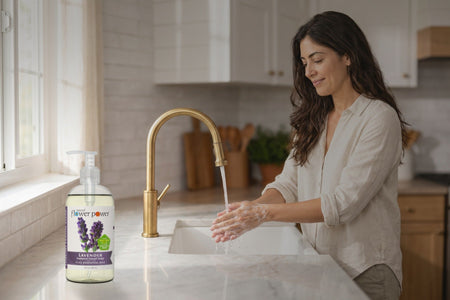
Hand soap is the obvious starting point. You use it ten or fifteen times a day. It sits on your skin more than any other cleaning product in your house. If there's one product where you want plant-derived surfactants instead of petroleum-based ones, this is it. One thing we hear from customers who switch to our hand soaps is that their hands stop drying out and cracking — which is often the old surfactant system doing damage, not just the water temperature.
Dish soap is next. It touches your plates, your cups, your cutting boards — everything your family eats from. And because you're usually standing at the sink with your hands in it, the formula matters for your skin too. Our dish soaps use a concentrated, plant-derived surfactant blend that cuts grease without stripping your hands in the process.
Kitchen surface cleaner rounds out the top three. You're spraying it directly where you prep food, so what's in it matters more than what's in your bathroom glass cleaner.
Floor cleaners, glass cleaners, bathroom scrubs — those can all wait. They're used less often, they have less direct contact with skin and food, and swapping them later keeps the whole thing manageable.
How to Read a Label Without a Chemistry Degree
You don't need to understand every ingredient on the label. You just need to ask a few practical questions.
Are the ingredients actually listed? It's 2026, and some brands still don't disclose full ingredient lists. That alone tells you something about how they think about transparency.
Does every ingredient have a job? In a well-formulated product, each ingredient earns its place — cleaning, preserving stability, or carrying fragrance from essential oils. If you see a long list and can't tell why half of it exists, that's worth questioning. We think about this constantly in our own formulations. Every component has to have a functional reason to be there, or it doesn't make the cut.
Is the fragrance doing anything, or just covering something up? Synthetic fragrances can make a product smell "clean" without actually improving its performance. Products scented with essential oils tend to rely on the formula itself to do the work. And if fragrance sensitivity is a concern, look for genuinely unscented formulations — not "fragrance-free" products that still contain masking agents.
Where DIY Cleaning Actually Works (and Where It Honestly Doesn't)
We're not going to pretend DIY cleaning has no place, because it does. Baking soda and vinegar handle light jobs fine — freshening a drain, wiping down a cutting board after lunch, deodorizing a garbage disposal. For simple daily maintenance, pantry staples are perfectly reasonable.
But when grease has been building on a stovetop after a week of real dinners? When soap scum has been layering onto a glass shower door for months? Baking soda and a spray bottle are not going to cut it.
This isn't a guess. Plant-derived surfactants exist specifically because some messes need real mechanical cleaning power — molecules that grab onto grease and oil, break the bond with the surface, and let water carry it away. That's what surfactants do. Vinegar doesn't do that. Baking soda doesn't do that. They're fine for light-duty work, but they're not formulated cleaning products, and expecting them to perform like one leads to frustration.
The realistic approach for most households is somewhere in the middle: simple DIY solutions for light daily stuff, and a properly formulated plant-derived cleaner for the jobs that actually need one. There's nothing wrong with that middle ground. Most of the homes we hear from end up there, and it works.
Making the Change Actually Stick
The biggest reason people go back to conventional products isn't performance. It's overwhelm. They tried to change everything at once, didn't give any single product a fair shot, or expected a plant-derived cleaner to smell and feel exactly like the petroleum-based one they'd been using for years.
A few things that help. Switch one product at a time and live with it for at least two or three weeks before deciding whether it works for your household. Tell the rest of your household what changed and why — because if someone doesn't know the dish soap is different, they'll pump out three times as much and blame the product.
And accept that this takes months, not a weekend. The households that actually stick with the switch are almost always the ones that gave themselves room to adjust instead of treating it like a one-day project.
The Goal Here
You don't need a perfectly "clean" home by some influencer's definition. You need products that work, that you're comfortable using around your family, and that come from companies willing to explain what's actually in the bottle.
Start with hand soap. Replace things as they run out. Read the label. Ask questions. That's more than most people do, and it's a solid place to begin.
